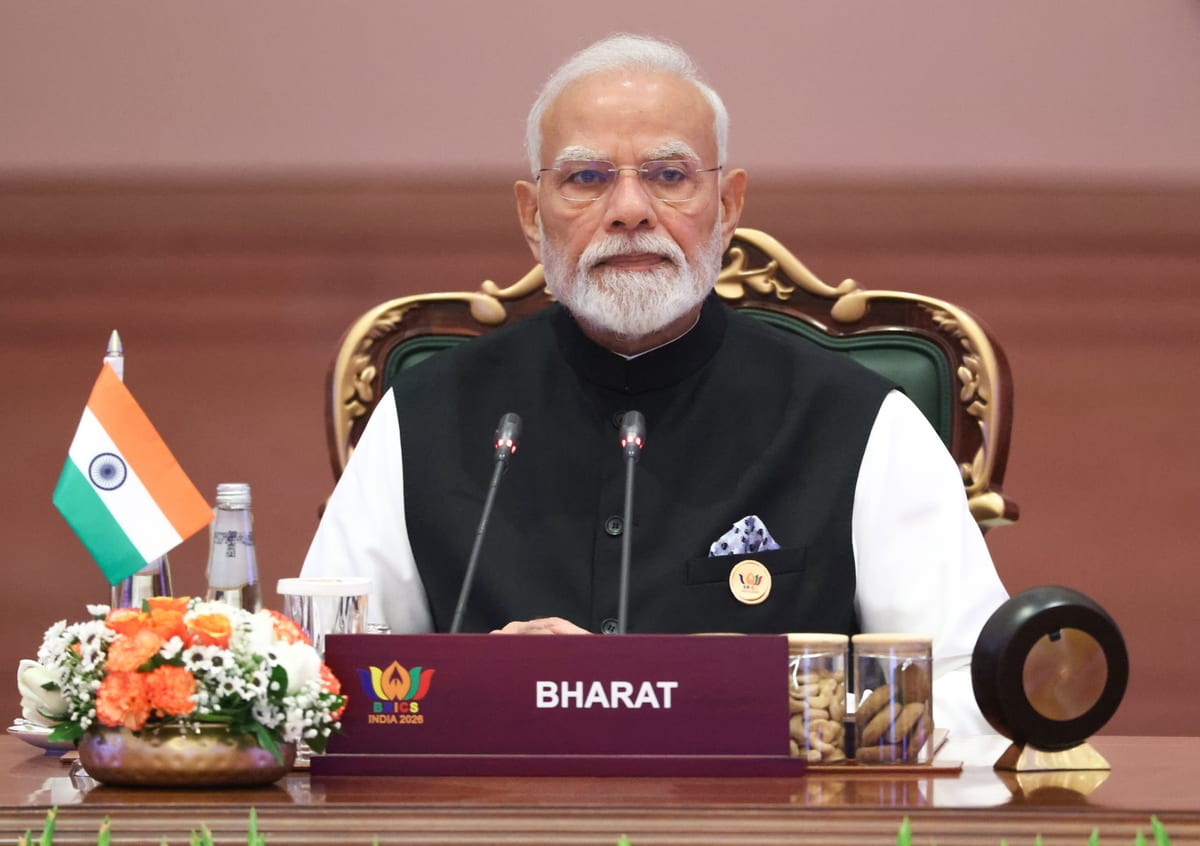
Prime Minister Narendra Modi opened the 18th BRICS Summit at the Bharat Mandapam in New Delhi on Saturday with a proposition that has been framing New Delhi's diplomatic posture for three years: the Global South must stop accepting rules written elsewhere and start shaping them itself. "Global South needs to be rule-shaper, India ready to take lead," Modi said in his opening statement, a phrase NDTV used to headline its coverage of the summit.
The prime minister went further than rhetoric. He proposed that BRICS formulate a reform roadmap before its next summit, converting the bloc's perennial talk of institutional change into a timetable with accountable milestones. That roadmap is the summit's most consequential deliverable in the making: a document that would test whether a grouping spanning a dominant share of the world's population and output can convert demographic weight into actual leverage over the institutions that govern trade, finance, and security.
Rule-shaper, not rule-taker
The phrase "rule-shaper" does not emerge from a vacuum. It is the natural outgrowth of India's three Voice of Global South Summits, the most recent held virtually in August 2024, which drew 173 dignitaries from 123 countries. Those summits, organised around themes of development finance and sustainability, established a rhetorical foundation. New Delhi uses the convening power of those gatherings to demonstrate that it speaks not for itself alone but for a constituency.
What BRICS adds to that foundation is institutional heft. Since the Fortaleza Summit in 2014, the grouping has operated its own financial architecture through the New Development Bank and the Contingent Reserve Arrangement, both of which became operational in 2015. These are functioning institutions, not communiqués. They lend credibility to the argument that the Global South can administer its own development finance rather than wait indefinitely for quota reform at the IMF or voting reform at the World Bank.
The consensus formulation
The most striking element of Modi's opening statement is not the ambition but the qualifier. The prime minister did not frame BRICS as a counterweight to the G7 or as a challenger to the Western alliance. He framed it as a consensus project. "We move ahead with consensus, not against anyone," he said, a line the government has been careful to repeat whenever BRICS expansion raises questions in Western capitals.
This is a deliberate choice with a precise strategic function. It allows New Delhi to pursue structural reform of the international system while preserving its defence ties with the United States, its technology partnerships with Europe, and its economic corridor ambitions with Japan and the Gulf states. India does not need to choose, and the consensus language ensures it does not have to. The framing neutralises the most persistent criticism of BRICS: that it exists to assemble an anti-Western bloc rather than to repair the scaffolding of multilateralism.
The reform roadmap as a diplomatic deliverable
The proposed roadmap is what transforms Modi's speech from aspiration into agenda. LiveMint reported that the prime minister laid out a ten-point reform roadmap and told fellow leaders that BRICS "must now translate its internal unity and consensus into tangible results internationally." The verb is telling: translate. Unity that stays inside the meeting room is not unity at all.
What might such a roadmap contain? Indian strategic commentators, including scholars at the Observer Research Foundation and the Manohar Parrikar Institute for Defence Studies and Analyses, have argued that the agenda must cover UN Security Council expansion, IMF quota reallocation, and local-currency trade finance. None of these are new demands. India has been pressing for permanent Security Council membership for decades, and the IMF's quota structure, which leaves India's voting share below its economic weight, has been a grievance of long standing. What changes with a formal roadmap is the mechanism of accountability: a deadline, a set of milestones, and a follow-up summit at which progress is measured.
The roadmap also gives New Delhi a standard against which to judge its own leadership. India chairs BRICS this year, and the next summit will be chaired by another member. If the roadmap is tabled as a text rather than a concept, the chair's influence extends beyond the closing press conference. The irony is subtle: a grouping often dismissed as a talking shop would be institutionalised precisely through a document that demands institutional reform elsewhere.
The strategic space argument
There is a second irony, and it cuts the other way. The more successful India's Global South leadership becomes, the more it must reassure its Western partners that BRICS is not what some of them fear. Al Jazeera's framing of the summit as an "empowerment of Global South" moment captures the appeal but not the nuance. Empowerment, in India's telling, is not about reducing Western influence. It is about expanding the number of actors who get to write the rules.
This is why the "not against anyone" clause matters, and why it sits in the same sentence as the rule-shaper demand. The two ideas are not in tension; they are the same idea addressed to different audiences. For a BRICS partner in Africa or Latin America, the promise is inclusion. For a Quad partner in Washington or Tokyo, the promise is non-revisionism. India's diplomatic tradition has always treated these as compatible, and the consensus formula is that tradition applied to a twenty-first-century institution.
What the summit in New Delhi signals
The summit itself is performing quiet work for the argument. India is hosting leaders whose countries disagree on a great deal (China and Iran among them, alongside Russia), and the fact that the meeting is happening in New Delhi, with Indian security managing the logistics and Indian diplomacy managing the agenda, is itself a statement. The chair's role is not to referee arguments but to keep the group focused on what it can collectively demand of the world's rule-making bodies.
That is the measure of the next twelve months. Will the reform roadmap have quantifiable targets? Will the New Development Bank expand lending for infrastructure projects that benefit Indian engineering firms and Global South borrowers alike? Will the consensus framing hold when the conversation turns to Security Council expansion, the topic on which several permanent members have been most stone-faced? The answers will determine whether "rule-shaper" becomes a descriptive title or another line in a summit communiqué.
For Indian readers, the question is not whether BRICS matters; it does, and it will matter more as long as the institutions it targets remain unreformed. The question is whether India's chairmanship converts the bloc's demographic and economic weight into something measurable: a quota formula changed, a Security Council seat won, a trade settlement cleared without a Western intermediary. That is what leading looks like when you are not against anyone. You simply stop waiting for permission.