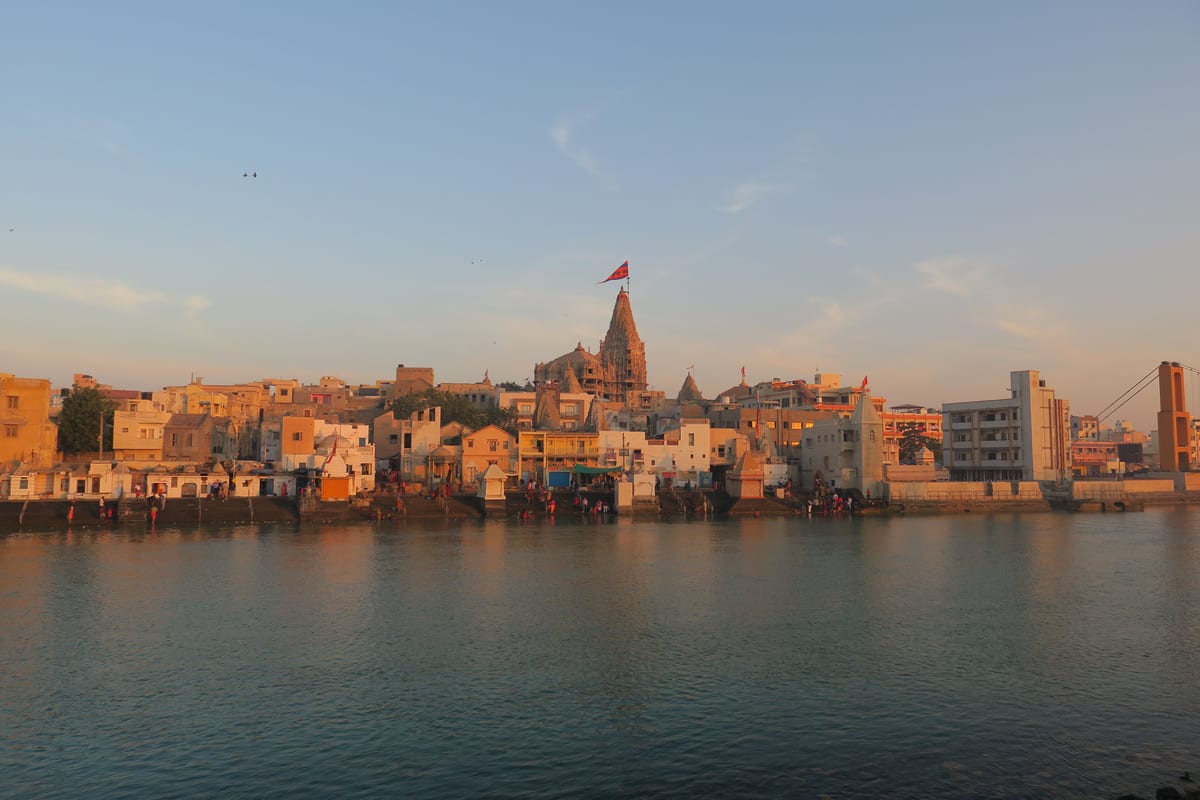
There are destinations that you visit, and there are destinations that visit you long after you have left. Somnath Temple, rising in pale limestone at the edge of the Arabian Sea in Saurashtra, Gujarat, belongs firmly to the second category. I have stood on the Prabhás Patan shoreline at dusk, the salt wind pressing against my face, watching the last embers of sunlight dissolve into the water below the temple's spire, and felt something that no travel writer should admit too readily: the specific vertigo of encountering a place that is simply older than your capacity to comprehend it.
A Shrine Born Before History Was Written Down
Somnath is one of the twelve Jyotirlingas, the supreme manifestations of Lord Shiva, and tradition holds that the original shrine here was constructed in gold by Soma, the Moon God himself, in an age before recorded time. Successive temples were built in silver, sandalwood, and stone, each drawing pilgrims from across the subcontinent. The site sits at the sacred Triveni Sangam, where the Hiran, Kapila, and Saraswati rivers meet the sea, a confluence that imbues the ground with spiritual significance across multiple Hindu traditions.
What distinguishes Somnath from India's many ancient temples is its history of destruction and rebirth. The temple was sacked and pillaged multiple times over centuries, most famously by Mahmud of Ghazni in 1025 CE, who reportedly carried away unimaginable wealth and desecrated the sanctum. Yet the shrine was rebuilt. And rebuilt again. And again. The reconstructions reach into double figures depending on the historical account. This is a civilisational argument made in stone and prayer: that certain truths cannot be permanently silenced.
The 1951 Consecration: A Nation Reclaims Its Soul
The temple that stands today was consecrated on the 11th of May, 1951, barely four years after Indian Independence, and the politics of that moment matter. Sardar Vallabhbhai Patel championed the reconstruction as an act of national reintegration as much as religious renewal. When President Rajendra Prasad performed the installation ceremony, it carried meaning that extended far beyond ritual: a newly sovereign India was deliberately reconnecting with its pre-colonial sacred geography. The Somnath Trust, established to manage and maintain the temple, continues to oversee the site. You can read more about the temple's significance and facilities on the official Incredible India page for Somnath Temple.
What the Visitor Experiences
Arriving at Somnath, the first thing that strikes you is the deliberate simplicity of the approach. The surrounding town of Veraval is a working fishing port, unglamorous, salt-stained, functional, which makes the sudden appearance of the temple's Chalukya-style tower all the more arresting. The shikhara soars skyward in a grammar of carved stone that speaks directly to the eye.
Inside the sanctum, the atmosphere is one of concentrated devotion. The Jyotirlinga itself is housed in the inner shrine, and during the principal aarti ceremonies, conducted morning, noon, and evening, the air fills with the percussion of bells, the fragrance of incense, and the collective vibration of hundreds of voices in prayer. These are people who have come a very long way, in some cases across multiple generations of the same family, to stand in exactly this spot.
The shoreline immediately south of the temple complex is marked by the Baan Stambha, an ancient column inscription that states there is nothing between this point and the South Pole but open ocean. Standing beside it at dawn, with the sea spreading away to the horizon and the temple rising at your back, you feel caught between two kinds of infinity.
The Sound and Light show held at the temple grounds each evening narrates Somnath's history with atmospheric clarity and provides historical context worth absorbing.
Nearby Attractions
Somnath sits within a region dense with heritage. The town of Veraval itself has a functioning dhow-building tradition that is centuries old. Gir National Park, home to the last wild population of Asiatic lions, is approximately 45 kilometres away and can be combined with a Somnath visit for a longer Gujarat itinerary. The ancient city of Junagadh, with its Uparkot Fort and the remarkable Ashoka rock edicts, lies roughly 85 kilometres to the north. The coastal town of Diu, with its Portuguese colonial architecture and tranquil beaches, is also within reach.
Best Time to Visit and How to Reach
The ideal window for visiting Somnath is between October and March, when Gujarat's coastal climate is temperate and the Arabian Sea is calm. The festival of Maha Shivaratri draws enormous gatherings of pilgrims and is a remarkable cultural experience, though accommodation needs to be secured well in advance during this period.
The nearest major airport is at Diu, approximately 90 kilometres away, with connections from Mumbai and Ahmedabad. Veraval railway station is the closest railhead, served by trains from major Gujarat cities including Ahmedabad and Surat. Road connectivity is excellent; private taxis and state transport buses operate regularly from Junagadh, Rajkot, and other regional centres.
Why Somnath Matters
India has thousands of ancient temples. Only a handful carry the weight that Somnath carries. It matters because it refused to disappear. It matters because ordinary people, not emperors or states or institutions alone, but ordinary devotees across ordinary centuries, kept returning to rebuild it with their own hands and their own resources. It matters because in 1951, a newly free nation chose to make this temple's reconstruction one of its earliest symbolic acts, understanding that a civilisation's health can be measured by its relationship with its own sacred memory.
To visit Somnath is to visit a place that has been tested by history and endured. That is rarer than it sounds, and it makes the journey, however long, however inconvenient, more than worth making.