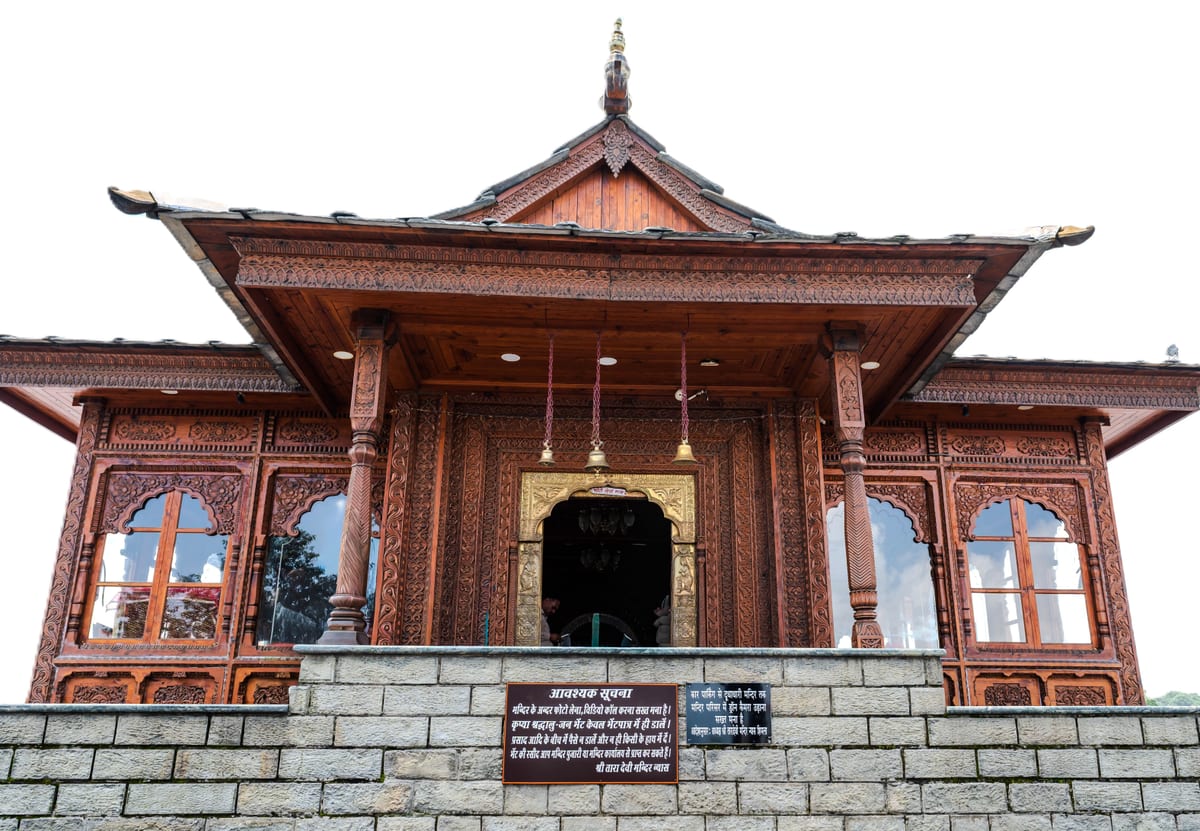
There is a moment, as you step off the main road in Manali and enter the deodar cedar forest that cradles the Hidimba Devi Temple, when the noise of the tourist town simply falls away. The air changes. It smells of resin and cold mountain earth. And rising through the trees, you see it, a dark, tiered pagoda crowned with a cone of wood and thatch, its doorway etched with mythological carvings so intricate they seem to have grown from the timber itself. This is not a heritage site frozen in glass. This is a place where India's civilisational story is still being told, in real time, by real people.
A Goddess From the Epic Age
The story of Hidimba Devi begins in the Mahabharata, one of the foundational texts of Indian civilisation. Hidimba was a rakshasi, a forest-dwelling being, who fell in love with the Pandava hero Bhima during the brothers' years of exile. Their union produced a son, Ghatotkacha, who played a significant role in the Kurukshetra war. What might elsewhere be a footnote in mythology is, in the Kullu valley, the beginning of a living religious tradition. Hidimba is worshipped here not as a character from a story, but as a goddess, a protector of the land and its people. She is one of the principal devis of the region, and her blessings are sought at marriages, festivals, and moments of community importance.
This is distinctive to India: a woman from a poem composed two millennia ago is a living deity today, with priests who attend her, devotees who offer prayers at her feet, and a temple that has stood in her name for nearly five centuries. Few cultures sustain this kind of unbroken mythological memory with such warmth and immediacy.
The Temple Itself, Architecture as Devotion
The Hidimba Devi Temple was constructed in 1553 CE by Raja Bahadur Singh, the ruler of Kullu. It is built in the traditional pagoda style of Himalayan temple architecture, four storeys of timber and stone rising to a peak, each tier slightly narrower than the one below, the whole structure crowned with a distinctive conical shikhara made of wood. The exterior walls are adorned with carvings of animals, deities, and scenes from Hindu mythology, each panel a devotional act in itself.
The sanctum sanctorum is small and cave-like, as is characteristic of many ancient Himalayan shrines, suggesting that worship here predates the structure itself, that people may have venerated this forest site long before a formal temple was ever built. Inside, a large rock is the focus of worship, believed to bear the footprints of the goddess. The atmosphere is intimate and profound, far removed from the grandeur of temple complexes in the plains.
Adjacent to the main shrine stands a newer temple dedicated to Ghatotkacha, Hidimba's son, a touching detail that speaks to the familial warmth at the heart of this tradition. The forest setting, with its towering deodars and occasional glimpses of snow-capped peaks beyond, completes a picture of rare spiritual beauty.
What Visitors Experience
Coming to Hidimba Temple is not simply a sightseeing exercise. Even for visitors who do not share the faith, the experience carries weight. The forest itself feels ancient and intentional, as if the trees were planted as guardians. Local women often sell flowers and offerings near the entrance, and the sound of temple bells drifts through the cedar canopy. During festivals, particularly the Dussehra celebrations of the Kullu valley, which are among the most spectacular in India, Hidimba Devi plays a central role, her idol carried in procession as communities reaffirm their bond with their goddess.
The temple draws visitors from across India and around the world, and yet it retains a quality of genuine, unhurried devotion that many more famous sites have lost. You are welcome here as a witness, and perhaps as a participant. That openness is itself a civilisational statement.
Best Time to Visit
Manali and the Hidimba Temple are accessible year-round, but each season offers a different quality of experience. May to June brings pleasant temperatures and clear skies, ideal for those who also want to explore the surrounding mountains and valleys. October is particularly special, coinciding with the Kullu Dussehra festival, when the goddess is celebrated with extraordinary fervour across the valley. Winter months, from December to February, drape the forest and temple in snow, creating an atmosphere of austere, crystalline beauty, though road access can be challenging at times. Monsoon, from July to September, brings lush greenery but also the possibility of landslides on mountain roads.
Getting There and Getting Around
Manali is well connected to the rest of Himachal Pradesh and northern India. The nearest airport is Kullu-Manali Airport (Bhuntar), approximately 50 kilometres from the town, with flights from Delhi and Chandigarh. By road, Manali is roughly 570 kilometres from Delhi, accessible via NH3, a scenic but long drive, or an overnight bus journey that many travellers find part of the adventure. From Shimla, the drive is approximately 270 kilometres.
Once in Manali, the Hidimba Temple is located in the Dhungri area, within easy walking distance or a short auto-rickshaw ride from the main market. The forest path to the temple is part of the experience, resist the urge to rush it.
Nearby Attractions
Manali and its surroundings offer a richness that rewards several days of exploration. The Manu Temple, dedicated to the sage Manu, regarded in Hindu tradition as the progenitor of humanity, sits further into the old village. The Vashisht hot springs and temple complex are a short drive away, combining natural thermal baths with ancient shrines. For those drawn to the high mountains, Rohtang Pass offers breathtaking views of the Himalayan range, while the Solang Valley is beloved for adventure activities in both summer and winter. The old Manali village itself, with its traditional Himachali architecture and apple orchards, is worth an afternoon of unhurried wandering.
Why This Temple Matters
India's heritage is sometimes presented as a collection of monuments, things to be photographed, catalogued, and preserved behind barriers. Hidimba Temple refuses that framing. It is a place where civilisation is not curated but lived. A goddess from a 2,000-year-old epic is loved, dressed, celebrated, and consulted here. The forest that surrounds her is not a backdrop but a participant. The people who tend her shrine carry forward a tradition that has never, not once, been interrupted.
In a world increasingly anxious about the loss of continuity, cultural, spiritual, environmental, Hidimba Devi Temple in Manali stands as quiet, confident evidence that some roots go too deep to be pulled. Come here not just to see a temple, but to understand what it means for a civilisation to remember itself.