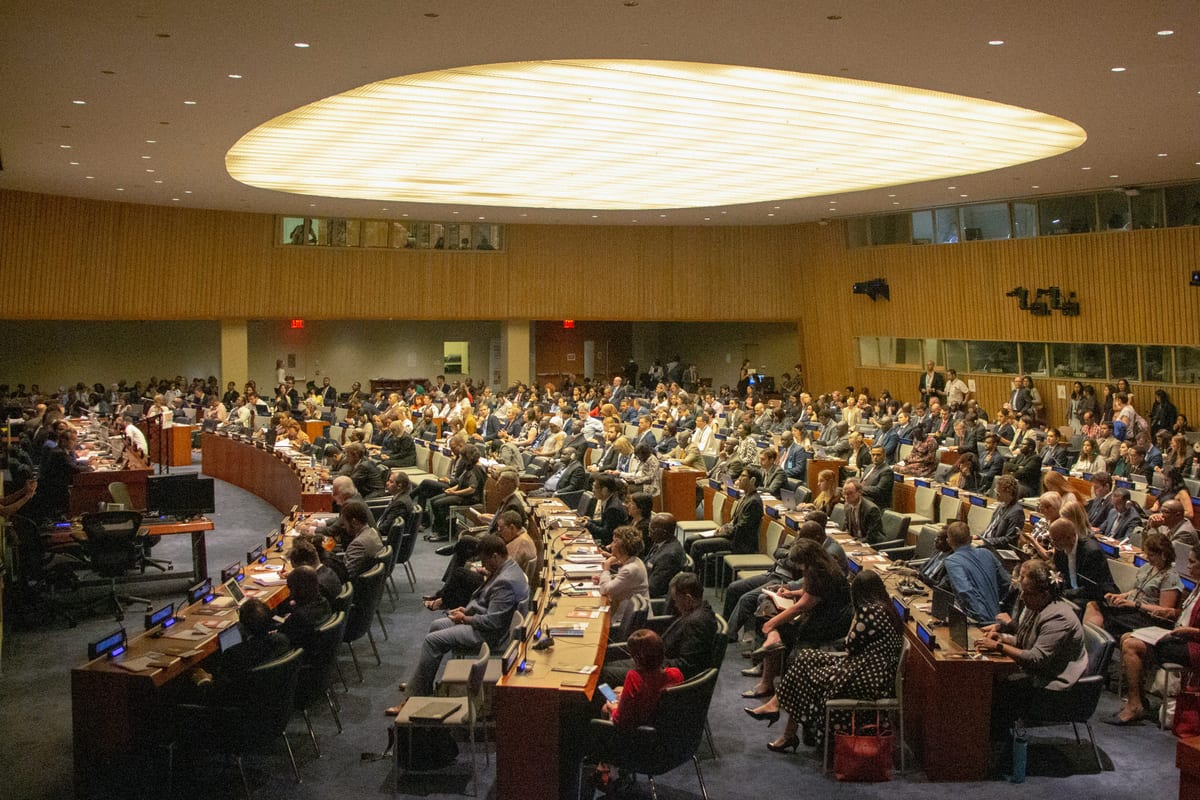
There is a particular quality to UN Security Council debates about process — a kind of aspirational fluency that fills the chamber and then dissipates into the air above Turtle Bay. Thursday's open session on preventive diplomacy carried that quality in abundance. Ambassadors spoke of early warning systems, good offices, and the underused Chapter VI powers of the UN Charter. They invoked successes. They catalogued obstacles. And underneath the careful language ran the question that nobody posed directly: if the Council has always had these tools, why does it keep reaching for the hammer?
Chapter VI of the UN Charter gives the Security Council a range of instruments for the peaceful settlement of disputes — investigation, mediation, conciliation, arbitration — that sit well short of the coercive Chapter VII measures that authorize sanctions and force. The gap between the two chapters is not merely legal. It represents a political choice made, crisis by crisis, about whether a conflict is worth managing early or only worth addressing once it has matured into something that demands a response the P5 can agree to authorize. That choice, consistently, has favored the latter.
Rhetoric Has Its Own Architecture
What Thursday's debate clarified, beneath the diplomatic courtesy, is that the problem is structural rather than attitudinal. Member states do not disagree in principle about the value of preventive diplomacy. They disagree about who controls its activation, whose disputes qualify for the Council's attention, and whether early engagement serves the interests of the permanent members or threatens them. The veto hangs over every procedural question like an unacknowledged fact.
The Council's Chapter VI powers are not triggered automatically by early warning. They require political consensus. And political consensus, among five states with competing alliance systems and economic interests, is precisely what tends to be absent when prevention would actually matter. By the time consensus forms, the window for prevention has typically closed. The Council then reaches for Chapter VII not because it is better suited to the problem but because the problem has grown large enough to force agreement on something.
Ambassadors at Thursday's session acknowledged the gap between the UN's analytical capacity to identify escalating disputes and the Council's political willingness to act on that analysis. This is a real gap, but it follows from the deeper one: the absence of any mechanism that compels the P5 to engage preventively when doing so is inconvenient.
India's Calculated Interest
New Delhi's engagement with this debate is neither sentimental nor coincidental. India served as a non-permanent Council member in 2021-22, and its UN Mission has spent years articulating a position that links the effectiveness of peaceful settlement instruments to the composition of the body wielding them. The argument, stated plainly by former Permanent Representative Ruchira Kamboj, is that a body excluding the voice of two-thirds of humanity cannot credibly prevent conflict. It is a structural claim, not merely a rhetorical one.
India's strategic interest in Chapter VI is layered. At the normative level, New Delhi prefers dialogue-first frameworks — a preference rooted in Panchsheel principles and a foreign policy tradition that has consistently resisted legitimizing unilateral military escalation by major powers. Stronger Chapter VI instruments, institutionalized and consistently deployed, would constrain the kind of muscular unilateralism that creates facts on the ground before diplomatic processes can operate.
But the interest cuts the other way too. An activist Security Council, newly empowered under Chapter VI and eager to demonstrate preventive credentials, could be invoked by adversarial states to raise disputes that India regards as bilateral or already settled. The same instruments that might usefully contain conflict in the Sahel or the South China Sea could, in different hands, be pointed at questions India has no desire to see internationalized. India's neighborhood carries enough live wires that this concern is not abstract.
This is why New Delhi's position is calibrated rather than unconditional. India supports stronger Chapter VI mechanisms, but it wants those mechanisms housed in a reformed Council, one where equitable representation creates the political accountability that would deter abuse. Reform is not an afterthought to the preventive diplomacy agenda; it is, from India's vantage, a precondition for that agenda's legitimacy.
The G4 Lever and the Global South Platform
The question is whether India can convert this analytical position into diplomatic traction. The Intergovernmental Negotiations framework on Council reform has ground along for years, producing papers and procedural deadlock in roughly equal measure. The P5's rhetorical endorsement of preventive diplomacy sits uneasily beside their structural interest in preserving veto-based Chapter VII dominance. India's opportunity is to widen that contradiction in public.
The Voice of Global South Summit, which India hosted in its third iteration in August 2024 with participation from 123 countries, offers one lever. The Summit's architecture — ministerial sessions across foreign affairs, finance, energy, and more — provides the kind of normative amplification that can shift the terms of a UN debate without requiring P5 agreement. If the Global South speaks with collective weight about the gap between Chapter VI promise and Chapter VII practice, the pressure on major powers to demonstrate consistency between their stated commitments and their procedural choices increases.
India's G4 coalition with Brazil, Germany, and Japan offers a second lever, one more directly connected to Council reform timelines. The argument worth pressing is that the credibility of any enhanced preventive diplomacy architecture depends on the representativeness of the Council deploying it. Separating Chapter VI reform from expansion negotiations is a convenience for those who benefit from delay; linking them is analytically honest and strategically sound.
The Early Warning That Nobody Acts On
There is a deeper irony embedded in Thursday's proceedings. The UN system already produces early warning analysis of considerable quality. Political affairs officers, regional desks, and the Secretary-General's own reporting mechanisms generate detailed assessments of escalating disputes. The problem is not information. It is the political decision, taken implicitly every time the Council defers, that acting on the information is too costly. Better paperwork without addressing that political economy does not produce fewer conflicts.
This is the situation that India — and every serious reformer at the UN — actually confronts. The tools exist. The analytical capacity exists. What does not exist is an enforcement mechanism for the P5's own stated preferences. Thursday's debate will produce a summary, perhaps a presidential statement, possibly a proposal for a follow-on process. What it will not produce, absent structural change, is a Council that uses its Chapter VI powers before the cameras arrive.
For New Delhi, the takeaway is not pessimism but precision. The Chapter VI debate is real terrain, not theater, and the states that shape its outcomes will influence how international dispute management evolves through the rest of the decade. India's most productive move is to treat this session not as a procedural ritual but as an opportunity to place its reform argument on the record: that preventive diplomacy's credibility is inseparable from the composition of the body claiming to practice it. A Council that remains structured for 1945 cannot convincingly claim to be preventing the conflicts of 2026.