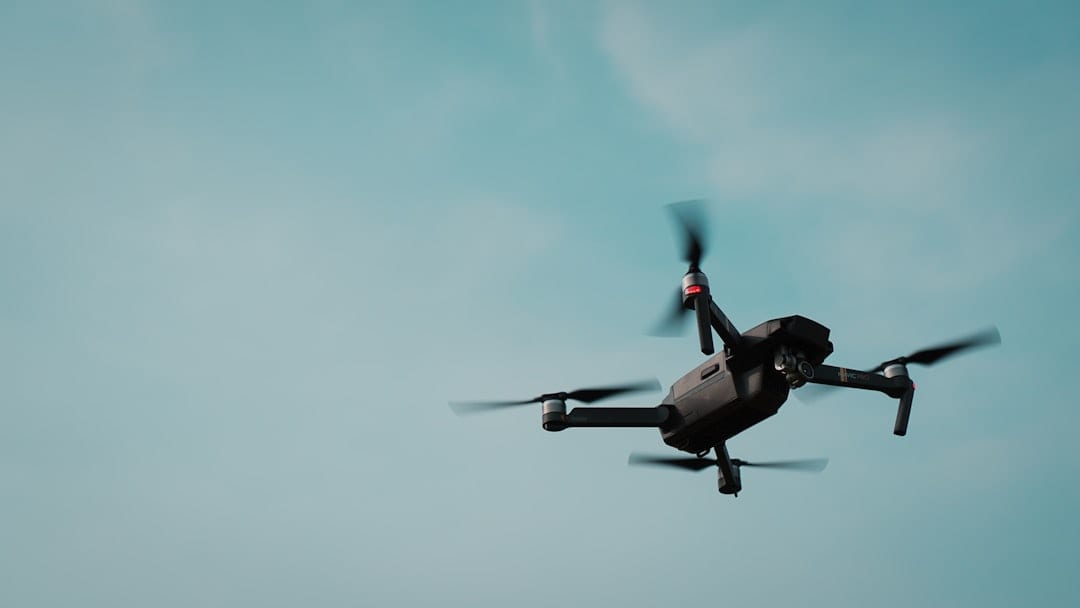
Taiwan is designing its own funeral for any Chinese amphibious force that attempts a landing. The plan, which Taipei's defence establishment has been refining for several years, relies on massed drone swarms to spot PLA naval and ground forces, track their movements across the Taiwan Strait, and strike before they can establish a beachhead. The phrase circulating among analysts, "drone hellscape", describes a doctrine of layered, distributed, low-cost aerial attrition designed to exhaust a much larger invading force before it reaches the shore.
Taiwan cannot match the PLA in raw tonnage, manpower, or missile arsenals. Its strategy is to raise the cost of invasion to a level that breaks the political will behind one. Drones, particularly commercial off-the-shelf swarm systems integrated with military command-and-control networks, and purpose-built loitering munitions, are the instrument of that cost. They are cheap enough to mass-produce, lethal enough to threaten armoured vehicles and landing craft, and numerous enough to overwhelm point-defence systems through sheer volume.
The Doctrine in Outline
Taipei is building a layered kill-chain, not a single weapons programme. According to NDTV's reporting on Taiwan's defence posture, the Taiwanese approach uses drones at each stage of a potential invasion: reconnaissance drones to detect PLA fleet movements, surveillance systems to cue ground-based anti-ship missiles, and attack drones to strike landing craft, armoured vehicles, and supply lines once forces hit the beaches. The logic echoes what Ukraine demonstrated against Russian armour in 2022 and after, a technologically agile defender with distributed drone assets can impose disproportionate casualties on a conventionally superior attacker.
Taiwan's geography amplifies the doctrine's potential. The strait is roughly 180 kilometres wide at its narrowest. Any amphibious crossing requires hours of exposure across open water, during which drone-cued precision fires can attrite the assault force before it reaches the surf. The island's mountainous interior further compresses any force that does land. Taiwan is militarising these natural chokepoints through autonomous systems, converting geography into a kill zone.
The PLA's Calculus and India's Northern Interest
The military dimension of the Taiwan question matters to India for a reason that has nothing to do with formal diplomacy. The PLA is a finite institution. Its amphibious forces, logistics chains, air defence assets, and leadership attention are all resources with limits. A Taiwan contingency that demands serious PLA commitment, even one that never crosses into open conflict, constrains Beijing's capacity to press simultaneously on the Himalayan frontier.
Rear Admiral (Retd.) Raja Menon, writing for the Observer Research Foundation, has argued that China's two-front operational capacity is limited, and that a Taiwan-focused PLA is one with less bandwidth for Ladakh or Arunachal Pradesh. This is basic force-planning arithmetic. The same PLA formations that would execute a Taiwan crossing are the ones Beijing would need for coercive moves on the LAC. Taiwan's success in building a credible deterrent therefore has a direct bearing on India's northern border security.
New Delhi does not say this publicly. India's formal One China position is a diplomatic inheritance that successive governments have treated as the floor of Sino-Indian relations, even as the ceiling has repeatedly cracked. But the studied silence is itself a posture, as IDSA's Smruti Pattanaik has noted, India's deliberate ambiguity on cross-strait issues preserves flexibility as the Indo-Pacific security architecture evolves. It is optionality, held in reserve.
The Drone Lesson India Can Use Right Now
Strip away the geopolitics and Taiwan's doctrine reduces to a procurement and integration problem India is actively solving, with slower results than the threat environment demands.
India's defence modernisation framework, through mechanisms like the iDEX innovation programme and the Defence Acquisition Procedure 2020, has placed indigenous drone development at the centre of future warfighting concepts. DRDO's CATS Warrior programme represents India's most public attempt to build an autonomous loyal-wingman-class system. The Drone Shakti initiative aims to seed a domestic manufacturing ecosystem capable of supplying military-grade systems at scale.
Taiwan's model is instructive because it does not depend on bespoke military hardware alone. Taipei has leaned into commercial off-the-shelf swarm systems, integrating cheap, expendable units with hardened military command networks. The cost asymmetry is the point: a drone that costs a few thousand dollars destroying a tank or a landing craft worth millions is a favourable exchange ratio that even a defence budget under pressure can sustain. Indian defence planners studying the LAC, where high-altitude terrain, thin logistics corridors, and limited airfield infrastructure constrain conventional force projection, should recognise this template as directly applicable.
The comparison is not perfect. Taiwan's scenario is an amphibious crossing; India's is contested mountain and river-valley terrain above 4,000 metres. But the underlying logic, cheap distributed systems cuing precision fires against a numerically superior adversary, translates. Israeli and American firms already working with Taipei on drone integration have expressed interest in the Indian market. A Taiwan that demonstrates the model works accelerates that commercial interest and shortens the procurement pipeline for Indian planners.
The Semiconductor Shadow
There is a second way Taiwan's security is India's problem, and it has nothing to do with drones.
The Taiwan Semiconductor Manufacturing Company produces chips that underpin electronics manufacturing globally, including the ambitions India has staked on becoming a major semiconductor fabrication hub. Takshashila Institution's Pranay Kotasthane has flagged TSMC dependency as India's single largest semiconductor supply-chain vulnerability. A PLA miscalculation over Taiwan, even a blockade short of full invasion, would trigger supply shocks cascading through every electronics assembly line India is trying to build under its semiconductor mission. The factories India is courting, the design capabilities it is trying to seed, the consumer electronics production it is trying to capture from China: all of it connects back to Taiwanese chip fabrication.
India has an economic interest in Taiwan's physical security that is, in absolute terms, larger than many countries with formal Taiwan relations. Yet the diplomatic vocabulary to express that interest does not exist in India's official toolkit. The gap between operational interest and formal posture is not unique to India, Japan and South Korea navigate similar contradictions, but it is growing as India's semiconductor ambitions grow with it.
What New Delhi Can Learn Without Saying So
Brahma Chellaney of the Centre for Policy Research has argued for years that India should treat Taiwan as a strategic asset rather than a diplomatic liability, deepening unofficial ties because of shared threat perceptions regarding the PLA. The argument has never gained official traction, but the operational logic is accumulating weight with each passing year of LAC standoff and each new quarter of TSMC dependence.
India need not announce a Taiwan policy to act on Taiwan's lessons. Track 1.5 defence-technology exchanges, benchmarking iDEX procurement against Taipei's asymmetric drone model, and quiet engagement with the firms supplying Taiwan's autonomous systems are all available without triggering diplomatic friction with Beijing. The India-Taiwan Parliamentary Friendship Group already provides a non-governmental framework for this kind of structured knowledge exchange.
The deeper lesson Taiwan's drone doctrine offers is not tactical but strategic: a smaller, technologically serious democracy facing a continental military power can impose costs sufficient to deter. India's defence establishment has absorbed a version of this lesson from Ukraine. Taiwan now offers a second data point, one closer to India's own threat geometry, and one where the adversary is the same. Whether New Delhi chooses to learn from it openly or quietly, the curriculum is there.