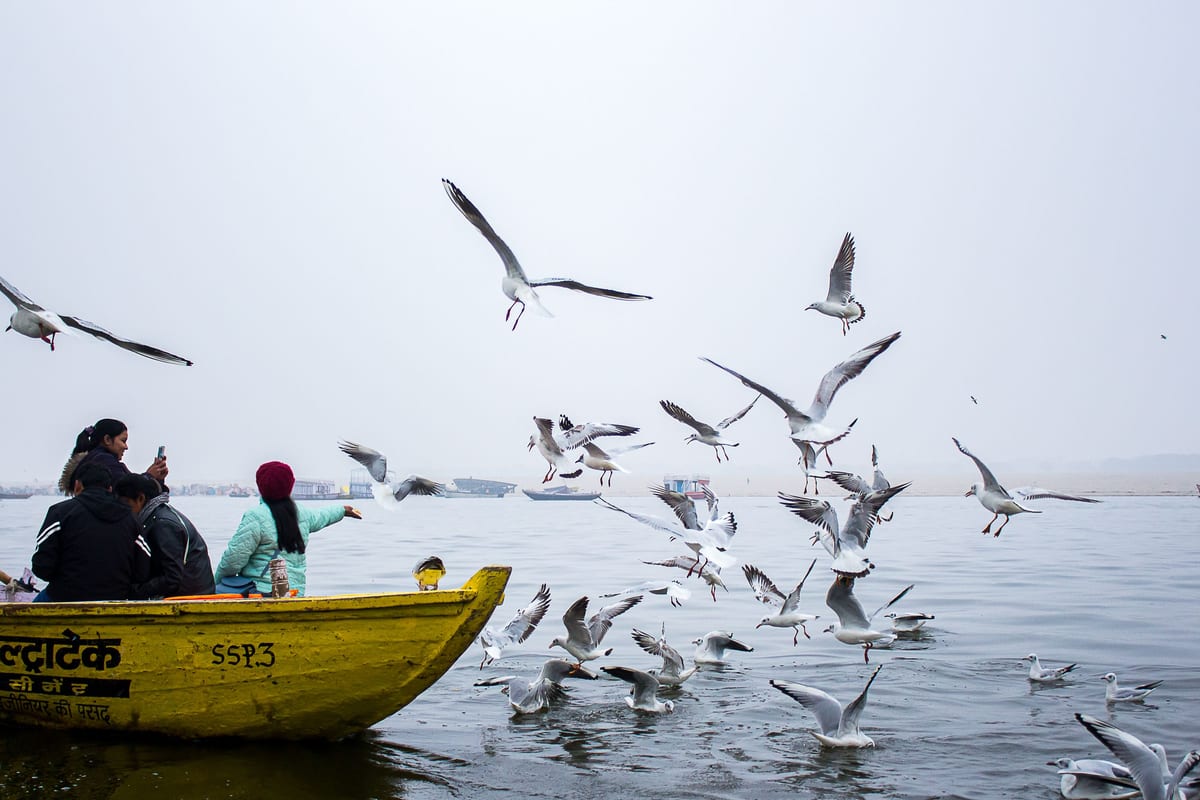
There is a moment, it arrives somewhere between the first smell of incense and the first sound of temple bells drifting across the water, when you understand that Varanasi does not belong to the present. It belongs to all time, simultaneously. Mark Twain, who was not easily awed, wrote that "Banaras is older than history, older than tradition, older even than legend." He was right. And yet, somehow, this city is also startlingly, stubbornly alive.
Welcome to Varanasi, as celebrated by Incredible India, a city of many names and infinite dimensions. Call it Kashi, call it Banaras, call it the City of Light. Each name carries its own weight of reverence. According to legend, this is the place where the first ray of light touched the earth. The name Kashi comes from the Sanskrit word Kash, meaning "to shine." Believed to have been founded by Lord Shiva and counted among Hinduism's seven sacred cities, Varanasi is eternal in its orientation, a city that has always looked beyond the ordinary business of time.
A Civilisation That Never Stopped Burning
What makes Varanasi extraordinary is that it is not a museum of a vanished culture. There are no velvet ropes, no reconstructed ruins, no helpful placards explaining what once happened here. Everything that happened here is still happening. Priests still perform the same ancient rituals their ancestors performed. Silk weavers in the old city still work the same patterns of brocade that have adorned royal wardrobes for centuries. Students still come to study Sanskrit and classical music in a city that has functioned as an intellectual and spiritual university since before the Common Era.
In Varanasi, life and death exist not in opposition but in conversation. A wedding procession may pass a funeral cortege on the same narrow lane. The sacred and the ordinary are so thoroughly intertwined that the distinction eventually stops feeling meaningful. Civilisational continuity here is not preservation behind glass, but perpetual, breathing, sometimes chaotic, always purposeful living.
The Ghats: Where the City Meets Its Soul
No account of Varanasi is complete without the ghats, the great stone stairways that descend to the Ganga and serve as the riverfront's defining architecture. There are dozens of them, each carrying its own history, its own presiding deity, its own time of day when it comes most alive.
Dashashwamedh Ghat is the most famous. Every evening, as darkness gathers over the river, priests dressed in ochre perform the Ganga Aarti, a choreographed ritual of fire, flowers, incense and Sanskrit chant that draws crowds of pilgrims and travellers alike. It is spectacular in the theatrical sense, but more than spectacle: it is a ceremony of gratitude to the river that has sustained this civilisation since its earliest memory.
Assi Ghat, at the southern end of the riverfront, offers a gentler experience. Each morning, the gathering known as Subah-e-Banaras unfolds here, a quiet, luminous assembly of yoga practitioners, classical musicians and devotees watching the sunrise over the Ganga. Dashashwamedh shows you Varanasi's grandeur; Assi shows you its grace.
Manikarnika Ghat is the most confronting and, for many visitors, the most transformative. One of Hinduism's holiest cremation grounds, it burns day and night without pause. To witness it is to see a culture's profound, unfrightened relationship with mortality. Hindus believe that to die in Varanasi is to be granted moksha, liberation from the cycle of rebirth. The fires of Manikarnika are not morbid; they are the city's most honest statement of faith.
Beyond the River: The City Within the City
Pull away from the ghats and into the labyrinthine lanes of the old city, the galis, and Varanasi reveals another self entirely. Ancient temples appear unexpectedly between sweet shops and silk merchants. The Kashi Vishwanath Temple, dedicated to Lord Shiva and newly restored within the magnificent Kashi Vishwanath Corridor, is among the most sacred sites in Hinduism. The Sarnath archaeological site, located just outside the city, marks the spot where the Buddha delivered his first sermon after attaining enlightenment, making the broader Varanasi region sacred to multiple traditions simultaneously.
The Banarasi silk sari, woven with gold and silver brocade in the workshops of the Muslim weavers of the old city, is itself a piece of living heritage, an art form that has survived centuries of economic change because its quality remains unmatched. Buying a Banarasi sari here is not shopping. It is participation in a tradition.
When to Go and How to Get There
Varanasi is a year-round destination, though the experience changes dramatically by season. The most comfortable and atmospheric time to visit is between October and March, when temperatures are cooler and the city hosts some of its most vivid festivals. The Dev Deepawali celebration in November, when the ghats are lit with hundreds of thousands of earthen lamps, is among the most visually arresting sights in all of India. Summers (April through June) are intensely hot, with temperatures reaching well above 40°C, and are best avoided by those unaccustomed to the subcontinent's heat.
Getting here is straightforward. Lal Bahadur Shastri International Airport (VNS) connects Varanasi to major Indian cities and select international destinations. For those who prefer the romance of rail, Varanasi Junction Railway Station (BSB) is well connected to Delhi, Mumbai, Kolkata and beyond. Once in the city, the ghats are best explored on foot at dawn, when the river catches the first light and the city is still finding its breath.
Why Varanasi Matters
Every country has heritage sites. Very few have a Varanasi. What this city offers is not a reconstruction of the past but the past itself, still functioning, still faithful to its original purpose, still drawing millions of people who come not to look at something old but to participate in something enduring. It is a place that asks something of you, a willingness to sit with complexity, with beauty, with the full human spectrum from birth to ash.
India's heritage story is often told through monuments, the Taj Mahal, the forts, the cave temples. Varanasi tells a different story: that civilisation is built from devotion, continuity and the stubborn, luminous insistence on meaning. Come to Varanasi not just to see India, but to understand what it has always believed itself to be.