There is a moment, just after you step through the carved wooden gateway and into the dim cool of the deodar grove surrounding Hidimba Devi Temple in Manali, when the twenty-first century quietly falls away. The smell of pine resin, the distant sound of the Beas River, the sight of prayer flags trembling in a Himalayan breeze, and at the centre of it all, a four-tiered pagoda rising from the forest floor like something that grew rather than was built. This is not a monument frozen in amber. Devotion still moves through it.
A Temple Born from Epic and Stone
The Hidimba Devi Temple was constructed in 1553 CE by Raja Bahadur Singh, the ruler of Kullu, though the sanctity of this forest site is believed to predate the structure by centuries. The temple is dedicated to Hidimba Devi, known in the Mahabharata as Hidimbi, the forest-dwelling demoness who fell in love with the Pandava hero Bhima, married him, and bore their son Ghatotkacha. In the Kullu Valley, she is no marginal figure from a distant epic. She is the presiding mother goddess, the kuldevi of local clans, a presence whose blessing is sought at every significant moment of community life.
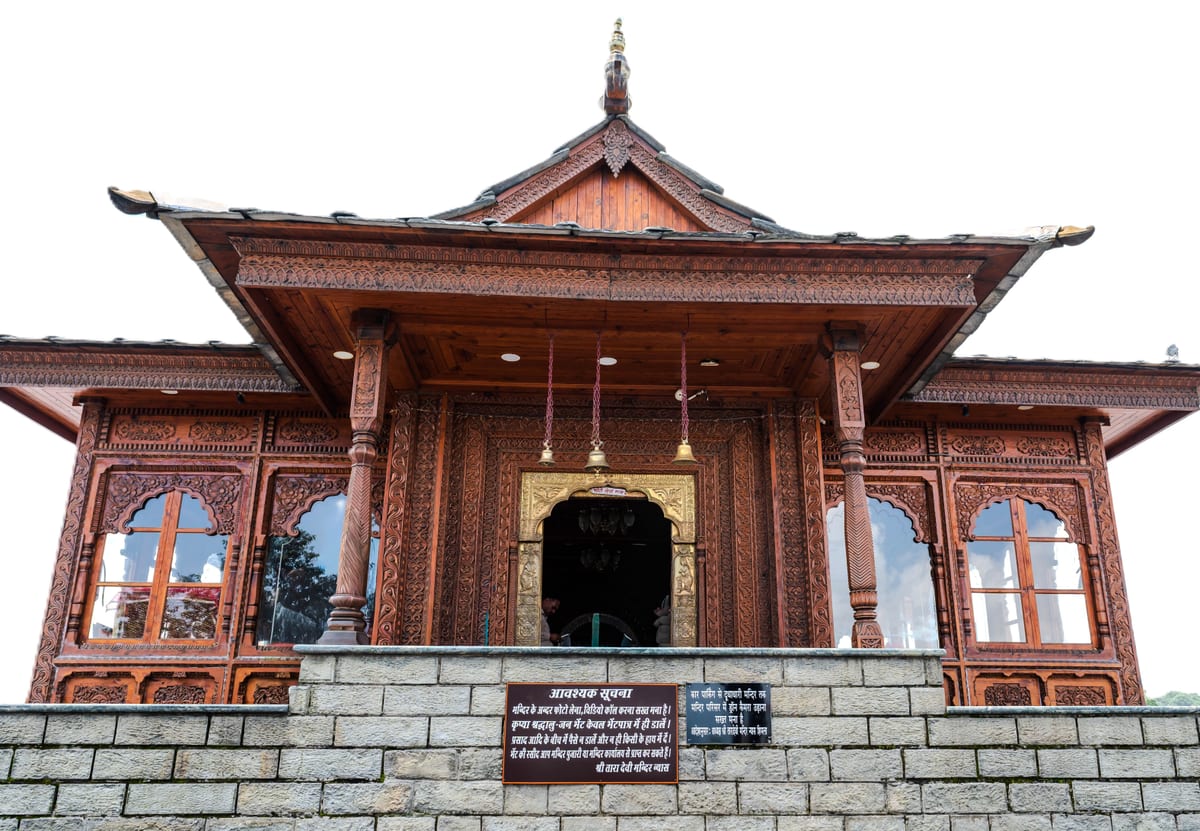
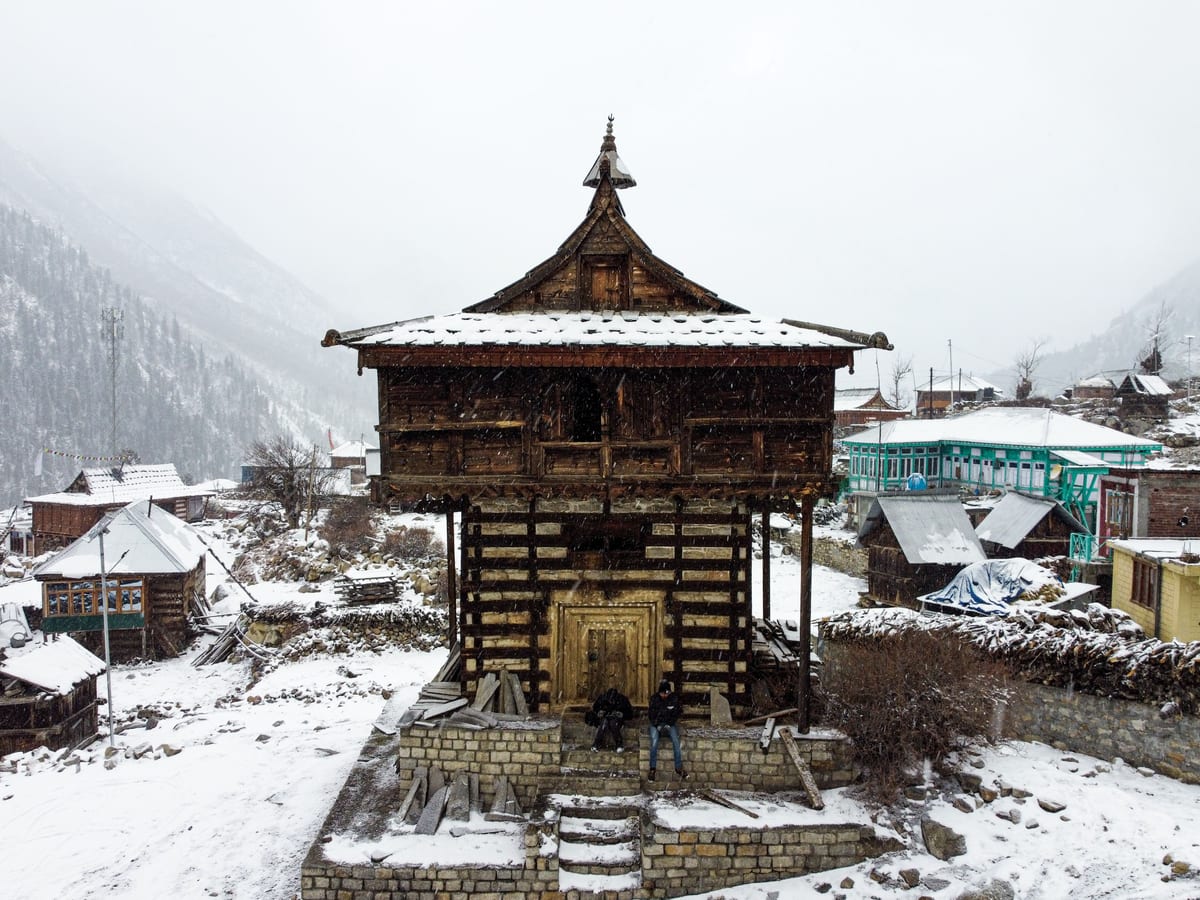
The architecture is a masterwork of Himalayan craft tradition. Built almost entirely of wood and stone without mortar in the traditional manner, the temple rises in four progressively smaller tiers, each roof shingled with wooden tiles and crowned with a dome-shaped brass finial. The doorway is an exquisite gallery of woodcarving, panels depicting animals, deities, and hunting scenes rendered with a fineness that rewards long looking. This is Nagara style meeting the Himalayan pagoda, a regional synthesis found nowhere else.
The Living Covenant of Devotion
What separates Hidimba Temple from a heritage site is this: it is not curated. There are no velvet ropes, no audio guides narrating the past in polite, distancing tones. Pilgrims arrive from across Kullu and Manali to offer prayers to the goddess. During the Hidimba Devi Festival held annually in May, processions move through the forest, traditional music fills the air, and the deity's palanquin is carried out. The celebration reaffirms what scholars struggle to articulate: in India, myth is not the opposite of history. It is history's deepest register.
Inside the sanctum, the goddess is represented by a rock formation, a form of worship known as swayambhu, self-manifested, untouched by human artifice. Devotees leave offerings of flowers, coconuts, and red cloth. The atmosphere is intimate rather than grand, devotional rather than touristic. For the sensitive visitor, the experience is quietly arresting: you are not observing a tradition from the outside. You are, however briefly, folded into it.
Learn more about this remarkable site through the official Incredible India page for Hidimba Temple, maintained by India's Ministry of Tourism.
The Forest as Sacred Geography
The deodar cedar forest that envelops the temple is not incidental scenery. It is part of the shrine itself. Deodar derives from the Sanskrit devadaru, meaning wood of the gods, and walking beneath these ancient trees one understands why. The forest has been protected for centuries because of its sacred association with the goddess. This is an early form of environmental stewardship rooted not in regulation but in reverence, a model that modern conservation discourse is only beginning to rediscover.
Adjacent to the main temple stands a smaller shrine dedicated to Ghatotkacha, Hidimba's son, and another to Hadimba's brother Hidimb, completing the family's mythological geography in wood and stone. The landscape itself becomes a narrative, a three-dimensional telling of the epic across living terrain.
When to Visit and How to Reach
The best season to visit Hidimba Temple is between May and June and again from September to November. The summer months offer pleasant weather ideal for exploring Manali's surroundings, while autumn brings crystalline skies and the first dustings of snow on surrounding peaks. Winters, though dramatically beautiful, can bring heavy snowfall that makes roads difficult. The temple is located just two kilometres from Manali town centre, easily reached by road or a gentle uphill walk through the Old Manali lanes.
Getting There: Manali is connected by road to Chandigarh (approximately 310 km) and Delhi (approximately 570 km), with regular Himachal Road Transport Corporation buses and private volvo coaches operating on both routes. The nearest airport is Bhuntar Airport (Kullu-Manali Airport), roughly 50 kilometres south of Manali, with flights connecting to Delhi and Chandigarh. From Bhuntar, taxis and local buses complete the journey to Manali.
Nearby Attractions: The Manu Temple in Old Manali, the Vashisht hot springs and temple complex, the vast meadows of Solang Valley, and the Rohtang Pass, gateway to Lahaul and Spiti, all lie within comfortable reach. Manali itself is a bustling Himalayan town with a rich layering of Tibetan, Kullu, and contemporary Indian cultures.
Why This Place Matters
India's heritage story is often told through the grandeur of Mughal forts or the mathematical precision of temple complexes further south. Hidimba Temple offers a different chapter: the story of how mountain communities, across five centuries and more, kept a goddess alive not in scholarship but in song, in festival, in the daily act of lighting a lamp before an ancient rock. This is continuity without self-consciousness, heritage without a heritage department.
To visit Hidimba Temple is to understand something essential about the way India holds time, not as a linear progression from past to present, but as a layered, living palimpsest where the forest goddess of an ancient epic still accepts flowers from the hands of her people, season after season, in a grove of the gods' own trees.