There is a moment, about twenty steps inside Cave 1 at Ajanta, when your eyes adjust to the dimness and a face emerges from the rock. It is the Bodhisattva Padmapani, serene, lotus-bearing, gaze cast slightly downward as if contemplating the weight of all human suffering. The painting is over 1,500 years old. And yet it does not feel old. It feels like someone left it there this morning.
That is the essential truth of Ajanta Caves in Maharashtra's Aurangabad district: this is not a graveyard of a lost civilisation. It is a living conversation across millennia. A place where ancient India is not behind glass, not behind velvet rope, but right there, inches from your face, asking you to remember.
A Monument Born of Faith, Forgotten by Time, Reclaimed by History
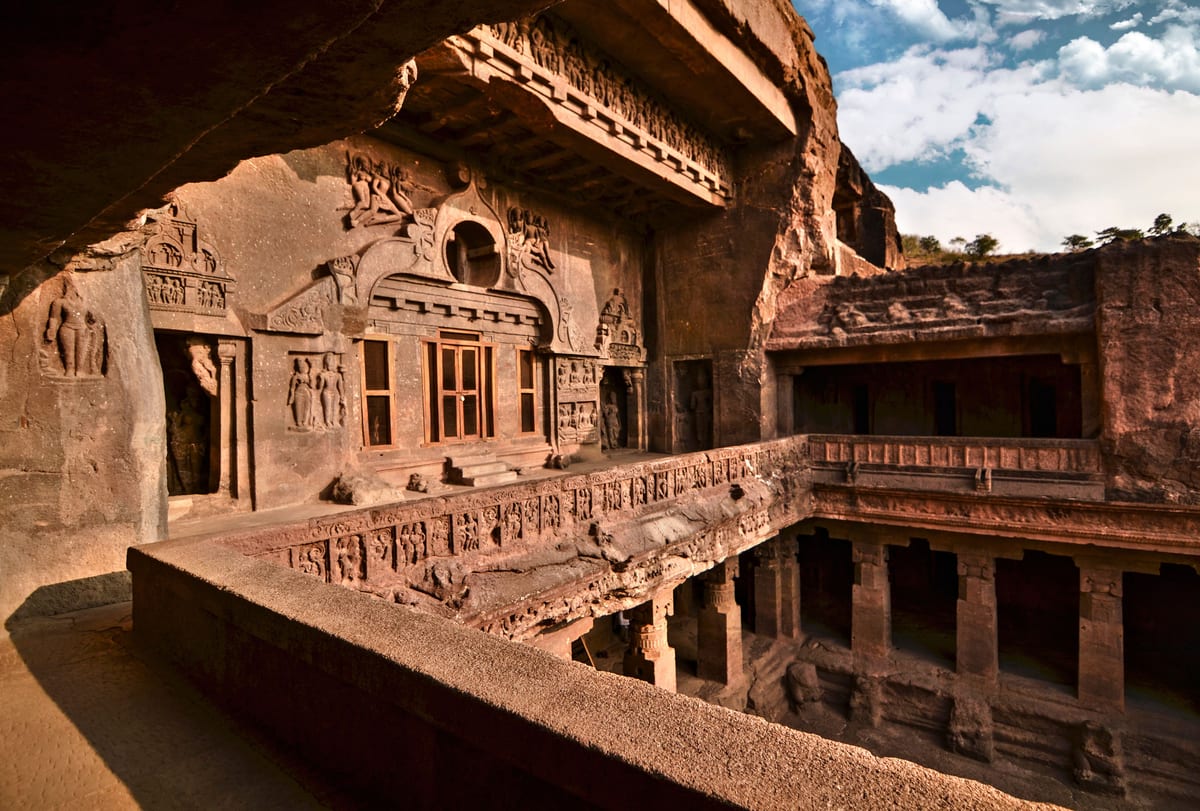
The Ajanta Caves were carved in two distinct phases. The first, beginning around the 2nd century BCE, produced the earliest rock-cut Buddhist prayer halls and monasteries known as chaityas and viharas. Then came a long silence. In the 5th century CE, under the patronage of the Vakataka dynasty, artists and monks returned with renewed ambition, carving and painting the remaining caves with an artistic vocabulary so sophisticated it staggers modern minds.
There are 30 caves in total, cut into a horseshoe-shaped cliff face above the Waghora River. They were abandoned around 650 CE, swallowed by jungle, and forgotten by the wider world for over a thousand years, until a British officer named John Smith stumbled upon them in 1819 during a tiger hunt. What he found had been hiding in plain sight, watched over by the forest and the river, waiting.
In 1983, UNESCO inscribed Ajanta as a World Heritage Site. You can explore the official listing and plan your visit through the Incredible India page for Ajanta Caves, maintained by India's Ministry of Tourism.
What You Will See: Art That Should Not Be Possible
The paintings of Ajanta depict the Jataka tales, stories of the Buddha's previous lives, alongside scenes of court life, nature, love, grief, and transcendence. What astonishes every visitor is not merely their age but their technique. These artists understood perspective, foreshortening, emotional expression, and colour harmony. They painted by lamplight, using natural pigments, lapis lazuli, ochre, charcoal, on surfaces prepared with clay, dung, and rice husks. The result is a visual language of extraordinary warmth and humanity.
Cave 16 contains the famous painting of the dying princess, a woman collapsing with such anatomical and emotional precision that she appears to breathe her last breath every time someone raises a torch to her. Cave 17 is sometimes called the picture gallery of Ajanta for the sheer density and quality of its murals. Cave 26 houses a magnificent reclining Buddha in the Mahaparinirvana pose, 7 metres long, carved from the living rock, surrounded by mourning figures whose grief is palpable across the centuries.
The sculptures, too, are extraordinary. Every pillar, every bracket, every doorway carries meaning. Ajanta is narrated, every inch of it telling a story of dharma, compassion, and the long arc of spiritual striving.
Civilisational Continuity: Why Ajanta Is Not a Museum Piece
India is often asked to treat its heritage as history, as something that happened, ended, and must now be preserved under climate-controlled glass. Ajanta refuses this framing. The philosophical traditions that animated these caves, Buddhist thought, the concept of ahimsa, the aesthetic doctrine of rasa that governs how art must evoke emotion, these are not extinct. They run through Indian classical dance, through Sanskrit poetry, through the way a craftsperson in Patan still lays a loom, through the way a Bharatanatyam dancer holds her gaze.
When you stand before the Bodhisattva Padmapani, you are not looking at a dead religion's artifact. You are looking at the root system of an entire way of understanding beauty, duty, and human consciousness, a root system that is still alive, still branching, still flowering in a thousand forms across the subcontinent.
Practical Guide: Planning Your Visit to Ajanta
Best Time to Visit: October to March is ideal, when the Deccan plateau cools and the air is clear. Monsoon months (July–September) bring dramatic mist over the Waghora gorge and lush green surroundings, beautiful, but the caves can be humid and the approach roads occasionally difficult. Avoid the peak summer months of April and May when temperatures can be punishing.
How to Reach: The nearest major city is Aurangabad (approximately 100 km away), which is well connected by air, rail, and road to Mumbai, Pune, Delhi, and other major cities. From Aurangabad, buses, taxis, and organised tours operate regularly to the caves. A Maharashtra State Transport (MSRTC) depot near the site provides feeder buses to the cave entrance from the main parking area, helping protect the site from vehicle congestion.
Nearby Attractions: No visit to this region is complete without the Ellora Caves, just 30 km from Aurangabad, another UNESCO World Heritage Site where Hindu, Buddhist, and Jain rock-cut temples exist in extraordinary proximity. The Bibi Ka Maqbara and Daulatabad Fort in Aurangabad are also well worth a half-day each.
Visitor Tips: Carry a small torch or use your phone's flashlight, the interiors of the caves are dark and the paintings reward close, unhurried attention. Wear comfortable shoes as the terrain is uneven. Photography rules apply inside the caves, so check current guidelines at the site entrance. Go early in the morning to beat crowds and catch the best available natural light at the cave mouths.
A Final Word: Come Ready to Be Changed
Most destinations offer experience. Ajanta offers something rarer, recognition. A sense that you have always known this place, that these faces have been watching over something you carry within you without knowing its name. India's civilisation produced Ajanta as an act of devotion, devotion to beauty, to the dharma, to the idea that the human spirit, given enough faith and enough time, can make even stone sing.
Come to Ajanta not to tick a box on a heritage trail. Come to listen. The caves have been talking for two thousand years. They have a great deal left to say.