There is a particular quality of light in Mumbai just before the Arabian Sea swallows the sun, golden, salt-edged, almost cinematic. Stand before the Gateway of India at that hour and you understand why this structure has endured not merely as architecture but as feeling. It is one of those rare places that does something to people. It stills them. It makes them look.
A Monument Born of Ceremony, Claimed by Civilisation
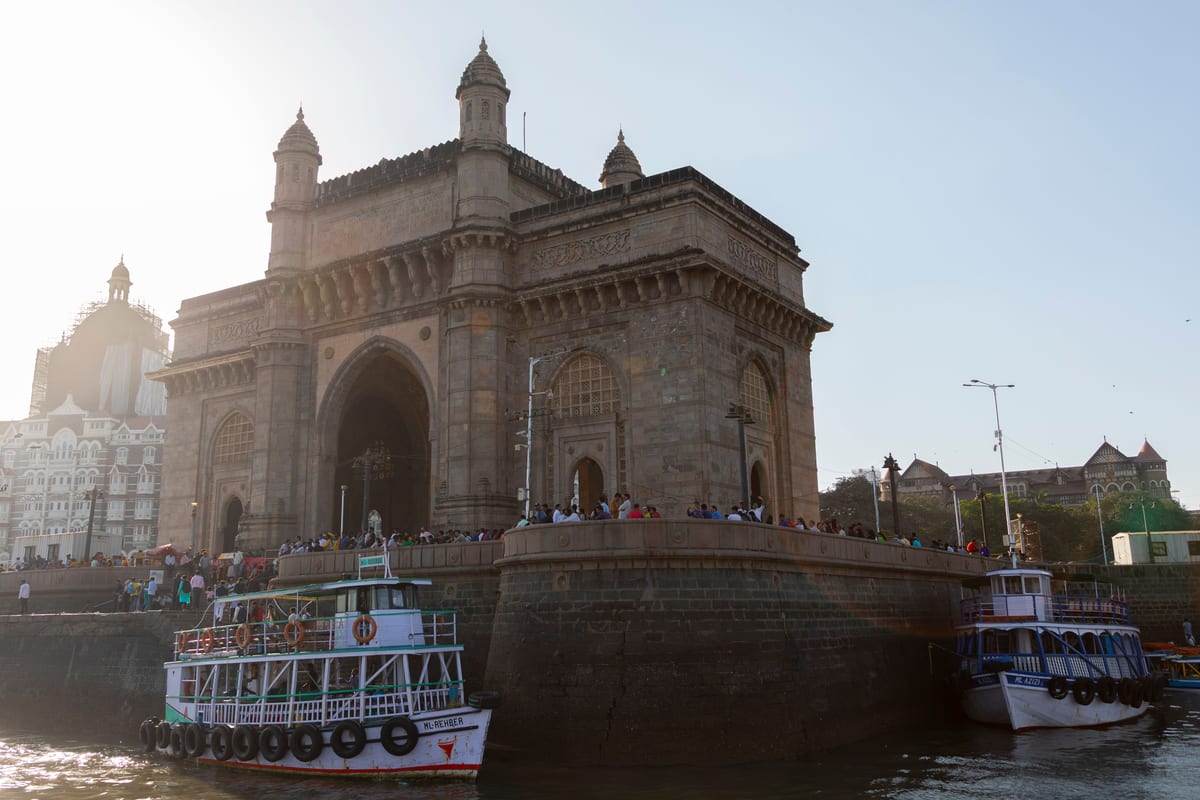
The Gateway of India was conceived to mark the visit of King George V and Queen Mary to India in 1911, the first time a British monarch had set foot on Indian soil. The foundation stone was laid that same year, and architect George Wittet designed a structure that blended Indo-Saracenic architecture with elements drawn from 16th-century Gujarati style: a grand central arch rising 26 metres high, flanked by ornate turrets and perforated stone screens that catch the sea breeze like lacework. Construction was completed in 1924, using local yellow basalt and reinforced concrete.
But here is where India's story diverges from the colonial script. The arch built to celebrate imperial arrival became the stage for imperial exit. In February 1948, the last British regiment, the Somerset Light Infantry, marched through the Gateway of India and boarded a ship back to England. A monument of welcome became a monument of departure. In that inversion lies a distinctive pattern in India's civilisational character: the ability to take what was imposed and make it mean something truer, something ours.
What You Experience Standing There
Mumbai does not let you be a passive tourist. The Gateway of India least of all. The moment you arrive at the Apollo Bunder waterfront, the city enfolds you. Vendors move through the crowd with garlands of jasmine and marigold. Children press close to the water's edge, daring each other toward the spray. Photographers with vintage cameras offer to take your portrait against the arch, a service that has existed here for generations and shows no sign of stopping.
The structure itself commands the eye from every angle. Up close, the carved detail in the basalt is extraordinary, geometric patterns, floral medallions, and latticed jali screens that filter light into something almost devotional. Step back to the promenade and the full composition reveals itself: the arch, the sea, and just behind you, the imperious façade of the Taj Mahal Palace hotel, which has stood watch over this waterfront since 1903. The two buildings are in constant, elegant conversation, and the space between them has become one of the most photographed squares in Asia.
Ferries depart from the jetty beside the Gateway for Elephanta Island, home to the magnificent cave temples dedicated to Lord Shiva, a UNESCO World Heritage Site and a reminder that Mumbai's sacred geography predates its colonial one by many centuries. Taking that ferry, watching the Gateway recede as the boat pushes into open water, is one of those travel moments that earns the word unforgettable.
Living Heritage, Not a Relic
What distinguishes the Gateway of India from monuments that merely survive is that it actively participates in daily life. Families from across Maharashtra come here on weekends and festivals, treating it as a gathering place rather than a heritage site to be observed from a respectful distance. During Ganesh Chaturthi, the streets surrounding it pulse with processions heading toward the sea for visarjan. On Republic Day and Independence Day, the monument wears its significance differently, not as colonial history, but as a backdrop to Indian pride.
This is what India does with its layered past. It does not freeze monuments in amber or fence them behind interpretation boards that tell visitors how to feel. It lives alongside them, arguing with them, celebrating in front of them, using them as backdrops for wedding photographs and political rallies and quiet evenings by the water. The Gateway of India is not a museum piece. It is furniture in a room that is very much still occupied.
Practical Travel Guide: Planning Your Visit
Best Time to Visit: Mumbai's most welcoming season runs from October through February, when the humidity drops, the skies clear, and the waterfront becomes genuinely pleasant in the evenings. Monsoon months, June through September, bring dramatic grey skies and crashing waves that lend the Gateway a different, more elemental mood. If you can tolerate the rain, the crowds thin and the experience deepens. Avoid the peak summer months of April and May if heat is not your preference.
How to Reach: The Gateway of India sits at Apollo Bunder in Colaba, South Mumbai. The nearest railway station is Chhatrapati Shivaji Maharaj Terminus (CSMT), from which the monument is roughly five kilometres, a short taxi or auto-rickshaw ride. Mumbai's local train network is vast and efficient; Churchgate station is also nearby for those arriving from the western suburbs. For those flying in, Chhatrapati Shivaji Maharaj International Airport connects Mumbai to virtually every major Indian city and dozens of international destinations.
Nearby Attractions: No visit to the Gateway is complete without crossing the harbour to Elephanta Island, whose rock-cut Shiva temples date to the 5th and 8th centuries CE and represent one of India's finest achievements in sculptural art. Back on the mainland, Colaba Causeway offers a sensory immersion in Mumbai's street culture, antiques, street food, textiles, and the particular energy of a city that never quite stops. The Chhatrapati Shivaji Maharaj Vastu Sangrahalaya (formerly the Prince of Wales Museum) is a ten-minute walk away and houses one of western India's finest collections of art, natural history, and archaeology.
Why It Belongs in India's Heritage Story
India's civilisational story is not a straight line. It is a palimpsest, layer upon layer of meaning, each era writing over the last without fully erasing it. The Gateway of India is a perfect emblem of that complexity. Built by one power, completed just as that power's hold was beginning to loosen, and ultimately inherited by a nation that had its own ideas about what arches could mean.
When you stand beneath it and look out at the Arabian Sea, the same sea that brought traders, invaders, pilgrims, and poets to this coast across millennia, you are not looking at colonial history. You are looking at India's capacity to absorb the world and remain, recognisably, itself.
The Gateway of India does not ask you to remember an empire. It asks you to understand a civilisation that outlasted one.