There are monuments that record history, and then there are monuments that are history. The Konark Sun Temple in Odisha, standing on the northeastern coast of India roughly 35 kilometres from Puri, is the latter. This thirteenth-century masterpiece does not ask you to remember the past. It insists you inhabit it.
A Chariot Frozen in Eternity
Conceived as the colossal chariot of Surya, the sun god, the Konark Sun Temple was built circa 1250 CE under King Narasimhadeva I of the Eastern Ganga dynasty. The architectural conceit is staggering: the entire temple complex is designed as a divine chariot drawn by seven galloping horses, riding on twenty-four elaborately carved stone wheels. Each wheel stands more than three metres in diameter and is not merely decorative, they function as precise sundials, their spokes casting shadows that allow a skilled observer to read the time of day with remarkable accuracy. The sacred and the scientific are inseparable here.
The main sanctum, the deul, once rose to a height believed to exceed 70 metres, a tower so tall that sailors on the Bay of Bengal reportedly used it as a navigational landmark, calling it the "Black Pagoda" to distinguish it from Puri's "White Pagoda" (the Jagannath Temple). Though the deul no longer stands in its full glory, the jagamohana (assembly hall) survives as a monument of immense power, its pyramidal form still commanding the flat coastal landscape.
Stone That Speaks Every Language
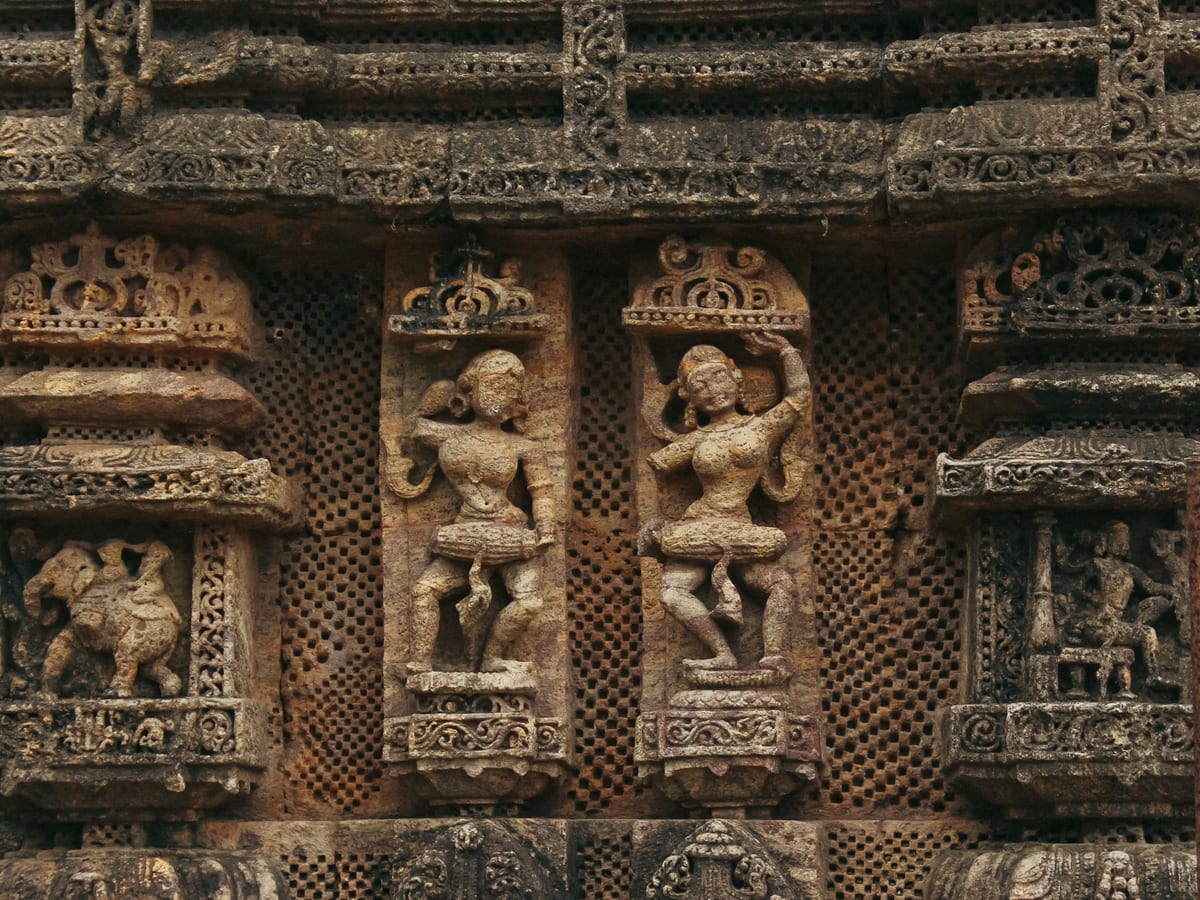
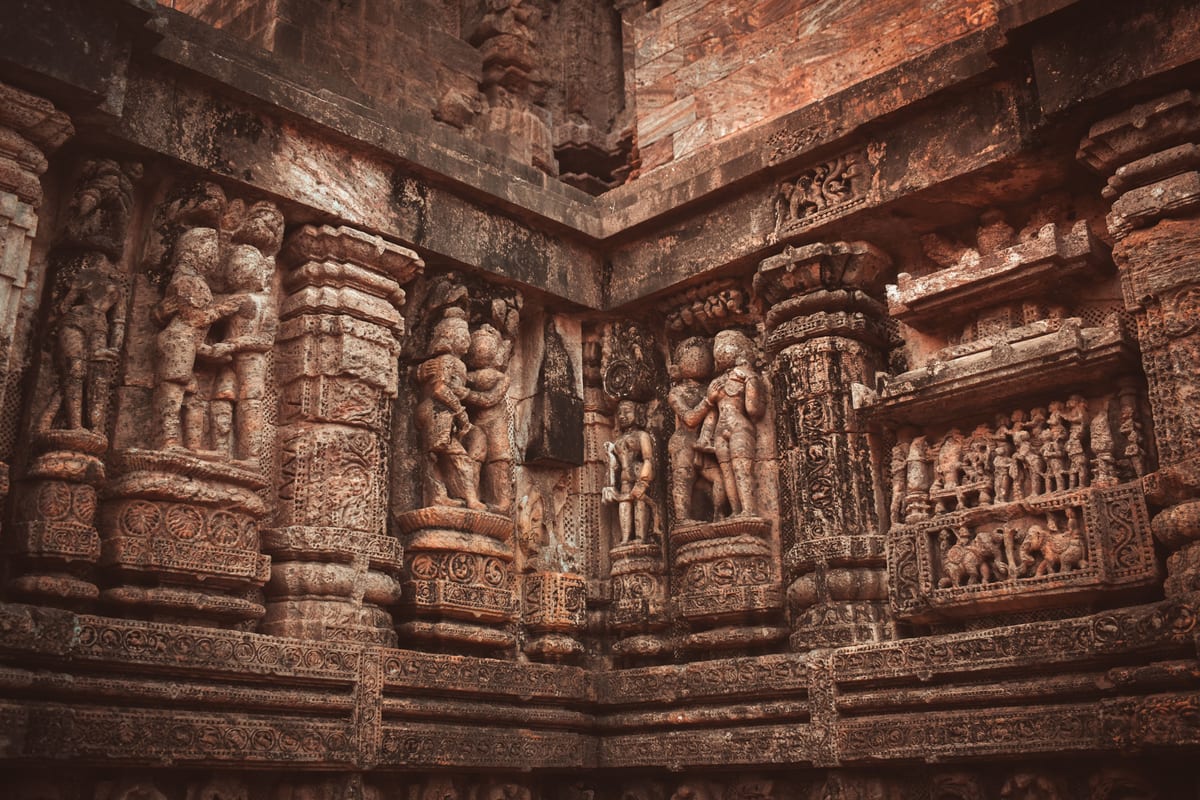
To walk around Konark is to receive an education in everything the Eastern Ganga civilisation held dear. The temple's surfaces are covered with an extraordinary density of carving, celestial musicians, erotic mithuna couples, warriors on horseback, processions of elephants, scenes of court life, divine beings, and intricate floral patterns. This is not ornamentation. This is a civilisational text, written in the universal language of image.
The erotic sculptures are consistent with the broader Shaiva and Tantric traditions of the region, they represent the fullness of human experience as a path toward the divine, not a detour from it. Konark reflects a philosophical generosity that is characteristically Indian: life in all its dimensions is worthy of being consecrated in stone and offered to the gods.
The three prominent statues of Surya, positioned to catch the light of dawn, midday, and sunset, reveal the temple's precise astronomical orientation. The rising sun once struck the diamond placed in the sanctum's idol, scattering light across the interior in a daily act of cosmic drama. That Narasimhadeva I's architects achieved this without modern instruments is a fact that deserves pause.
Learn more about the temple's history, iconography, and visitor information at the Konark Sun Temple page on Incredible India, the official tourism portal of the Government of India.
The Living Heritage Argument
UNESCO inscribed the Konark Sun Temple as a World Heritage Site in 1984, recognising it as "one of the most famous landmarks of India." Every December, the temple becomes the stage for the Konark Dance Festival, a five-day celebration in which classical dancers from across India, performing Odissi, Bharatanatyam, Kathak, Manipuri, and more, reclaim the temple's courtyards as performance space. The sculptures come alive again: the celestial apsaras carved into the stone find their echo in the human bodies moving before them. This is civilisational continuity.
The Odissi dance form itself, lyrical, sinuous, deeply devotional, has its roots in the traditions of the devadasis and maharis who once served the great Odishan temples. To watch an Odissi performance against the backdrop of Konark at twilight is to understand that India's heritage lives in the bodies of its practitioners.
Planning Your Journey to Konark
Best time to visit: The ideal window is October through February, when Odisha's coastal weather is cool and clear. The monsoon months, June through September, bring heavy rainfall and high humidity, though the landscape turns dramatically lush. If your visit can align with the Konark Dance Festival, typically held in the first week of December, that is ideal.
How to reach: The nearest major city is Bhubaneswar, Odisha's capital, which is well connected by air, rail, and road to Delhi, Mumbai, Kolkata, Chennai, and Bengaluru. From Bhubaneswar, Konark is approximately 65 kilometres, roughly a 90-minute drive through a scenic coastal route. Puri, one of India's holiest pilgrimage towns, sits just 35 kilometres from Konark and makes an excellent base, with a wider range of accommodation options. Regular bus and taxi services connect Puri to Konark throughout the day.
Nearby attractions: The Chandrabhaga Beach, just two kilometres from the temple, is one of Odisha's most beautiful and least crowded coastal stretches. Puri's Jagannath Temple and the pristine beaches of Puri itself are essential companions to any Konark visit. The Raghurajpur Crafts Village, roughly 14 kilometres from Puri, is a living museum of Pattachitra painting, palm-leaf engraving, and traditional Odishan crafts. Chilika Lake, Asia's largest coastal lagoon, lies about 50 kilometres south of Bhubaneswar and completes a remarkable Odisha itinerary.
Why Konark Matters
India has no shortage of extraordinary monuments. But Konark occupies a singular place because it refuses to be merely beautiful. It is an argument, made in sandstone and chlorite, about what a civilisation believes. It argues that the sun is divine and time is sacred. That the human body is holy. That mathematics and mythology are not opposites but complements. That art is knowledge.
Stand before its wheels and you will find yourself calculating shadows. Study its carvings and you will find yourself reading a civilisation's mind. Listen to the wind off the Bay of Bengal moving through its stones and you will understand that some things are built not for a century but for eternity. That is Konark's final lesson: civilisation, at its best, does not build for the present. It builds for the sun itself.