There are places in India that do not simply ask to be seen. They demand reckoning. The Konark Sun Temple, rising from the coastal plains of Odisha about 35 kilometres from Puri, is one such place. It does not perform heritage for the tourist. It endures, magnificent, insistent, and alive, as it has for nearly eight centuries.
A Chariot Frozen in Stone
Conceived as the colossal chariot of Surya, the sun god, the Konark Sun Temple was built in the 13th century, around 1250 CE, under the patronage of the Eastern Ganga dynasty king, Narasimhadeva I. The vision was staggering: an entire temple complex designed to resemble the sun god's divine vehicle, drawn by seven horses and mounted on twelve pairs of intricately carved wheels. Those wheels, each nearly three metres in diameter, are perhaps the most iconic images in all of Indian architecture. They function as sundials of extraordinary accuracy, still capable of telling the time to this day if you know how to read their spokes.
The temple was constructed from Khondalite rock, a warm golden-grey stone quarried from the region. In its full glory it must have towered over the coastal landscape like a vision from another world. Sailors once called it the Black Pagoda, using it as a navigational landmark, a detail that quietly tells you everything about how commanding its presence was, and continues to be, even in its partially ruined state.
The Language of the Sculptures
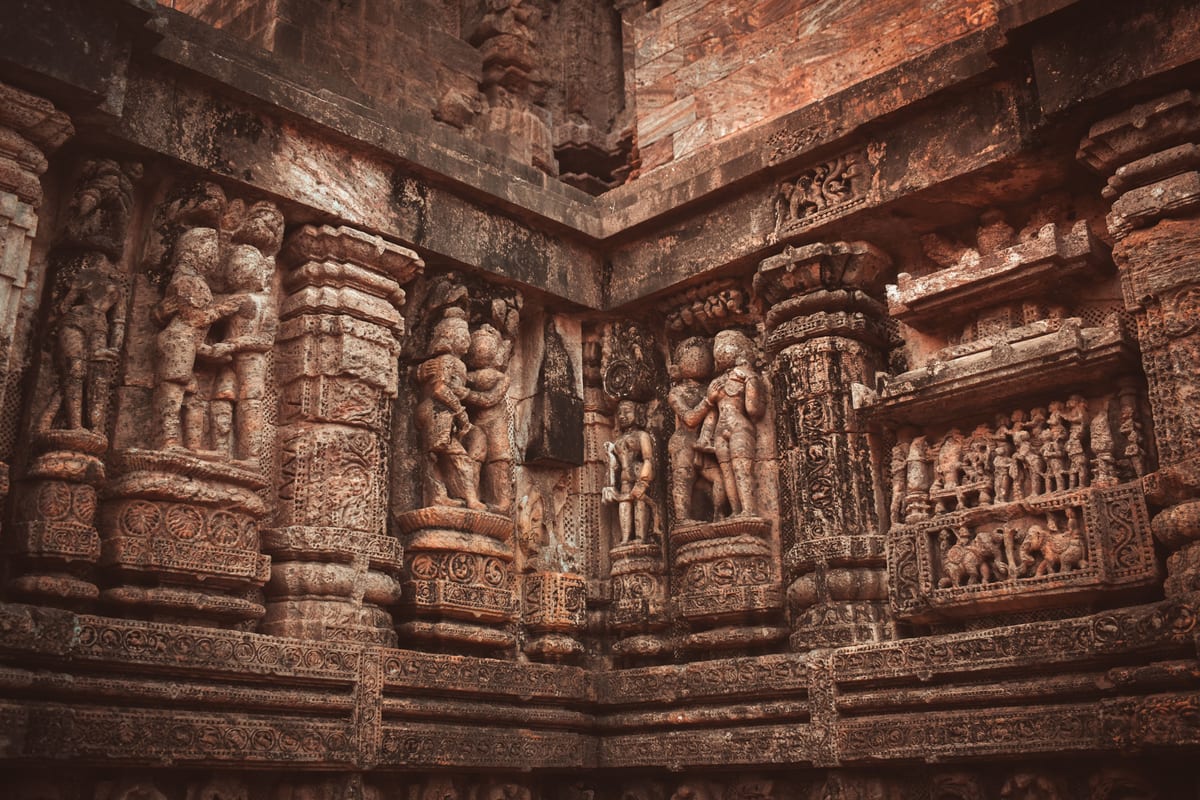
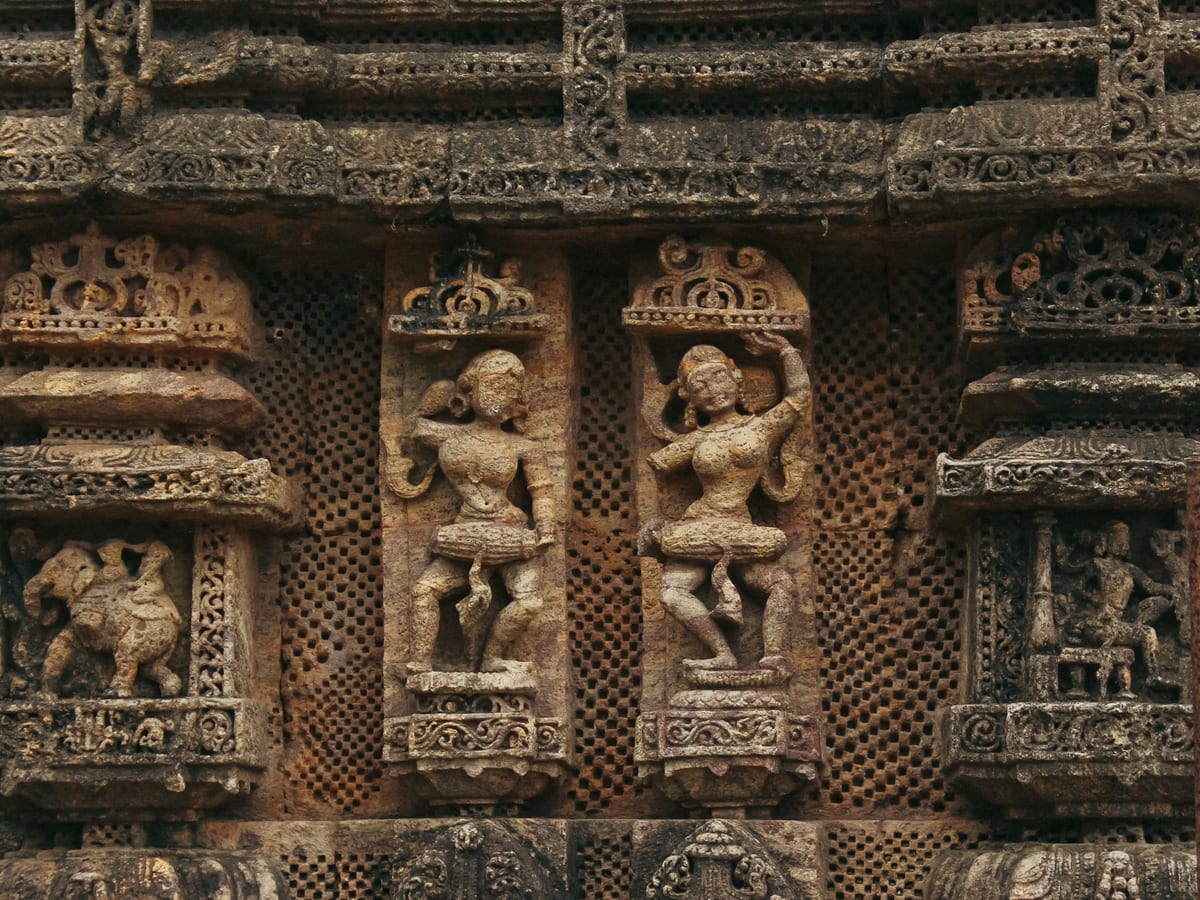
To walk around the base of the Konark Sun Temple is to encounter what an ancient civilisation believed about human life. Every surface the builders could reach with a chisel, they carved. What they carved was life in its extraordinary fullness: celestial nymphs in mid-dance, musicians lost in their rhythms, erotic panels of rare tenderness and candour, scenes of royal procession, hunting, and battle, and the great beasts, horses, elephants, and lions, that animate the structure with kinetic energy.
These are not decorations. They are a philosophical statement. The Konark sculptors understood that the sacred does not exist in opposition to the worldly. Surya, who illuminates everything without discrimination, would naturally preside over a temple that depicted everything without shame. Every carved panel at Konark makes an argument for civilisational wholeness: that light touches all of life, and all of life is therefore worthy of art.
A UNESCO World Heritage Site and Its Continuing Story
Konark was designated a UNESCO World Heritage Site in 1984. Yet the temple's true significance runs deeper than any international designation. It is the centrepiece of the sacred Odishan golden triangle, Bhubaneswar, Puri, and Konark, a circuit of temples and traditions that has sustained one of India's most distinct regional cultures for over a millennium. The annual Konark Dance Festival, held every December against the temple's floodlit backdrop, draws classical dancers from across the country who perform Odissi and other Indian classical forms in a setting that feels, quite simply, mythological.
The Archaeological Survey of India continues its stewardship of the site, and visitors will find the complex thoughtfully maintained. The main sanctum, the deul, collapsed long ago, the sand filling that once supported its interior was removed in colonial times. But the jagamohana, or audience hall, still stands with authority, and the natamandira, the dance pavilion, endures as a hauntingly beautiful fragment. What survives is enough to arrest attention. What is lost only deepens the ache of wonder.
What Visitors Experience
Walking the site at dawn, when the stone is cool and the coastal light is soft and golden, is as close to a spiritual experience as secular travel gets. The site museum on the premises houses a collection of sculptures and architectural fragments that would be extraordinary in any context. Here they serve as footnotes to the larger text written in stone outside. Give yourself at least half a day; the complex rewards slow attention and a willingness to sit and absorb.
The beach at Chandrabhaga, just a few kilometres from the temple, is one of Odisha's most beautiful and uncrowded stretches of coastline. The Chandrabhaga Mela, held here in the month of Magha (January–February), draws pilgrims who come to bathe in the sea and honour the sun, a living ritual that connects contemporary Odisha to the same spiritual impulse that built the temple itself. This is what civilisational continuity looks like: not a museum exhibit behind glass, but a tradition that walks barefoot to the sea on a winter morning.
Best Time to Visit and How to Get There
The best season to visit Konark is between October and February, when the weather along the Odisha coast is mild, breezy, and entirely forgiving. The monsoon months (June to September) bring heavy rainfall and high humidity, though the landscape turns dramatically lush. Summers (March to May) are hot and humid and best avoided if comfort matters to you.
The nearest major airport is Biju Patnaik International Airport in Bhubaneswar, approximately 65 kilometres from Konark, with good connections to Delhi, Mumbai, Kolkata, and Hyderabad. From Bhubaneswar, taxis, state-run buses, and private vehicles make the coastal drive to Konark, passing paddy fields and casuarina groves, straightforward and scenic. Puri, 35 kilometres away, is the more popular base for travellers combining Konark with the Jagannath Temple; regular bus and cab services connect the two.
Nearby, the seaside town of Puri and the temple city of Bhubaneswar, with its extraordinary cluster of Kalinga-style temples including the Lingaraja, complete what is one of India's most rewarding heritage circuits.
Why Konark Matters in India's Heritage Story
India's heritage story is too often told through the lens of loss, of what colonialism took, what time eroded, what was never recorded. Konark offers a different story. Even in its partial ruin, it radiates the confidence of a civilisation that was absolutely certain of what it believed and absolutely unafraid to carve that belief into stone at a scale that would outlast every empire that followed. The seven horses pulling the sun chariot forward, only one now fully intact, feel less like mythology and more like a statement of intent: we move toward the light, and we do not stop.
To visit Konark is to understand that India's ancient traditions were never primitive. They were sophisticated, sensuous, scientifically literate, and spiritually daring. The temple asks nothing of the visitor except honest attention. Give it that, and it will give you something you will carry for the rest of your life.