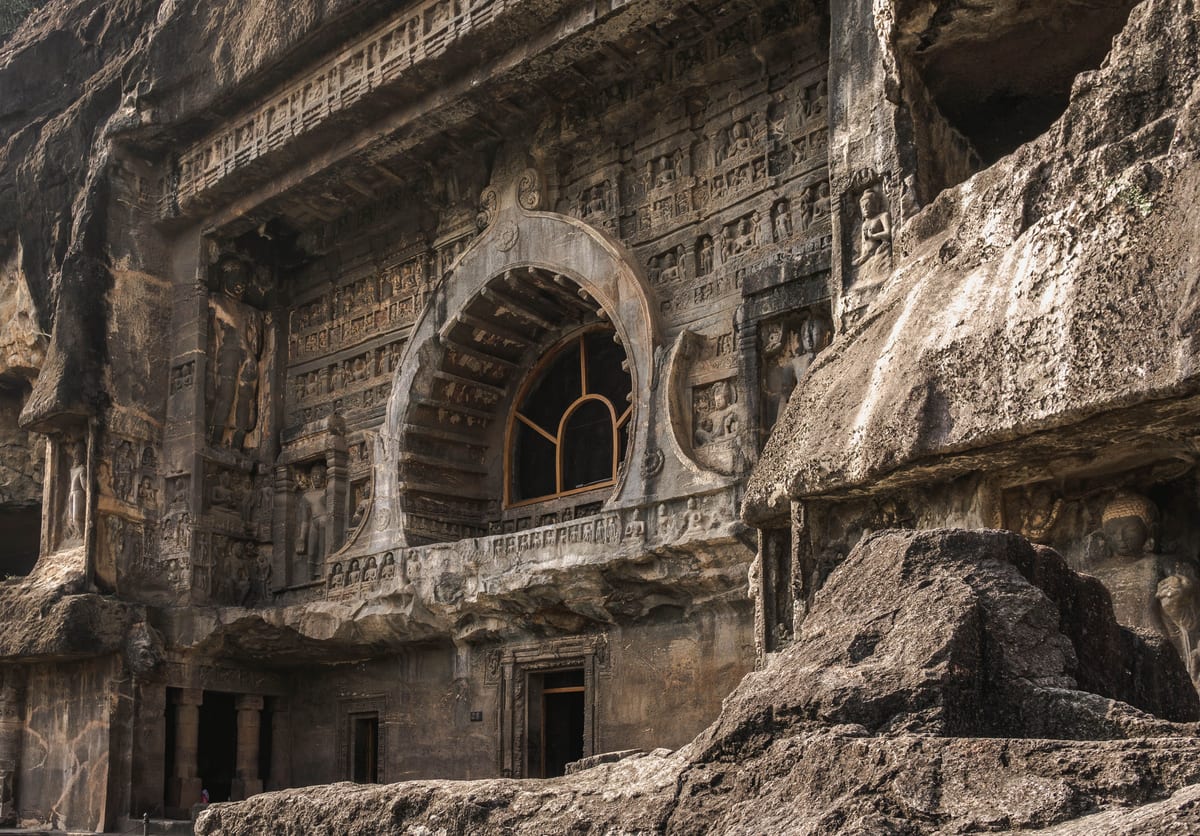
There is a moment, somewhere between stepping off the shuttle bus and walking through the first arched mouth of stone, when the noise of the modern world simply falls away. The Waghora River murmurs below. Peacocks cry from the teak forests on the far ridge. And ahead of you, cut into a curving basalt cliff as though the rock itself exhaled and made room, are thirty cave monuments that contain some of the most luminous art ever created by human hands. Welcome to Ajanta, not a ruin, not a museum, but a conversation between a civilisation and its own deepest longings.
A Story Carved in Two Acts
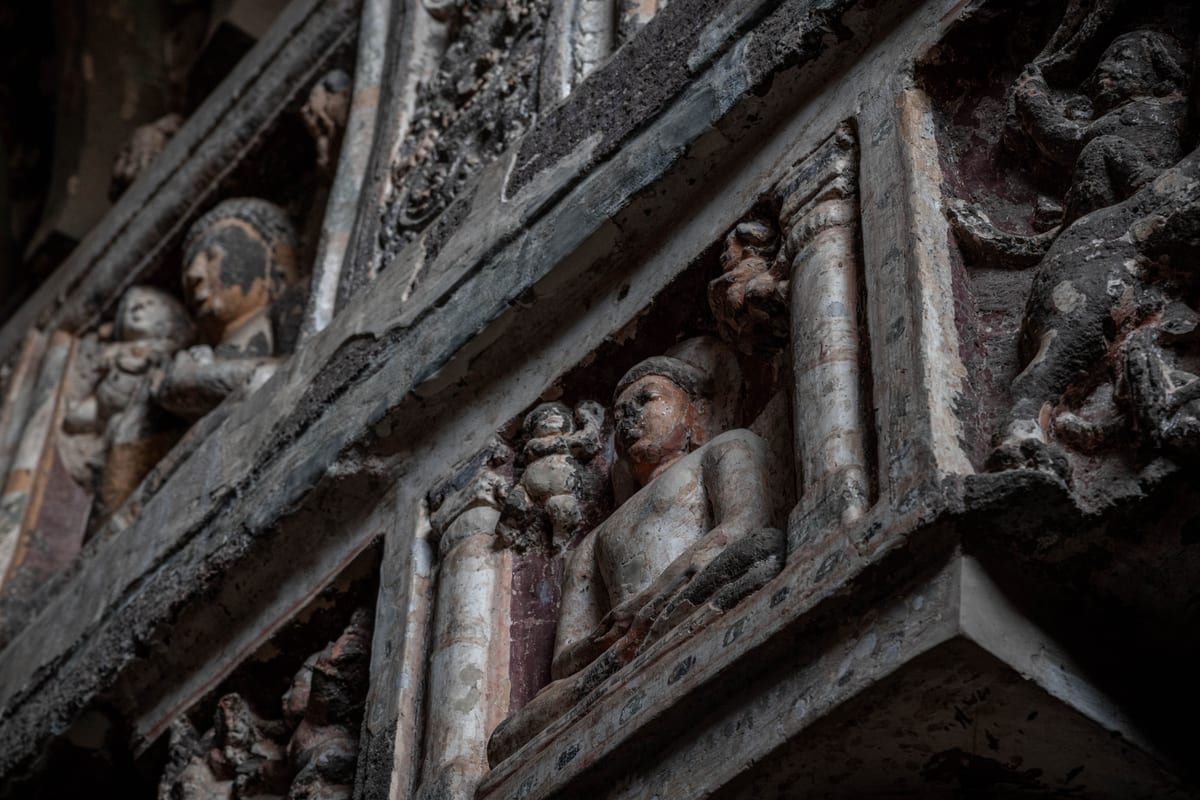
The Ajanta Caves were created across two distinct periods, separated by centuries of silence. The earliest group, Caves 9, 10, 12, 13, and 15A, dates to the Hinayana phase of Buddhism, roughly the 2nd century BCE to the 1st century CE. These are austere, contemplative spaces: prayer halls with ribbed barrel vaults and simple stupas at their centre, meant for monks who had renounced the world's decoration. Then, after a long pause, the Mahayana phase erupted in extraordinary creative energy between the 5th and 6th centuries CE, during the reign of the Vakatakas. Most of Ajanta's paintings and the exquisitely carved facades that make the cliff look, at a distance, like an illuminated manuscript written in stone, come from this second period.
Ajanta was not rediscovered by scholars poring over texts. It was stumbled upon in 1819 by a British Army officer named John Smith, who was tiger-hunting in the hills above the Waghora gorge. He noticed, through the undergrowth, what appeared to be the arch of Cave 10. What followed was one of archaeology's great slow revelations, the gradual uncovering of a world that had been sealed by jungle for perhaps a thousand years, perfectly preserved precisely because it had been forgotten.
The Murals: Art as an Act of Faith
To stand inside Cave 1 or Cave 17 and look up at the painted ceilings is to understand something fundamental about the civilisation that produced them: for these artists, beauty was not an indulgence but a spiritual obligation. The murals, executed in a technique using local minerals, clay, and organic pigments on a lime-plastered surface, depict the Jataka tales, the previous lives of the Buddha, in narrative sequences of astonishing psychological complexity. Figures grieve, celebrate, tempt, and transcend. Animals display more humanity than many human faces in lesser art. The composition is never static; it swirls and breathes.
The celebrated image of the Bodhisattva Padmapani in Cave 1, a lotus-bearing figure of such serene melancholy that it has been compared to Leonardo's finest work, is perhaps the most reproduced image from ancient India. But the caves reward slow, patient looking. In a corner of Cave 16, a dying princess is attended by weeping ladies-in-waiting; her expression holds a stillness that transcends the drama around her. In Cave 2, a palace ceiling is covered in a carpet of geometric and floral medallions so precisely rendered they appear almost Mughal, except they predate the Mughal empire by a thousand years.
The Living Civilisation Argument
There is a temptation, especially for foreign visitors, to frame Ajanta as evidence of a glorious past that India has since moved on from. That framing is a mistake. The monks who built these caves were part of a living network of trade, philosophy, and artistic exchange that connected the Deccan plateau to Sri Lanka, Central Asia, and the courts of Southeast Asia. The Ajanta style of painting travelled to Sigiriya in Sri Lanka, to Dunhuang in China, to Bamiyan in Afghanistan. What we see in these caves is not the apex of a dead culture but a node in a civilisational web that was very much alive and remains, in many ways, alive in the aesthetic instincts and devotional practices of the subcontinent today.
When a sculptor in Chennai carves a dancing Nataraja, when a miniature painter in Rajasthan renders a narrative in a single crowded frame, when a filmmaker uses light to convey a character's interior state without dialogue, they are inheriting, however unconsciously, a tradition of visual storytelling that Ajanta represents at its most magnificent. India's heritage is not a museum exhibit. It is a grammar that the culture still speaks.
What Visitors Experience
The thirty caves are numbered geographically, not chronologically, so visitors move through time in a pleasantly non-linear way. The chaitya grihas, prayer halls, are distinguished by their horseshoe-shaped windows and the dramatic play of natural light across the stupa interiors. The viharas, monastic halls, are larger, their walls covered in painted panels, their pillared verandahs offering extraordinary views of the gorge below. Cave 26 alone, with its colossal reclining Buddha and elaborately carved facade, would justify a journey from any city in India.
The Archaeological Survey of India manages the site with care, and artificial lighting has been installed sensitively inside the caves to protect the murals while allowing visitors to see clearly. Guides, official ones are strongly recommended, can illuminate the iconographic details that an untrained eye might miss entirely.
Planning Your Visit: Practical Notes
Best Season: October to March is ideal, when Maharashtra's interior is cool and dry. The monsoon months (June to September) make the gorge dramatically beautiful but the humidity and mist can obscure the murals. Summer (April to June) is hot and best avoided unless you visit very early in the morning.
How to Reach: The nearest major town is Aurangabad, approximately 107 kilometres from Ajanta. Aurangabad is well connected by air (Chhatrapati Sambhaji Nagar Airport) and rail to Mumbai, Pune, and other major cities. From Aurangabad, state buses, private taxis, and organised tours run regularly to the caves. The Maharashtra Tourism Development Corporation (MTDC) operates comfortable package tours that include both Ajanta and Ellora on the same circuit, highly recommended for first-time visitors.
Nearby Attractions: The Ellora Caves, just 30 kilometres from Aurangabad, are an essential complement to Ajanta, they represent a later, multi-religious phase of rock-cut architecture encompassing Buddhist, Hindu, and Jain traditions. The Kailasa Temple at Ellora (Cave 16) is one of the largest monolithic rock-cut structures on Earth. Aurangabad itself offers the Bibi Ka Maqbara, the Daulatabad Fort, and the Aurangabad Caves, making the region one of the most concentrated heritage corridors in India.
At the Site: Wear comfortable walking shoes; the path between caves involves uneven stone steps and some gradients. Carry water and a light snack. Photography policies vary by cave; always check signage. Arrive early to experience the first caves in relative quiet before tour groups arrive.
Why Ajanta Belongs on Every Indian's List
Indians travel in enormous numbers to temples, to pilgrimage sites, to beaches and hill stations. Fewer make the deliberate journey to Ajanta, and that is a quiet loss. These caves are not foreign history. They are the record of a moment when Indian genius was operating at full power, with nothing to prove and everything to express. To walk through them is to feel, in the most visceral way, that the civilisation you belong to has been capable of extraordinary things, and remains so.
Savitri Bhatia writes on travel, culture, and civilisation for IndiaWorldEye. She travelled to Ajanta in the winter season and recommends at least two full days in the region to do the caves justice.