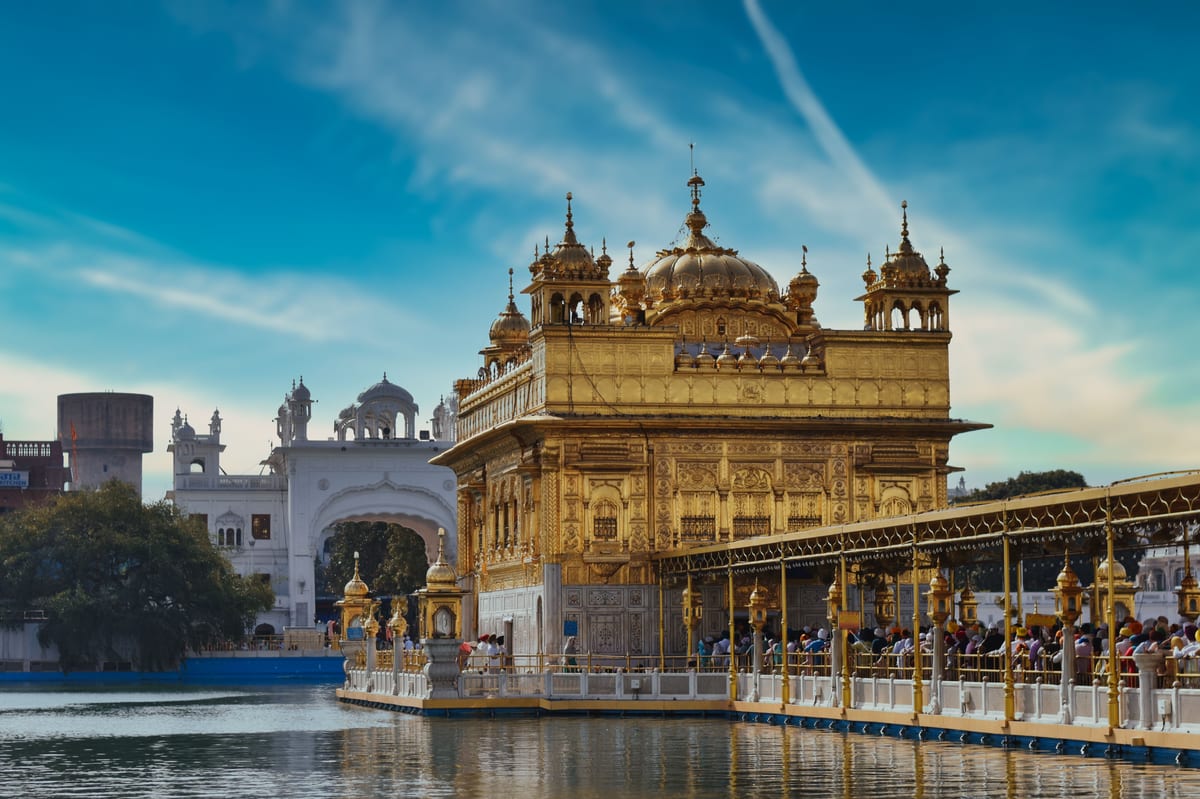
There are cities you visit, and there are cities that visit you back, settling into your memory long after you have left, returning unbidden in quiet moments. Amritsar is the second kind. The spiritual and cultural capital of Punjab, it arrives all at once: the smell of ghee on hot iron, the distant sound of kirtan rising over rooftops, the blinding flash of gold reflected in still water. To stand at the edge of the sarovar surrounding the Sri Harmandir Sahib, the Golden Temple, at dawn is to understand why this city holds such a sovereign place in India's soul.
A Temple That Belongs to Everyone
Your journey through Amritsar begins, as it almost certainly must, at the Golden Temple. This two-storeyed architectural marvel, its upper half sheathed in nearly 400 kilograms of pure gold leaf, sits at the centre of the Amrit Sarovar, the Pool of Nectar from which the city takes its name. The temple's reflection shimmers and shifts in the water below, so that the structure seems to exist in two worlds simultaneously: the earthly and the eternal.
But the Golden Temple is far more than an architectural wonder. It is a functioning expression of the Sikh principle of seva, selfless service. The langar, the free community kitchen attached to the temple, serves tens of thousands of meals every single day, prepared and distributed by volunteers from every walk of life. Sitting cross-legged on the floor, eating simple dal and roti alongside pilgrims, tourists, and strangers, is one of the most quietly radical acts of equality you will experience anywhere on earth. No reservation required. No hierarchy observed. Come hungry; leave nourished in every sense of the word.
Witness the rituals of the temple at different hours, the pre-dawn Palki Sahib ceremony, when the Guru Granth Sahib is carried in procession, is particularly moving, and you begin to see that this is not a heritage site kept alive for tourism. It is a living institution, as vital today as it was when construction began in the sixteenth century under Guru Ram Das and was completed by Guru Arjan Dev Ji.
Where History Weighs Heavily and Honestly
A short walk from the Golden Temple lies Jallianwala Bagh, and the shift in atmosphere is immediate and profound. On 13 April 1919, British colonial forces opened fire on thousands of unarmed civilians gathered in this enclosed garden, men, women, and children who had assembled to mark the festival of Baisakhi. Hundreds were killed. The bullet marks still scar the walls. The well into which people leapt to escape the gunfire still stands. Jallianwala Bagh is not comfortable history. It is not meant to be. It is a necessary reckoning, and Amritsar holds it without flinching.
Nearby, the Partition Museum carries forward that honest reckoning into the catastrophic displacement of 1947, when the subcontinent was divided and millions were uprooted from the land their families had worked for generations. The museum displays stories of heartbreak and hope, personal testimonies, photographs, objects, that transform abstract historical events into individual human lives. If Jallianwala Bagh shows you what colonial power looked like at its most brutal, the Partition Museum shows you what ordinary people endured in its aftermath. Together, they make Amritsar one of the most important sites of historical memory in all of India.
The Electrifying Theatre of the Wagah Border
As evening approaches, travellers make their way to the Attari-Wagah Border, roughly 30 kilometres from the city centre, for the nightly Beating Retreat Ceremony. What unfolds is unlike any other experience in India. The flag-lowering ritual, performed by the Border Security Force of India and the Pakistan Rangers simultaneously, is accompanied by precision drills, thunderous drumbeats, and an outpouring of patriotic fervour from the crowds on both sides of the gate. It is theatrical, emotional, and strangely moving, a reminder that borders are human inventions, maintained by ritual as much as by wire and stone.
Bazaars, Bites, and the Business of Living Well
Amritsar's streets are a sensory argument for being alive. The old city's narrow lanes, particularly around the Hall Bazaar and the labyrinthine lanes of the walled city, overflow with traditional crafts, Phulkari embroidery, juttis (embroidered leather shoes), and vivid, unhurried commerce that no shopping mall can replicate.
And then there is the food. Punjab's culinary traditions reach their most exuberant expression in Amritsar. The city's kulcha, a stuffed flatbread cooked in a tandoor and slathered in butter, has achieved almost legendary status. Amritsari fish fry, dal makhani, lassi served in clay cups wider than your face: the city offers a feast at every corner stall and every family-run dhaba. Come with appetite and leave all dietary restraint at the city gate.
Best Time to Visit and How to Get There
Amritsar's climate ranges from sharp winters to intense summers. The most comfortable months for visiting are October through March, when temperatures are moderate and the city's festivals, including the luminous celebration of Guru Nanak Jayanti, bring additional colour to an already vivid place. The height of summer (May and June) can see temperatures push above 44°C, which makes sightseeing demanding, though the Golden Temple remains beautiful at any hour and in any season.
The city is well connected by air via Sri Guru Ram Dass Jee International Airport (ATQ), which receives both domestic and international flights. By rail, Amritsar Central Railway Station (ASR) links the city to Delhi, Mumbai, and major Punjab towns with regular and reliable services. Road connections through the national highway network make Amritsar accessible from Chandigarh, Delhi, and the broader region. Once in the city, the compact old quarter is best explored on foot, with cycle rickshaws offering a pleasantly unhurried alternative.
A City That Asks Something of You
Most travel destinations ask only that you show up with a camera and an open schedule. Amritsar asks more. It asks you to sit quietly in a place of worship and let the kirtan do what it does. It asks you to read the names on the walls of Jallianwala Bagh and not look away. It asks you to eat alongside strangers and remember that hospitality is a form of theology. It asks you to stand in the roaring crowd at Wagah and feel what it means to belong to something larger than yourself.
India's civilisational story is long and layered, written in Sanskrit and steel, in temple gopurams and Mughal arches, in the Constitution and in the Guru Granth Sahib. Amritsar is one of the places where that story is not merely told, it is lived, daily, by the people who call this golden city home. Come and become, briefly, part of it.
For official travel information, itinerary suggestions, and visitor guidance, visit the Amritsar destination page on Incredible India, maintained by India's Ministry of Tourism.