There is a moment, usually just after sunset, when you stand on the white flats of the Great Rann of Kutch and the salt crust beneath your feet glows faintly pink and the horizon disappears entirely. Sky and earth become one unbroken field of colour. In that moment you understand, viscerally and without the help of any guidebook, that you are standing somewhere that has been sacred to human imagination for a very long time.
The Rann of Kutch, according to the Ministry of Tourism's Incredible India portal, is the world's largest salt desert, spanning roughly 30,000 square kilometres across the northern edge of Gujarat. It is divided into two parts, the Great Rann to the north and the Little Rann to the southeast, and together they form a landscape so unlike anything else on the subcontinent that first-time visitors often describe the experience as leaving India altogether. But that instinct is precisely wrong. This is not where India ends. It is, in a very real sense, where India began.
A Civilisational Threshold
The Kutch region borders the ancient floodplains of the Indus Valley, and the ruins of Dholavira, a UNESCO World Heritage Site located in the Rann itself, show that sophisticated urban life thrived here more than 4,500 years ago. The Harappans who built Dholavira engineered water conservation systems of breathtaking ingenuity in one of the driest landscapes on earth. They had script, trade networks, and aesthetic sensibility. They were not primitive. They were, by any honest reckoning, civilised in the fullest meaning of the word.
When you visit Dholavira today and walk its grid-planned streets and stand before the great reservoir that once held monsoon water for an entire city, you are not visiting a ruin. You are tracing a continuous thread. The Rabari pastoralists, the Ahir embroiderers, the Khatri block-printers, the Jat craftswomen of Kutch are not unrelated to that ancient impulse toward beauty, order, and ingenuity. Their work carries forward an aesthetic that is strikingly consistent across millennia. India's civilisational story is not one of glorious past and diminished present. The Rann teaches you that.
The White Desert and Its Seasons
The Rann is, geologically, a seasonal phenomenon of remarkable drama. During the monsoon months, roughly June through September, the entire flat fills with a shallow sheet of water, transforming into an inland sea. Flamingos arrive in their tens of thousands to breed in the Little Rann, and the horizon shimmers with pale pink. Then the waters recede. As winter arrives, the salt crust re-emerges, dazzling white under the sun, ghostly silver under a full moon. The landscape hardens into silence.
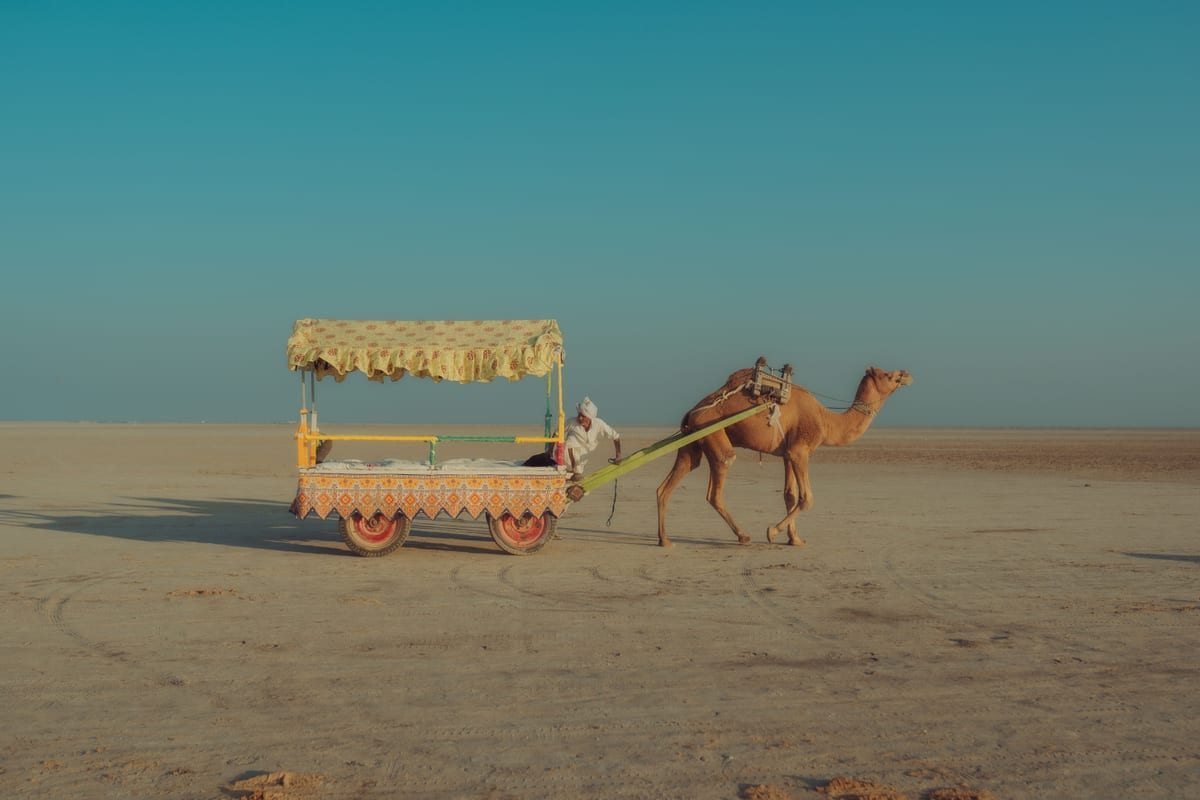
It is in this winter stillness that the Rann is most itself, and most accessible. The annual Rann Utsav festival, held between November and February in the tent city near Dhordo village, draws visitors from across India and abroad. Traditional folk performances, craft bazaars featuring Kutchi embroidery and mirror-work, camel rides across the white flats, and full-moon nights that feel like standing inside a dream offer an immersion in living culture.
The Artisans Who Carry the Thread
Do not visit the Rann without spending time among its craftspeople. Kutch is India's richest district for textile arts. Walk through the workshops of Bhujodi village or sit with an embroiderer in Hodka and you will see the depth of this claim. Each community within Kutch maintains its own distinct style of needlework: the Rabari stitch is different from the Ahir stitch; the Mutwa geometric precision is unlike the Suf embroidery's counted-thread geometry. These are not variations on a theme. They are entirely separate visual languages, each carrying a community's cosmology and social memory within its patterns.
Purchasing directly from artisan cooperatives and Self-Help Groups in the Kutch region is both an ethical and an experiential choice. What you take home is not a souvenir. It is a living object, made by hands that learned from hands that learned from hands, reaching back further than any museum label will tell you.
Practical Notes for the Traveller
Best time to visit: October to February is ideal. The white salt flats are fully accessible, temperatures are pleasant, and the Rann Utsav typically runs through this window. Avoid the monsoon months if your primary goal is the landscape; visit specifically during monsoon if birding, particularly flamingo viewing in the Little Rann, is your purpose.
How to reach: Bhuj is the gateway city to the Kutch region and has an airport with connections from Mumbai and Ahmedabad. Bhuj is also well connected by rail. From Bhuj, the Rann and Dhordo tent city are approximately 80 to 85 kilometres by road. Taxis and organised tour operators run regular services from Bhuj during the Utsav season.
Nearby attractions: Dholavira (UNESCO World Heritage Site, approximately 250 km from Bhuj), the Wild Ass Sanctuary in the Little Rann of Kutch, Bhuj city itself (with the Aina Mahal and Prag Mahal palaces), and the craft villages of Bhujodi, Hodka, and Nirona, each worth a dedicated half-day.
Accommodation: The Rann Utsav tent city at Dhordo offers the most atmospheric option during the festival season, with varying categories of tented accommodation. Bhuj city provides a broader range of hotels for those using it as a base for day excursions.
Why the Rann Matters
India has many landscapes of beauty and many sites of historical weight, but few places where beauty, history, living culture, and ecological drama converge so completely. The Rann of Kutch does not perform for its visitors. It simply is, vast, indifferent, luminous, and in that quality lies its deepest invitation. Come here not to be entertained but to be recalibrated. Come to understand that civilisation is not a monument. It is a practice, ongoing, and in Kutch, it has never stopped.