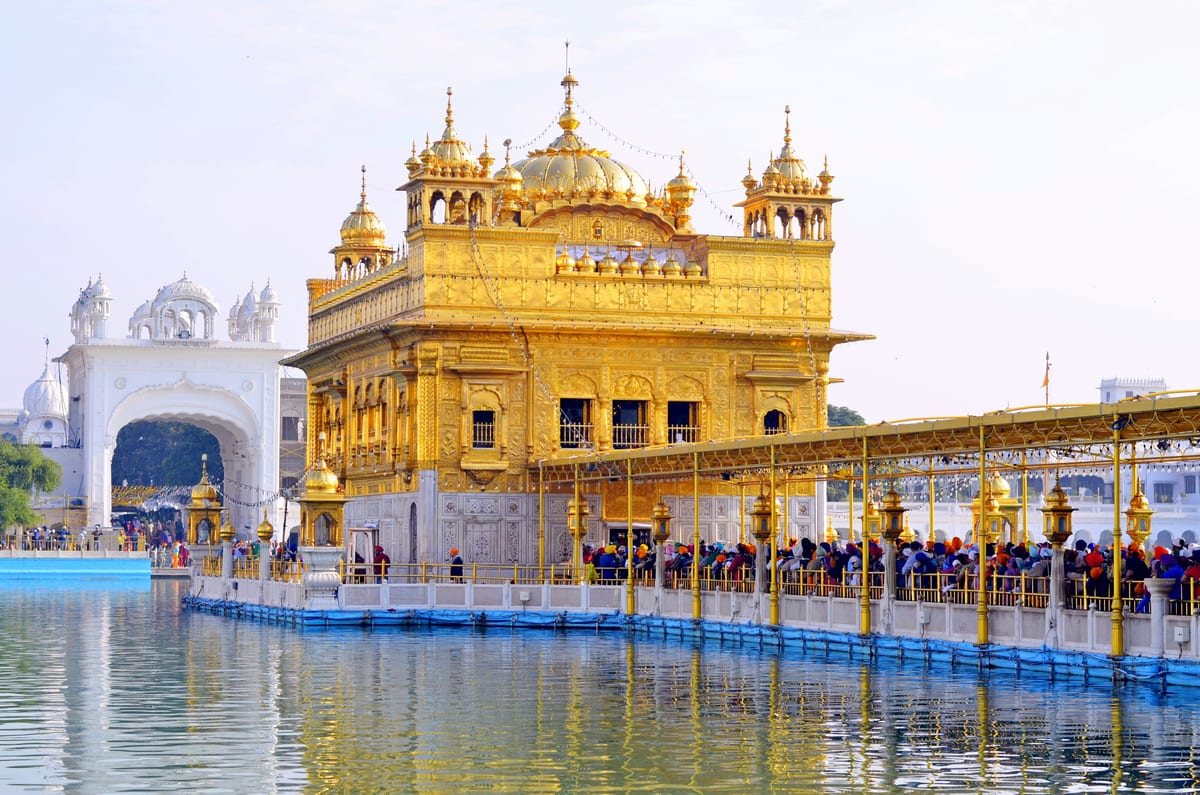
There are cities you visit, and then there are cities that visit you back — quietly, persistibly, long after you have returned home. Amritsar is the second kind. The moment you step onto its ancient streets, something shifts. The air is different here: thicker with incense and history, warmer with the smell of butter-soaked bread and spiced tea, alive with the distant sound of kirtan floating from the direction of the sarovar. This is Punjab's heart — and it beats loud enough for everyone to feel.
A City Built on Faith and Fire
Amritsar was founded in the 16th century around a sacred pool — the Amrit Sarovar, the Pool of Nectar — that gave the city its name. At its geographic and spiritual centre stands Sri Harmandir Sahib, universally known as the Golden Temple. This two-storeyed architectural marvel, its upper half sheathed in nearly 400 kilograms of pure gold leaf, rises from the middle of the sarovar. As Incredible India describes it, the Golden Temple is "a place of profound reverence for Sikh pilgrims and a sight that humbles all who visit."
And humble you it will. There is no admission fee, no dress requirement beyond modesty and covered heads, no distinction between the devout and the curious traveller. You wash your feet in the shallow pool at the entrance, wrap a cloth around your head, and walk forward. The marble causeway, the chanting that seems to rise from the stones themselves, the reflection of gold trembling on holy water at dawn — these are moments that rearrange a person quietly.
Then there is the langar. Every day, thousands of people — pilgrims, tourists, the hungry, the wandering — sit cross-legged on the floor of the community kitchen and eat together. The meal is free. The service is voluntary. It has been this way for centuries. The langar is a philosophical statement about the equality of all human beings, enacted in flour and lentils and shared space. To eat here is to understand, in a way no lecture could convey, what civilisational values look like when they are still functioning.
Where Wounds Become Witness
Amritsar does not let you look away from pain. A short walk from the Golden Temple, Jallianwala Bagh is one of India's most solemn memorial spaces. On 13 April 1919, British colonial troops opened fire on a peaceful gathering in this enclosed garden, killing hundreds of unarmed men, women, and children. The bullet marks are still visible in the walls. The well into which people jumped to escape the firing still stands. This is not a reconstructed history — it is the original wound, preserved and witnessed.
The nearby Partition Museum carries that weight forward to 1947, documenting one of the largest and most violent forced migrations in human history, when the subcontinent was divided and Punjab bore the deepest cuts. The museum's collection of personal testimonies, photographs, and artefacts transforms an abstract historical catastrophe into a human story, told in individual voices. Together, Jallianwala Bagh and the Partition Museum make Amritsar an essential stop for any honest engagement with India's journey to independence and self-determination.
The Ceremony at the Edge of the Nation
Every evening, at the Attari-Wagah border crossing between India and Pakistan, something extraordinary happens. Crowds gather on both sides of the gate as soldiers from both nations perform the Beating Retreat Ceremony — a choreographed display of precision, pride, and theatrical intensity that is unlike anything else in the world. Flags are lowered, boots strike the ground in perfect unison, and the crowd roars. It is simultaneously a military ceremony, a sporting event, and a piece of living theatre. As Incredible India notes, the patriotism on display here must be experienced to be truly understood.
The Bazaars: A Sensory Civilisation
Between the sacred and the solemn, Amritsar feeds you — lavishly, insistently, memorably. The old city bazaars are a cascade of colour, aroma, and noise. The famous Hall Bazaar and its surrounding lanes overflow with phulkari embroidery, traditional Punjabi juttis, and street food that has inspired pilgrimages of its own. Amritsari kulcha stuffed with spiced potato and eaten with chhole, lassi thick enough to stand a spoon in, and the legendary amritsari fish fry — the city's cuisine is as generous and unhurried as its people. Do not eat here in a rush. It would be a small crime.
When to Go and How to Reach Amritsar
Amritsar is a year-round destination, though the best time to visit falls between October and March, when temperatures are cool and comfortable, ranging from around 5°C to 35°C. Winters, from November through January, bring a golden haze to the mornings that makes the city feel particularly atmospheric. Summers (April through June) can be intensely hot, with temperatures climbing past 40°C, though the Golden Temple's marble stays cool and the city never truly empties.
The city is well connected by air through Sri Guru Ram Dass Jee International Airport (ATQ), which receives both domestic and international flights. By rail, Amritsar Central Railway Station (ASR) links the city to Delhi, Mumbai, and other major centres across India. By road, Amritsar sits on well-maintained national highways and is accessible by bus and private vehicle from Delhi — roughly a five to six hour drive.
Amritsar Is Not Behind You — It Is Still Happening
What makes Amritsar remarkable in the context of India's heritage story is precisely this: nothing here is behind glass. The Golden Temple was built centuries ago and continues today to be the living centre of a living faith. The langar that fed pilgrims in the 1600s feeds visitors in 2025. The bazaars that traded in silk and spices trade still. Amritsar is not a museum of Indian civilisation — it is Indian civilisation, still in motion, still generous, still golden. Come here and you will not merely see history. You will briefly, unforgettably, become part of it.