As you approach the Konark Sun Temple across the flat coastal plain of Odisha, the structure appears on the horizon like a vision from another world. The great tower rises, dark and ancient, against the blue sky of the Bay of Bengal coast. The closer you walk, the more you feel it: not the scale alone, but the realisation that every centimetre of this structure was once a conscious act of human devotion, intelligence, and artistic daring.
Welcome to Konark, the Black Pagoda, the Chariot of the Sun, a UNESCO World Heritage Site, and one of the most extraordinary monuments on earth.
A Temple That Is Also a Calendar, a Clock, and a Cosmology
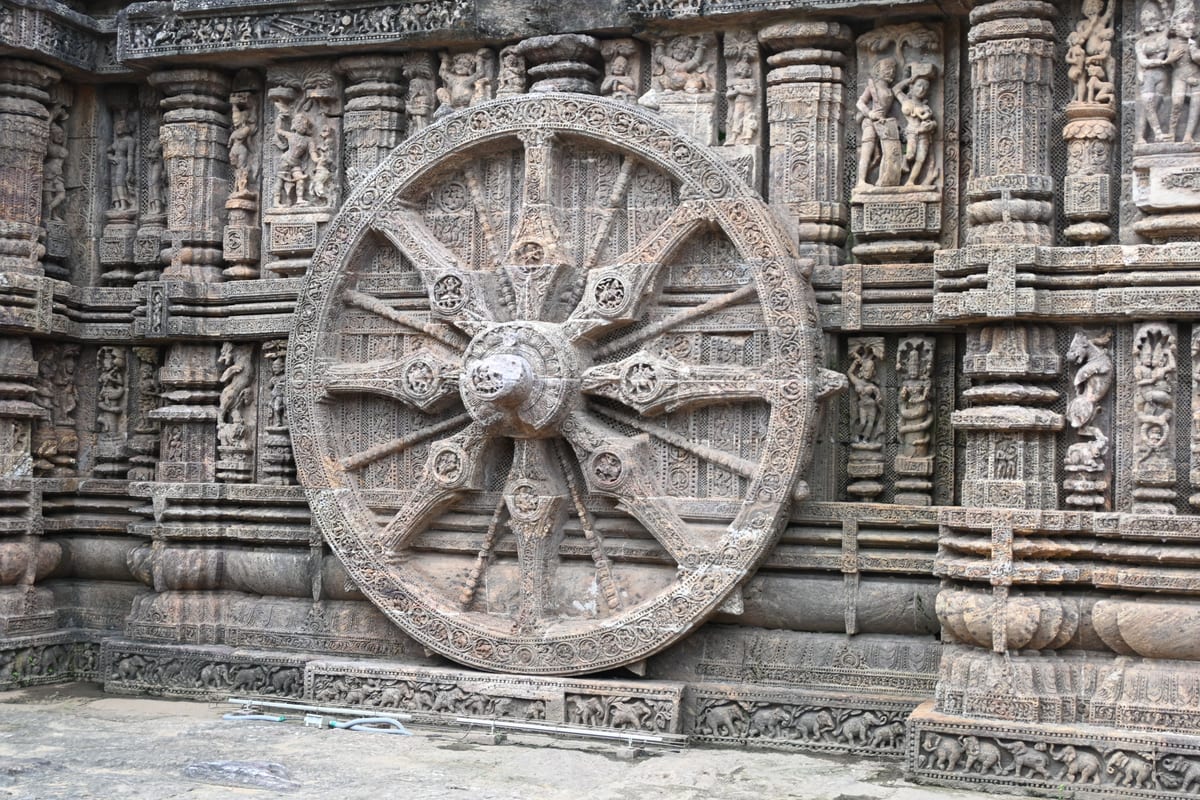
Built in the 13th century CE by King Narasimhadeva I of the Eastern Ganga dynasty, the Konark Sun Temple was conceived as a monumental chariot for Surya, the Vedic sun god. The architectural concept is staggering: the entire temple is designed as a giant stone rath, a chariot, with twelve pairs of intricately carved wheels (representing the twelve months of the Hindu calendar) pulled by seven horses (representing the seven days of the week). The wheels function as precise sundials; the spokes cast shadows that mark the hours of the day with remarkable accuracy.
This is Indian civilisational thought at its most eloquent. The temple is simultaneously a place of worship, a monument to astronomical knowledge, a meditation on cyclical time, and an act of royal power. It does not separate the sacred from the scientific. In granite and chlorite, it insists they are one.
The Stone That Breathes: Sculpture and Symbolism
No photograph prepares you for the sculpture at Konark. The temple's exterior surfaces are layered with carvings of extraordinary finesse. Celestial musicians and dancers, animals, mythological scenes, deities in their many moods, and the erotic panels that draw gasps and questions in equal measure. These are not provocations. They express the same Tantric philosophical tradition that produced the Kama Sutra, a tradition that regards human experience, including desire, as part of the sacred continuum of existence. Life, in this worldview, is not to be transcended by denial but understood through its fullness.
The three surviving chlorite statues of Surya, positioned on the north, south, and east faces, are masterpieces of Odishan sculpture. Each face of the sun god catches the light at a different hour, a deliberate architectural choice that ensures the deity is perpetually illuminated. The builders of Konark were poets working in stone.
Living Heritage, Not a Museum Piece
It would be easy, and wrong, to experience Konark as a ruin. Yes, the main shikhara (tower) collapsed centuries ago, and what stands today is the jagamohana, or assembly hall. But Konark is emphatically alive. Every December, the Konark Dance Festival fills the temple's outdoor Nata Mandir with the finest classical dance forms of India, Odissi, Bharatanatyam, Kathak, Manipuri, performed under open skies against the backdrop of ancient stone. In those evenings, the distance between the 13th century and the present collapses. The same artistic tradition that carved the apsaras on these walls still breathes through the bodies of today's dancers.
This is what India's heritage means when understood correctly, not as a museum exhibit preserved behind glass, but as a civilisational conversation that continues across centuries.
Planning Your Visit: Practical Travel Guide
Best Time to Visit: October to March is ideal, the coastal Odisha climate is pleasant, and the famous Konark Dance Festival (held in the first week of December) makes that month especially rewarding for cultural travellers. Summer months can be intensely hot and humid; the monsoon, while dramatically beautiful, can make outdoor exploration uncomfortable.
How to Reach: Konark is approximately 65 kilometres from Bhubaneswar, Odisha's capital and the nearest major airport. Regular bus services and hired taxis connect Bhubaneswar, Puri (35 kilometres away), and Konark. Many travellers combine Konark with Puri's Jagannath Temple, a deeply resonant pairing of India's two greatest Odishan religious monuments. The nearest railway station is at Puri.
Nearby Attractions: The Chandrabhaga Beach, just a short walk from the temple, is serene and sacred. Puri, one of the four dhams of Hindu pilgrimage, is an essential companion visit. The Odisha State Museum in Bhubaneswar provides invaluable context for the art and archaeology of the region. The Dhauli Peace Pagoda, marking the site of Emperor Ashoka's transformation after the Kalinga War, is also within easy reach.
For detailed visitor information, including entry guidelines and site regulations, the official Incredible India page for Konark Sun Temple is your most reliable and updated resource.
Why Konark Matters: India's Heritage Story in One Monument
In an era when civilisational heritage is reduced to tourist footfalls and Instagram frames, Konark demands something deeper. It demands that you stand before it and reckon with what a society can achieve when it believes, truly believes, that the highest human aspiration is to make the invisible visible, to carve the divine into the world of matter and time.
The Konark Sun Temple is not India's past. It is India's proof, proof that this land has always been capable of genius that belongs to all of humanity. To visit Konark is to receive that proof in person, written in stone that has outlasted dynasties, invasions, and centuries of sea wind.
Go. Stand before it. Let it recalibrate your sense of what human civilisation is capable of.