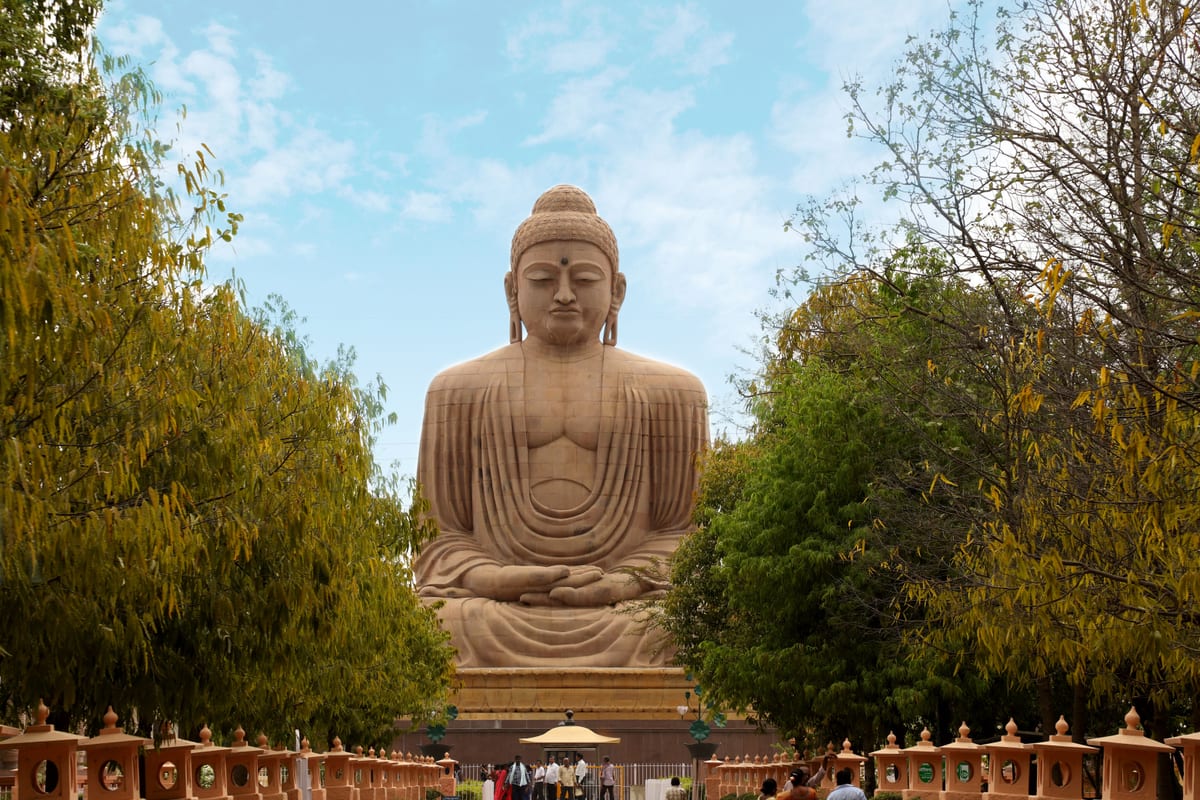
Some destinations reward you with photographs. Others reach into you and rearrange something fundamental. Bodh Gaya, tucked into Bihar's Gaya district, is emphatically the latter. Around the fifth century BCE, a prince from the Himalayan foothills sat beneath a fig tree, resolved not to rise until he understood the nature of human suffering, and did not rise, we are told, until he had. That moment transformed Siddhartha Gautama into the Buddha, and it transformed this corner of India into the most sacred site in the Buddhist world.
The Weight of History Beneath a Living Tree
What strikes every first-time visitor is not the grandeur of the Mahabodhi Temple, though it is formidable, but that the Bodhi Tree still grows. Botanists and Buddhist tradition agree the tree standing today in the temple complex is a direct descendant, through careful propagation across centuries, of the original Ficus religiosa under which the Buddha sat. You can sit beneath it yourself, as pilgrims from Thailand, Korea, Tibet, and Tamil Nadu do every day, and feel the particular quality of silence that accumulates in a place that has been prayed in for over two thousand years without interruption. India's heritage is often described as ancient, but Bodh Gaya insists on a more precise word: continuous.
The Incredible India page for Bodh Gaya rightly positions the site as one of the four holiest pilgrimage sites for Buddhists worldwide, alongside Lumbini (birthplace), Sarnath (first sermon), and Kushinagar (passing). Among these four, Bodh Gaya occupies a singular place. This is where the religion itself was born, where the central event that gave Buddhism its entire architecture of meaning actually happened. Standing here, even the non-religious traveller enters something larger than tourism.
The Mahabodhi Temple: A UNESCO World Heritage of Living Faith
The Mahabodhi Temple Complex was inscribed as a UNESCO World Heritage Site in 2002, recognition that was millennia overdue. The main temple, soaring roughly 55 metres into the Bihar sky in a tapering pyramidal form, was constructed in the fifth or sixth century CE on foundations that Emperor Ashoka himself laid in the third century BCE. Walk around its sandstone circumference and you pass carved reliefs, votive stupas placed by devotees across centuries, and the Animesh Lochana Chaitya, the spot where, according to tradition, the Buddha stood and gazed at the Bodhi Tree in gratitude during the first week after his enlightenment. Every stone here tells part of a very long story, and the story is still being written. Monks in saffron, crimson, and ochre robes circumambulate the temple at dawn while mist clings to the Niranjana River nearby. The smell of incense, the low drone of chanting, and Tibetan monastery prayer horns drifting across the complex in the early morning are not performances staged for tourists. They are the living practice of a tradition that never stopped.
A World That Came to Bow
Perhaps the most quietly astonishing thing about Bodh Gaya is its internationalism. Within a radius of a few kilometres from the Mahabodhi Temple, you will find the Thai Monastery, the Japanese Temple, the Bhutanese Monastery, the Chinese Temple, the Vietnamese Monastery, the Sri Lankan Temple, and the Tibetan Monastery, among others. Each one is an architectural embassy of its home culture, built on Indian soil as an act of reverence. Nowhere else in India, perhaps nowhere else in the world, do so many nations gather voluntarily around a single spot, not for trade or treaty, but for gratitude. India gave the world the Buddha. The world keeps coming back to say thank you.
Beyond the Temple: Nearby Attractions
The town of Gaya, just 13 kilometres away, is itself a major Hindu pilgrimage centre, famous for the Vishnupad Temple on the banks of the Falgu River. The combination of Bodh Gaya and Gaya in a single itinerary shows Indian pluralism in practice, Buddhist and Hindu sacred geographies as neighbours, each enriching the other's story. The Dungeshwari Cave Temples, about 12 kilometres from Bodh Gaya, mark the spot where the ascetic Siddhartha practised severe austerities before he renounced extreme self-mortification and found the Middle Way. The Sujata Stupa, across the Niranjana River, commemorates the village woman who offered the future Buddha a bowl of kheer, the act of nourishment that allowed him to regain his strength for the final push toward enlightenment. These sites together create an itinerary that is essentially biographical, you are walking through a man's transformation, landscape by landscape.
When to Visit and How to Get There
The best time to visit Bodh Gaya is between October and March, when Bihar's brutal summers have passed and the air is cool enough to walk comfortably between sites. The winter months, particularly around the Mahabodhi Mahotsav festival in December, draw international Buddhist delegations and create an atmosphere of extraordinary warmth and colour. The Dalai Lama frequently conducts teachings at Bodh Gaya during January, drawing tens of thousands of Tibetan Buddhists and practitioners from around the world, a sight that warrants a visit.
Gaya Airport connects the region to major Indian cities including Delhi, Kolkata, and Mumbai. Gaya Junction railway station links to the national rail network. From Gaya, Bodh Gaya is a short drive of roughly 13 kilometres, easily covered by auto-rickshaw or taxi. Patna, Bihar's capital, is approximately 110 kilometres away and serves as a regional hub with broader flight connectivity. Accommodation in Bodh Gaya ranges from basic guesthouses to comfortable hotels, and several of the international monasteries offer lodging to pilgrims of their respective traditions at modest rates.
Why Bodh Gaya Belongs in Every Indian's Story
In an age of rapid travel and curated experiences, it is tempting to treat Bodh Gaya as simply a tick on a heritage checklist. That would be a mistake. What this small town in Bihar holds is the moment India changed the trajectory of human civilisation, not through conquest or commerce, but through an idea. The idea that suffering has a cause, that the cause can be understood, and that understanding it is the beginning of freedom. That idea, born beneath a tree on the banks of the Niranjana, eventually shaped the ethics of rulers across Asia, inspired the architecture of a dozen cultures, and continues to offer consolation to hundreds of millions of people today.
India's heritage is often spoken of in superlatives, the oldest, the grandest, the most diverse. Bodh Gaya earns its superlative differently. It is simply the most consequential. To visit it is to stand at the precise origin point of one of humanity's most enduring conversations with itself, and to discover that the conversation is still going on.