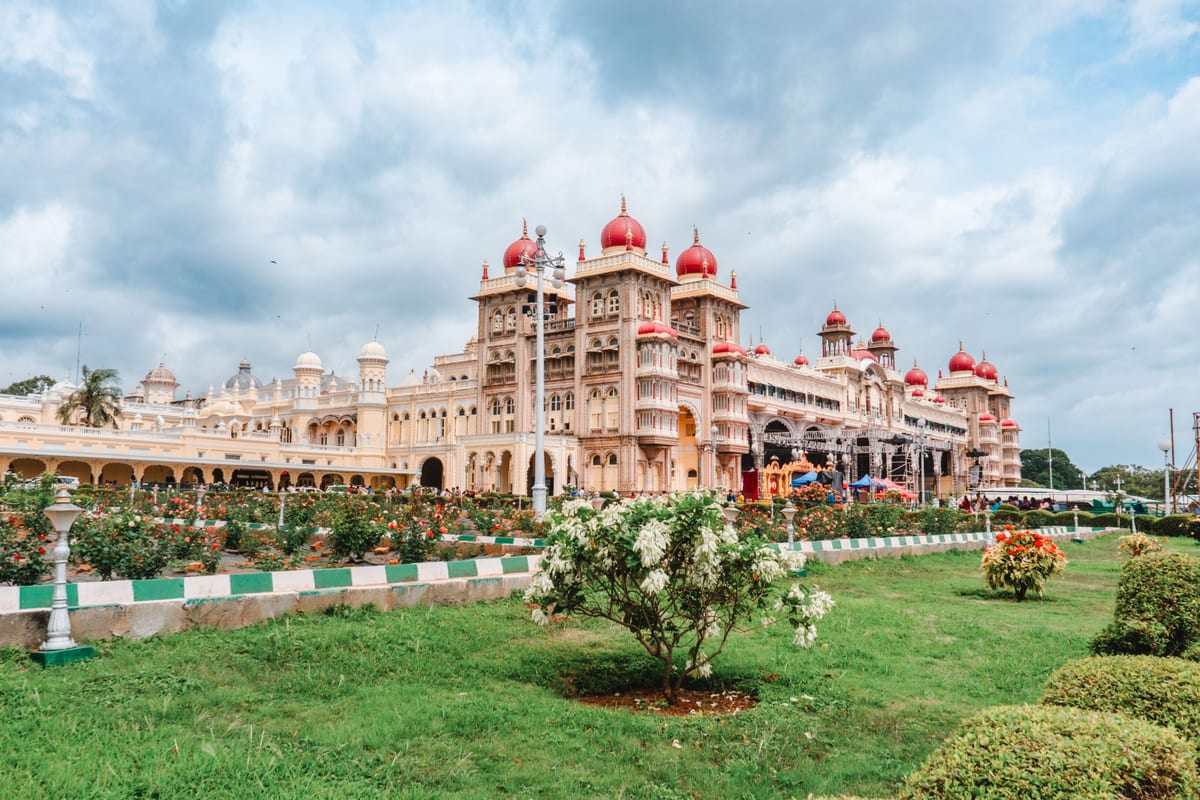
There is a moment, usually at dusk on a Sunday evening, when Mysore Palace exhales. Ten thousand light bulbs flicker on across its sandstone façade, domes, and turrets, and the building transforms from architecture into something closer to myth. Visitors standing in the vast courtyard fall quiet. Cameras rise instinctively. And for a few seconds, the twenty-first century loosens its grip. This is Mysore Palace, and this is what living heritage looks like.
A Palace With Deep Roots
The story of Mysore Palace is, in many ways, the story of South India's civilisational confidence. The site has hosted royal structures since the fourteenth century, when the Wadiyar dynasty first established its court here under the watchful eye of the Chamundeshwari goddess on the hill above the city. The current structure, an Indo-Saracenic masterpiece, was completed in 1912, designed by the British architect Henry Irwin after a fire destroyed its wooden predecessor. Yet its soul is thoroughly Indian: every arch, every painted ceiling, every inlaid floor speaks in the grammar of Dravidian and Hindu tradition, not in the vocabulary of colonial imposition.
The Wadiyars were not merely rulers; they were custodians of culture. Under their patronage, Mysore became a centre of Carnatic classical music, the distinctive Mysore style of painting flourished, and the city gave the world a refined school of Ashtanga yoga. The palace was never just a seat of power, it was a centre of civilisational production, and that legacy saturates every corridor you walk through today.
What You Will See, Feel, and Carry Home
Stepping through the palace gates, the first thing that strikes you is scale, but it is a humane scale, ornate rather than overwhelming. The Kalyana Mantapa, or marriage hall, stops visitors in their tracks with its cast-iron pillars from Glasgow and its stained-glass ceiling that scatters jewelled light across the floor in geometric patterns. A room that holds two worlds, industrial-age craftsmanship and ancient ceremonial purpose, and holds them effortlessly.
The Durbar Hall, where the Wadiyar kings once held public audiences, is a gallery of royal portraiture and gleaming gold. The ivory and sandalwood doors of the Ganesh Devalaya within the palace complex remind you that artisanal excellence here was not decorative excess but devotional precision. Mysore's master craftsmen put the same intention into a palace door as a temple sculptor put into a deity's expression. It was all an offering.
Do not rush the palace's exterior either. Walk its perimeter and notice how the architecture shifts registers, the central dome clearly Mughal-influenced, the turrets borrowing from Rajput tradition, the colonnades echoing South Indian temple corridors. This synthesis is not accidental. It is a portrait of how India has always worked, absorbing influences without losing its own centre of gravity.
Dasara: When the Palace Becomes a Living Festival
If you can time your visit for the ten days of Dasara, typically in October, you will witness something that defies easy description. Mysore's Dasara celebrations, rooted in the victory of the goddess Chamundeshwari over the demon Mahishasura, are among the grandest in India. The palace becomes the epicentre: lit magnificently each evening, hosting cultural programmes, and culminating in the iconic Jamboo Savari procession, where a gilded howdah bearing the goddess is carried through the city on a decorated elephant. This tradition has been observed for nearly four centuries by the Wadiyar dynasty and is embraced by the state and its people to this day. It is perhaps the most powerful illustration of what civilisational living heritage means.
For more information on visiting, including current details on timings and festivals, the official Mysore Palace listing on Incredible India is your most reliable starting point.
Best Time to Visit
Mysore is welcoming year-round, but the ideal window runs from October to February, when Karnataka's climate is cool, dry, and clear. October is exceptional if Dasara falls within your dates, book accommodation early, as the city fills quickly. The summer months (April to June) can be warm but are manageable if you visit the palace in the early morning hours. The monsoon (July to September) brings lush greenery to the surrounding countryside and fewer crowds at the palace, which has its own quiet appeal.
Getting There and Getting Around
Mysore is exceptionally well connected. From Bengaluru, the city lies roughly 150 kilometres away, a smooth three-hour drive on the Bengaluru-Mysuru Expressway, or an equally comfortable journey by train or KSRTC express bus. The nearest major airport is Kempegowda International Airport in Bengaluru. Within Mysore itself, auto-rickshaws, app-based cabs, and city buses all service the palace area conveniently.
Beyond the Palace: Mysore's Wider World
Mysore rewards those who linger. The Chamundeshwari Temple atop Chamundi Hill, with its commanding views over the city and the famous Nandi bull statue en route, is a spiritual counterpart to the palace's royal grandeur. Brindavan Gardens, with its musical fountains and geometrically precise Mughal-style layout, offers an evening of serenity. St. Philomena's Church, the Mysore Zoo, one of India's oldest and finest, and the bustling Devaraja Market, fragrant with jasmine, spices, and the city's famous sandalwood products, each add texture to a stay here.
Why This Place Matters
India has no shortage of palaces. But Mysore Palace occupies a singular position because it is genuinely loved, not preserved at a distance, but embraced, celebrated, illuminated. The families who picnic in its grounds on weekends, the schoolchildren who sketch its domes in notebooks, the musicians who perform within its walls during Dasara, they are not tourists of their own heritage. They are its inheritors, and they know it. In that knowledge lies everything India's civilisational story has always been about: not nostalgia, but continuity. Not a museum piece behind glass, but a living, breathing, lit-up declaration that the past is not past at all.