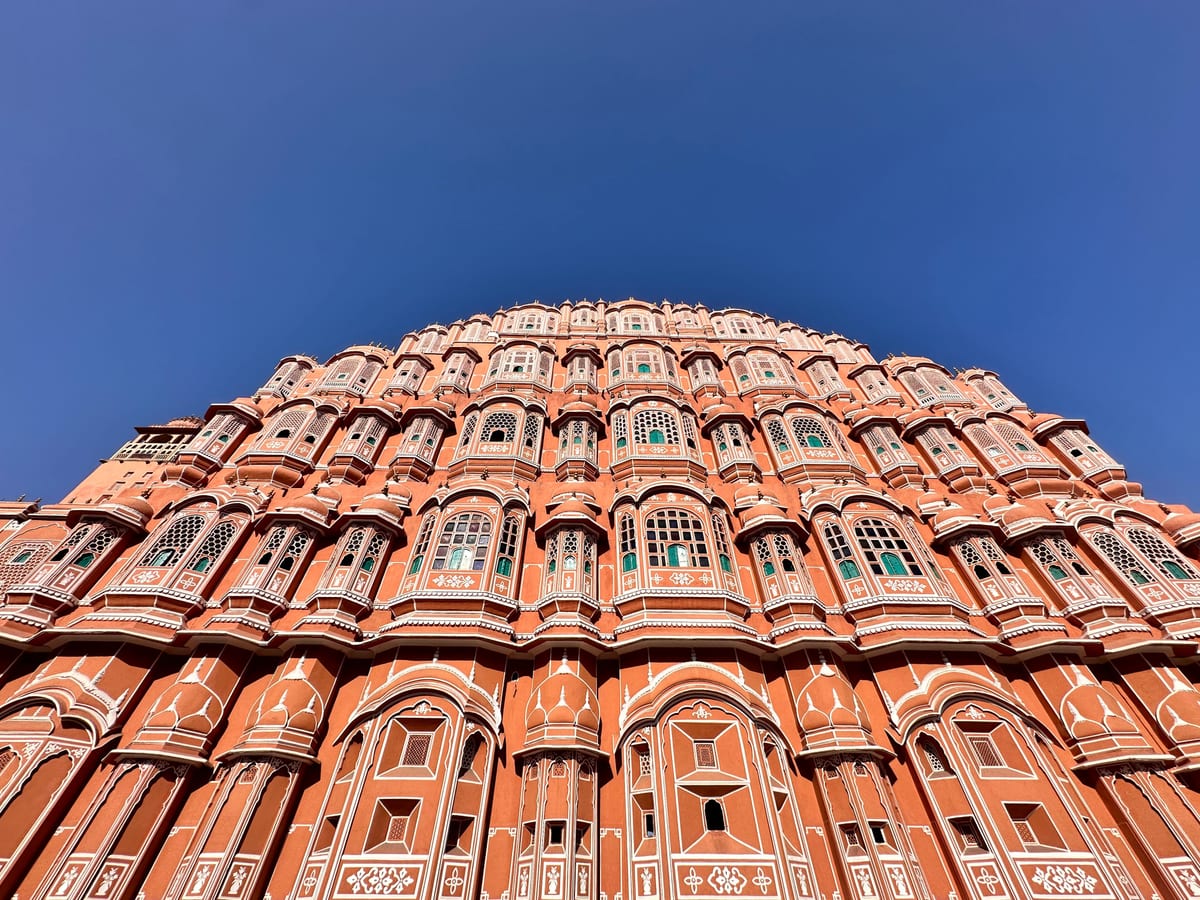
There is a moment, usually early morning when the light turns the city of Jaipur the colour of turmeric and rose, when you first see Hawa Mahal from the street below and something in you simply stops. Not from exhaustion. From awe. The Palace of Winds, Hawa Mahal, does not announce itself gently. It erupts from the Johari Bazaar streetscape like a coral reef rising from a shallow sea: five storeys, 953 latticed windows, and a silhouette so immediately recognisable that it has become shorthand for Rajasthan itself.
A Palace Built for the Wind, and for Women
Hawa Mahal was commissioned in 1799 by Maharaja Sawai Pratap Singh of Jaipur, a poet-king who dedicated the structure to Lord Krishna. The architecture, designed by Lal Chand Ustad, takes the form of Krishna's crown, a deliberate act of devotion rendered in red and pink sandstone. But the building's genius is as much social as it is spiritual. The palace was built so that the women of the royal household, observing the strictures of purdah, could watch the processions, festivals, and daily theatre of the city below without themselves being seen. Each of those 953 windows is a jharokha, a screened lattice through which the desert breeze flows freely, cooling the interior naturally even in the fierce Rajasthani summer. The palace was a sophisticated climate-control system and a social solution wrapped in one extraordinary shell.
This is the Indian civilisational instinct at its most eloquent: practical necessity elevated into beauty. The Mughal influence is visible in the cusped arches and the delicacy of the stonework; the Rajput spirit asserts itself in the scale, the daring verticality, and the almost defiant ornamentation. Hawa Mahal is a conversation between two great traditions, and it speaks in a language that still resonates across the centuries.
What You Experience Inside
Most visitors, gazing up from the street, do not realise there is an interior to explore. Step through the entrance on the rear side, the facade, famously, has no grand gate facing the bazaar, and you enter a courtyard that unfolds into something far more intimate than the dramatic exterior promises. The palace is only one room deep at most points; it is almost entirely a facade, a stage set for that extraordinary public face. The interior chambers are connected by ramps rather than staircases, a detail that speaks of graceful, veiled movement rather than brisk utility. They open out onto the latticed windows themselves.
Standing at a jharokha on the upper floors, looking down at the living chaos of Johari Bazaar, the spice sellers and jewellers, the autorickshaws and the tourists, you understand exactly what those royal women experienced. The city is yours, through stone and shadow. The breeze, even on a warm day, finds you. It is one of the most unexpectedly moving experiences any Indian monument can offer: empathy across time, mediated by architecture.
The palace also houses a small museum on the premises, where artefacts, miniature paintings, and ceremonial objects illuminate the world of the Kachhwaha Rajputs who built and inhabited this city. For those wishing to deepen their understanding of the monument's context and significance, the Incredible India official page on Hawa Mahal offers a well-curated introduction to its history and visiting information.
Living Heritage, Not a Museum Piece
What separates Hawa Mahal from many of India's great monuments is that it has never been frozen. The bazaar around it has always been alive, noisy, fragrant, commercial, human. The monument does not exist behind a glass case; it exists in relationship with the city that grew up around it. Jaipur's famous pink colour, applied to the old city's buildings to welcome the Prince of Wales in 1876, brought the palace into even sharper relief against its surroundings. Today, when the old city is lit at dusk and the sandstone glows amber and saffron, Hawa Mahal reads as the city's heartbeat, not its tombstone.
This is what India's civilisational heritage means at its finest: not preservation for preservation's sake, but continuity. The same street festivals that Maharaja Sawai Pratap Singh's queens watched through those jharokhas are still celebrated below. The craft traditions, jewellery, textiles, blue pottery, that animated this bazaar three centuries ago are still practiced and sold within walking distance. Hawa Mahal is not a monument you visit in the past tense. You visit it in the present continuous.
Best Time to Visit
The ideal window for visiting Hawa Mahal and Jaipur broadly is between October and March, when the Rajasthani climate is at its most hospitable. Days are warm and clear, evenings turn deliciously cool, and the light on the sandstone is at its photographic best. The summer months from April to June bring intense heat that, while historically mitigated by those famous winds funnelled through the jharokhas, can be taxing for visitors. The monsoon season (July to September) brings occasional dramatic skies and fewer crowds, which has its own appeal for the adventurous traveller.
How to Reach Hawa Mahal
Jaipur is exceptionally well connected. By air, Jaipur International Airport receives direct flights from Delhi, Mumbai, Bengaluru, and several other major Indian cities, as well as international connections. By rail, Jaipur Junction is a major hub on the Indian Railways network, with services including the celebrated Pink City Express from Delhi and the Palace on Wheels luxury train. By road, Jaipur sits on National Highway 48, approximately 270 kilometres from Delhi, a journey of around four to five hours by car or comfortable intercity bus. Once in Jaipur, Hawa Mahal is located on Siredeori Bazaar in the heart of the old city, easily reachable by autorickshaw, cycle rickshaw, or app-based cab.
Nearby Attractions
Hawa Mahal sits within easy reach of several of Jaipur's most significant sites. The City Palace, the sprawling royal complex that remains partly the residence of the Jaipur royal family, is a ten-minute walk away and contains superb museums of arms, textiles, and royal artefacts. Jantar Mantar, the extraordinary astronomical observatory built by Maharaja Sawai Jai Singh II in the eighteenth century, is a UNESCO World Heritage Site and only minutes from the palace. The Amber Fort, perched magnificently on a ridge above the city, is roughly eleven kilometres away and represents the older Rajput capital before Jaipur was founded. Johari Bazaar itself, running beneath Hawa Mahal's gaze, is one of India's great jewellery markets, a place where Rajasthani craftsmanship in gold, silver, and gemstones has been practised for generations.
Why Hawa Mahal Matters
India's heritage story is not a story of ruins. It is a story of ideas that refused to die, of beauty that kept finding new audiences, of buildings that kept generating new meanings. Hawa Mahal is five storeys of that story, told in sandstone and wind. The women who watched through those windows were not passive; they were present, witnessing, part of the life of their city even when the city could not officially see them. The craftsmen who carved those 953 windows were artists solving an engineering problem and a social problem simultaneously, with no apparent sense that these were separate concerns. And visitors, standing beneath it and feeling that first shock of recognition, find that some things built for one age manage to speak directly to every age that follows.
Come for the photograph. Stay for the understanding. Leave a little changed.