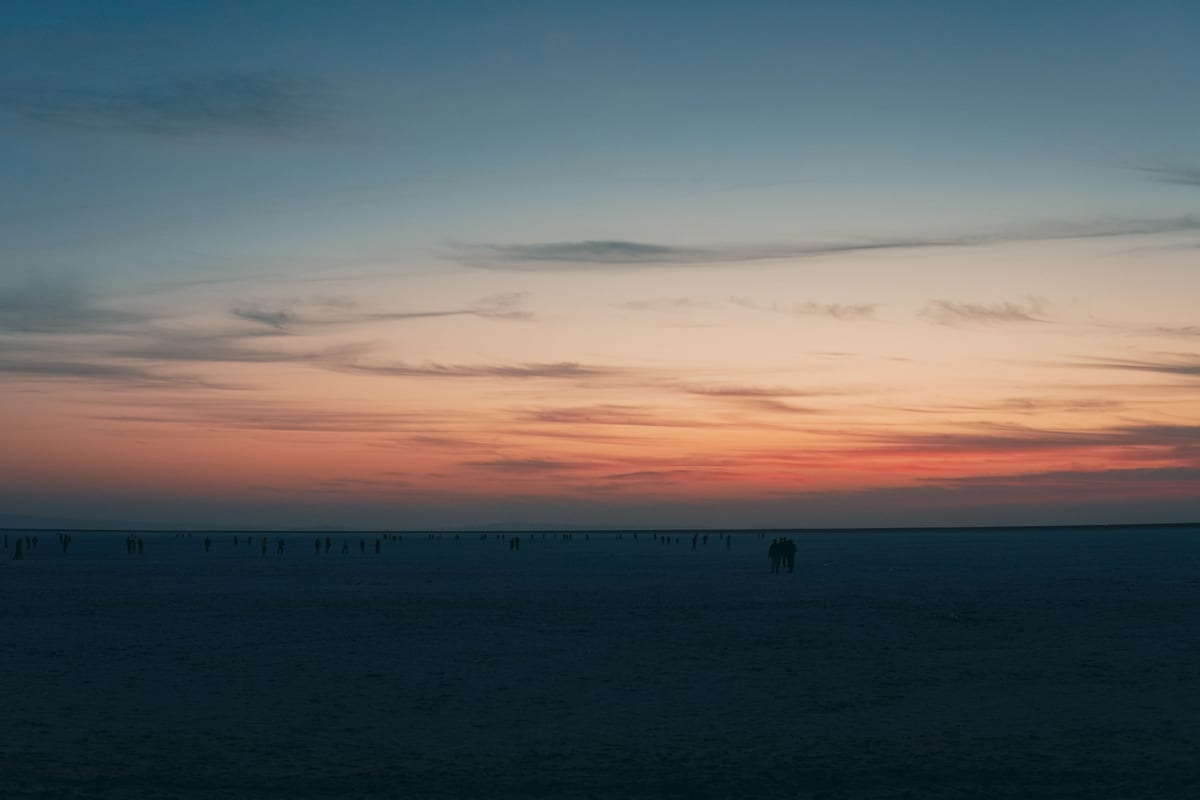
There is a moment, usually just after sunset, when you stand at the edge of the Rann of Kutch and the world simply stops making sense in the most beautiful way possible. The salt flat ahead of you is so white, so impossibly wide, that the horizon dissolves. The sky presses down in violet and gold. And somewhere behind you, a dholak begins to beat. That is when you understand that you have not merely arrived at a destination. You have arrived at something far older, a living edge of Indian civilisation.
A Landscape Born of Time
The Rann of Kutch, spread across the northern reaches of the Kutch district in Gujarat, is the world's largest salt desert, covering roughly 30,000 square kilometres across its Great Rann and Little Rann. For much of the year it is a cracked white expanse, baked under the Gujarati sun. But its origins are as dramatic as its appearance. Geologists believe the region was once an arm of the Arabian Sea, slowly sealed off over millennia by tectonic shifts and sedimentation. The same upheaval that isolated the sea created the conditions for one of South Asia's earliest and most sophisticated urban cultures, the Indus Valley Civilisation. Dholavira, now a UNESCO World Heritage Site, sits within the Kutch district and is evidence that this seemingly inhospitable terrain nurtured extraordinary human ingenuity more than 4,500 years ago.
The land has memory. And the people who live upon it have never let that memory fade.
India's Heritage as a Living Practice
What distinguishes the Rann of Kutch from other great natural landscapes is that the wilderness is inseparable from the culture. The communities of Kutch, the Rabari herders, the Mutwa embroiderers, the Meghwal leatherworkers, the Ahir craftspeople, carry traditions of extraordinary refinement. Kutchi embroidery, with its precise geometric patterns and cascading mirror-work, is not a craft revived for tourism. It is a language, stitched across generations of women who learned it as children and taught it as mothers. The same applies to the region's distinctive rogan art, a form of painting done with castor oil-based paint that is pressed onto fabric using a metal rod, a technique so rare it rests almost entirely with a single family in the village of Nirona.
India's heritage is not behind glass. It is in use. It is worn, sung, cooked, danced, and bartered. The Rann of Kutch is not a museum exhibit of what India once was. It is evidence of what India continues to be.
The Rann Utsav, When the Desert Celebrates
Every winter, the Gujarat Tourism department organises the Rann Utsav, a festival that transforms the white desert into an open-air theatre of Indian folk culture. Held from approximately November through February, the festival draws together musicians, dancers, artisans, and visitors from across India and the world. Tented accommodations rise from the salt flats near Dhordo village, creating a temporary city of lantern-lit canvas corridors and curated cultural performances. Folk singers from the Langa and Manganiyar traditions perform under open skies. Bhujodi weavers demonstrate the intricacies of their craft. Camel safaris carry visitors out onto the moonlit flats in the early hours, when the silence is so complete you can hear the salt crunch beneath your feet.
The full moon nights of the Rann Utsav are legendary. When the moon rises over the white expanse, the salt flat reflects the light back so completely that the landscape glows as though lit from within. It is one of those rare natural spectacles that photographs cannot adequately capture, something you have to let fall over you in person.
For further details on the destination, visiting periods, and curated experiences, the Rann of Kutch page on Incredible India, maintained by India's Ministry of Tourism, is an essential starting reference.
Beyond the Salt Flats, What Else to See
Kutch rewards those who linger. The Kutch Museum in Bhuj, one of Gujarat's oldest, holds artefacts and textile collections that contextualise everything you will see in the villages. The walled town of Mandvi, roughly 60 kilometres from Bhuj, offers a historic port, a stunning beach, and the remarkable Vijay Vilas Palace. Dholavira, a UNESCO World Heritage Site since 2021, is a half-day drive east across the Rann and deserves an unhurried visit, its water conservation systems and planned city grid change how you understand ancient India. The Wild Ass Sanctuary in the Little Rann protects the last population of the Indian wild ass and offers a quieter, more contemplative wilderness experience.
Practical Travel Information
Best season: October to February. The Rann is inaccessible during the monsoon months (June to September) when the salt flat floods with shallow water. Winter brings cool, clear days and the full cultural richness of the Rann Utsav season.
Getting there: The nearest airport and railway hub is Bhuj, which has regular flights from Mumbai, Ahmedabad, and other major cities. From Bhuj, the Rann and Dhordo village are approximately 80 kilometres by road. Bhuj is also well connected by train to Ahmedabad, which is a major rail junction. For those driving, the Ahmedabad–Bhuj highway is a scenic and comfortable route of roughly 350 kilometres.
Where to stay: The Rann Utsav tent city at Dhordo is the most atmospheric option during the festival season and is managed by Gujarat Tourism. Bhuj offers a wider range of hotel accommodation for those who prefer a town base. Book well in advance for the winter festival months, particularly around full moon dates, which are especially popular.
Why the Rann of Kutch Matters
India has hundreds of spectacular landscapes. What sets the Rann of Kutch apart is the density of meaning it carries. Here, in one district, you encounter evidence of one of humanity's earliest urban civilisations, the living craft traditions of a dozen distinct communities, an ecosystem found nowhere else on Earth, and a festival culture that refuses to treat heritage as nostalgia. The Rann asks nothing of you except attention. In return, it shows you something that is increasingly rare in our accelerating world, a place where time is long, where identity runs deep, and where the full moon still means something to the people who have always lived beneath it.
To travel to the Rann of Kutch is to remember that India is not a country that simply has a past. It is a civilisation that continues to evolve.