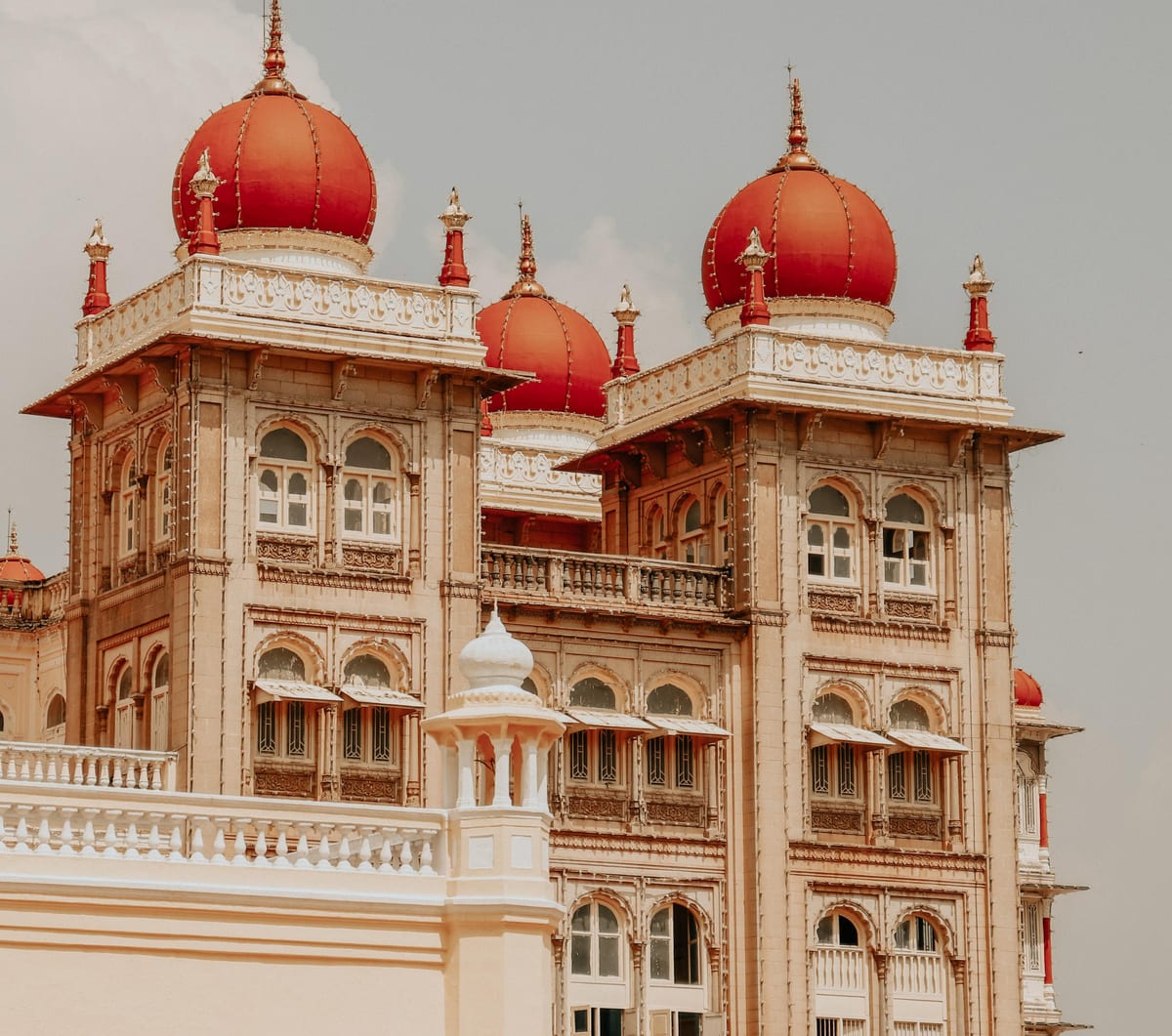
There is a moment, usually in the early evening, when the sun drops behind the Chamundi Hills and the lights of Mysore Palace blink on, all 97,000 of them, and the city holds its breath. In that instant, the palace does not look like history. It looks like a dream that India has been having for centuries and refuses to wake from.
A Palace Born from Fire and Ambition
The story of Mysore Palace is, in many ways, the story of Karnataka itself. The seat of the Wadiyar dynasty, one of India's longest-reigning royal families, the palace is at the heart of Mysore city, formally known today as Mysuru, as the official residence of the Mysore Royal Family. The current structure, an extraordinary blend of Indo-Saracenic, Dravidian, Roman, and Gothic architectural styles, was commissioned after the original wooden palace was destroyed by fire in 1897. The renowned British architect Henry Irwin designed the replacement, completed in 1912, widely regarded as one of the finest royal buildings in the Indian subcontinent.
To stand before its three-storied granite façade, topped with five domes finished in distinctive pink marble, is to feel the full confidence of a kingdom that understood itself. The Wadiyars were not merely rulers; they were custodians of a civilisation.
Inside the Palace: Opulence as a Form of Culture
Stepping through the palace gates is a sensory education. The interiors display painted ceilings by celebrated artists, stained glass imported from Glasgow, ornate ivory doors, and floors inlaid with precious and semi-precious stones. The Kalyana Mantapa, or the royal wedding pavilion, is particularly memorable: its peacock-shaped stained glass ceiling filters light into a spectacle of colour that feels less like architecture and more like scripture made visible.
The Durbar Hall, used historically for public audiences with the Maharaja, still carries the gravity of those occasions. Portraits of the Wadiyar rulers line the walls, each a chapter in a dynastic narrative stretching back to the fourteenth century. The golden howdah, the ceremonial elephant seat used during Dasara processions, is displayed here, a gilded reminder that monarchy in Mysore was inseparable from ritual, and ritual from community.
For a comprehensive guide to the palace's history, visiting hours, and heritage significance, the official Incredible India page on Mysore Palace is an invaluable starting point.
Dasara: When the Palace Becomes a Nation's Ceremony
If Mysore Palace is magnificent on an ordinary afternoon, during Dasara, the ten-day festival culminating on Vijayadashami, it becomes something else entirely. The Mysore Dasara, known as Nadahabba or the state festival of Karnataka, transforms the city into the most theatrically alive place in India. The centrepiece is the grand procession: a caparisoned elephant carries the idol of Goddess Chamundeshwari through the streets while tableaux, folk dancers, brass bands, and mounted cavalry follow in its wake.
The palace illumination during Dasara evenings draws visitors from across India and the world. This is not a recreation staged for tourists. This is a living tradition, unbroken across centuries, in which a city participates in its own mythology. When you watch that procession, you are watching India's present insisting that the past still matters.
The Civilisational Argument Mysore Makes
India's heritage debate is often framed in binary terms: preservation versus progress, museum versus lived space. Mysore Palace refuses that binary. The Wadiyar family still occupies a portion of the palace. Dasara traditions are still conducted with royal participation. The Chamundeshwari temple on the hill above the city remains an active site of daily worship. Heritage here is not cordoned off behind velvet ropes. It is a living system, architectural, spiritual, cultural, that continues to generate meaning for contemporary Kannada society.
The palace also speaks to the pluralism at the heart of South Indian kingship. The architectural vocabulary Irwin employed deliberately synthesised Hindu, Islamic, and European idioms, not as an act of colonial imposition but as an expression of a court that had long been a crossroads of ideas, traders, musicians, and scholars.
Practical Travel Guide: Planning Your Visit
Best Time to Visit: The ideal months to visit Mysore are from October to February, when the weather is cool and pleasant. If you wish to experience the Dasara celebrations, plan your visit for the period of Navaratri, which falls in September or October depending on the Hindu lunar calendar. The palace illumination on Vijayadashami evening is a once-in-a-lifetime spectacle.
How to Reach: Mysore is well-connected by road and rail from Bengaluru, approximately 150 kilometres away, roughly a three-hour drive or a comfortable train journey. The nearest major airport is Kempegowda International Airport in Bengaluru, from where cabs, buses, and trains connect regularly to Mysuru. The city also has its own smaller airport with limited connectivity.
Nearby Attractions: No visit to Mysore is complete without ascending Chamundi Hill to the Chamundeshwari Temple, one of Karnataka's most revered shrines. The Brindavan Gardens at the base of the Krishna Raja Sagara Dam, with their musical fountain shows, make for a perfect evening excursion. Art and craft enthusiasts should not miss Devaraja Market for sandalwood, silk, and agarbathi, all of which Mysore produces in abundance. The Sri Jayachamarajendra Art Gallery and the Rail Museum are also worth an afternoon each.
Why You Must Come
India has hundreds of palaces. It has forts, temples, stepwells, and mausoleums strewn across its geography like punctuation marks in a very long sentence. But Mysore Palace is not punctuation. It is an argument, a sustained, luminous argument that civilisation is not something that happens and ends, but something that a people choose, generation after generation, to continue.
When those 97,000 bulbs light up against the Karnataka sky, they illuminate a building. They also illuminate a conviction. That conviction, as much as any stone or stained glass, is what makes Mysore Palace one of the great heritage experiences on earth.