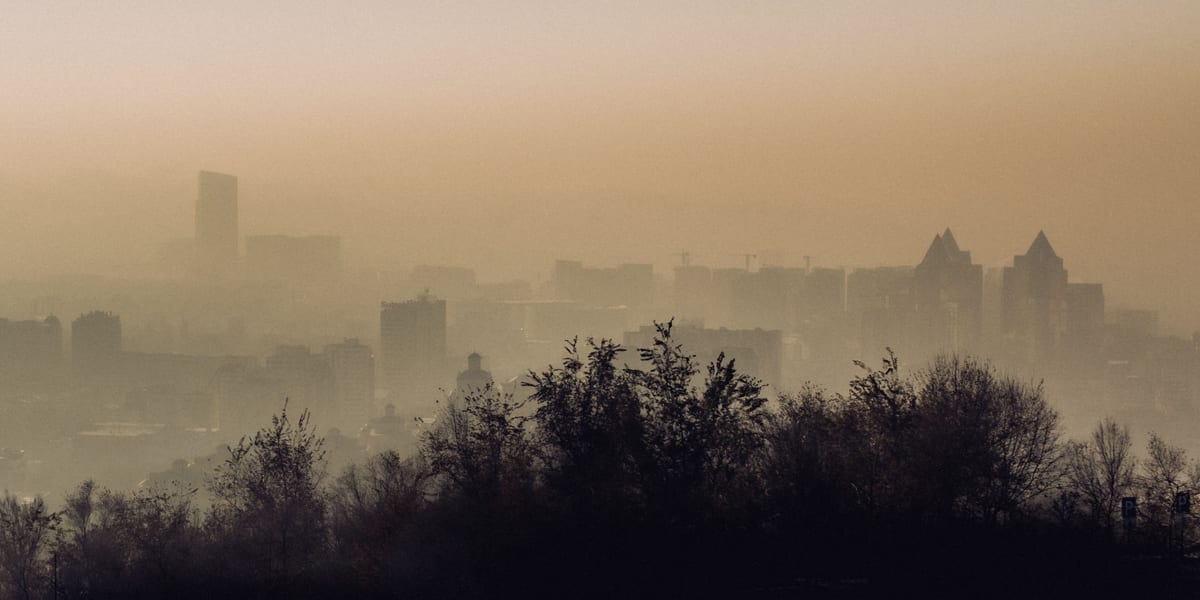
Delhi's Air Quality Index stood at 386 at 8:31 AM on Sunday, 22 November, according to live data from AQI.in. On the United States scale used for the morning update, the hazardous category begins at 301; Delhi's reading exceeded that mark by 85 points. The city ranked 14th among the world's most polluted cities and highest among eight Indian metros in the same snapshot. Smoky haze accompanied the morning pollution, with temperature at 18°C, humidity at 67 per cent, wind speed at 3.6 km/h, and an ultraviolet index of 0.5.
The pollutant composition was severe. PM2.5 concentration stood at 267 micrograms per cubic metre; PM10 measured 374 micrograms per cubic metre, a difference of 107. Carbon monoxide reached 2,105 parts per billion, nitrogen dioxide 16, sulphur dioxide six, ozone two. The slow wind is the immediate meteorological cause. At 3.6 km/h, the air barely moves, so the morning's haze does not disperse; it sits over the city until the boundary layer rises. A reading of 386 at 8:31 AM reflects an overnight accumulation that neither temperature nor breeze could undo. All pollution values are from the same morning update.
The metro comparison is revealing. Chennai was next at 240, 146 points below Delhi. Mumbai recorded 210, Pune 207, Bengaluru 205, Ahmedabad 195, Hyderabad 171, and Kolkata 109. Four of the seven other metros remained above 200. Kolkata's reading was 277 points lower than Delhi's, a gap that cannot be explained by population alone. The capital's winter geography, landlocked, ringed by construction, and downwind of agricultural burning, concentrates the same regional air into a heavier dose. Delhi's margin over the next metro was the widest in the set.
November's daily readings show how sharply the index swings. The city recorded 666 on November 9, the highest daily figure through November 21, and 547 on November 12. A three-day decline followed: 353 on November 19, 341 on November 20, and 313 on November 21. Sunday's live reading of 386 was 73 points above Saturday's daily figure. The month has spent 18 of its first 21 days above 300; the only three days below that mark fell between November 15 and 18, with the lowest at 224 on November 17. Using Berkeley Earth's method, the AQI.in tracker estimated the exposure equivalent to smoking 8.7 cigarettes daily. The relief of November 17 did not mark a structural change; it marked a change in wind direction. November's daily data come from the same tracker. Two days earlier, a separate morning snapshot on November 20 had put Delhi at 510 and ranked it eighth globally, according to LiveMint. The global ranking shifts with the weather; the move to 14th with 386 is meteorological, not structural.
A Classification Disconnect With Real Consequences
The US scale labels anything above 301 hazardous. Delhi's domestic categories, built into the National Air Quality Index, would likely place this morning's 386 into a lower urgency tier, not the top emergency band. That is not academic. The graded response plan, the mechanism that bans diesel generators, halts construction, and expands public transport, is triggered by specific thresholds. If the city's own tool declines to call a level hazardous that an imported tool would, officials can defer the highest-cost restrictions. The dispute is not about adjectives; it determines whether Monday brings road dust and concrete mixers back to life.
Health researchers have documented that readings above 300 push emergency admissions for COPD, asthma, and cardiac events. Children and the elderly absorb the worst of it. The same tracker that converted the morning into 8.7 cigarettes has, on heavier days this season, put the equivalence at 11 cigarettes. The body does not distinguish between a 24-hour average and an 8 AM spike; it receives the particulate load. A single morning at 386, repeated across weeks, is sufficient to fill outpatient departments. The statistical category, whether very poor, hazardous, or severe, matters less than the concentration in the alveoli.
The Response Is Regional, Not Municipal
Delhi cannot clean its air alone. Stubble burning in Punjab and Haryana, construction dust across the National Capital Region, vehicular exhaust, and industrial emissions all feed the same airshed. The Commission for Air Quality Management has the authority to impose stubble-burning penalties and coordinate across state lines, but the recurring November crisis suggests enforcement is episodic rather than year-round. Paddy-straw bio-decomposer deployment, expanded electric bus fleets, and real-time industrial emission monitors are all on the table; what is missing is the governance capacity to shift from emergency shutdowns to continuous source control. The city's 386 reading is less a weather event than an institutional test.
The economic burden rarely reaches the headlines. Delhi hosts the seat of national government, corporate headquarters, embassies, and a logistics network that moves goods across north India. Poor air raises healthcare costs, suppresses labour productivity, forces school closures, and makes the capital less attractive for talent recruitment. Foreign investors and diplomats notice the haze. A city that cannot keep its air breathable will eventually pay a premium in competition for human capital and investment.
The National Capital Region's airshed knows no municipal boundaries. A penalty imposed on a Punjab farm or a Haryana factory affects the air that a central Delhi office worker breathes the next morning; the institutional challenge is to price that externality without throttling the region's economic base. Bio-decomposer programmes that give farmers a cheaper alternative to burning paddy straw are a start, but they require procurement scale and extension machinery that state governments have yet to deliver. Until the Commission for Air Quality Management has the resources and mandate to act as a true regional regulator, Delhi's winter will remain a recurring negotiation between health and harvest.
The Next Morning Will Ask the Same Question
Sunday's 386 is not a new threshold; the city has already recorded 666 this month and will likely record worse before the season ends. What the number tests is not the accuracy of AQI.in or the diligence of the meteorological department. It tests whether the institutions that compile these readings can be made to act on them with the urgency the US scale displays. Until Delhi's own categories and its graded response plan are calibrated to health evidence rather than administrative convenience, the morning's reading is just the opening move in another winter argument. The wind will change again; the question is whether the policy response changes first.