
The 1996 Ganga Water Treaty, a thirty-year arrangement dividing the Ganga's dry-season flow at Farakka between India and Bangladesh, is approaching expiry. Bangladesh has written to New Delhi seeking formal negotiations on a guarantee clause, a demand that would commit India to a minimum volume of water even in deficient years. India has concerns about the proposal, according to NDTV.
The letter arrives as the current treaty enters its final stretch. The pact allocates Farakka waters on a formula that adjusts with availability, not on a fixed promise. Dhaka's request for a guarantee would change that formula. It would turn a share of whatever the river carries into an entitlement that must be delivered regardless of the monsoon.
What Farakka means for West Bengal
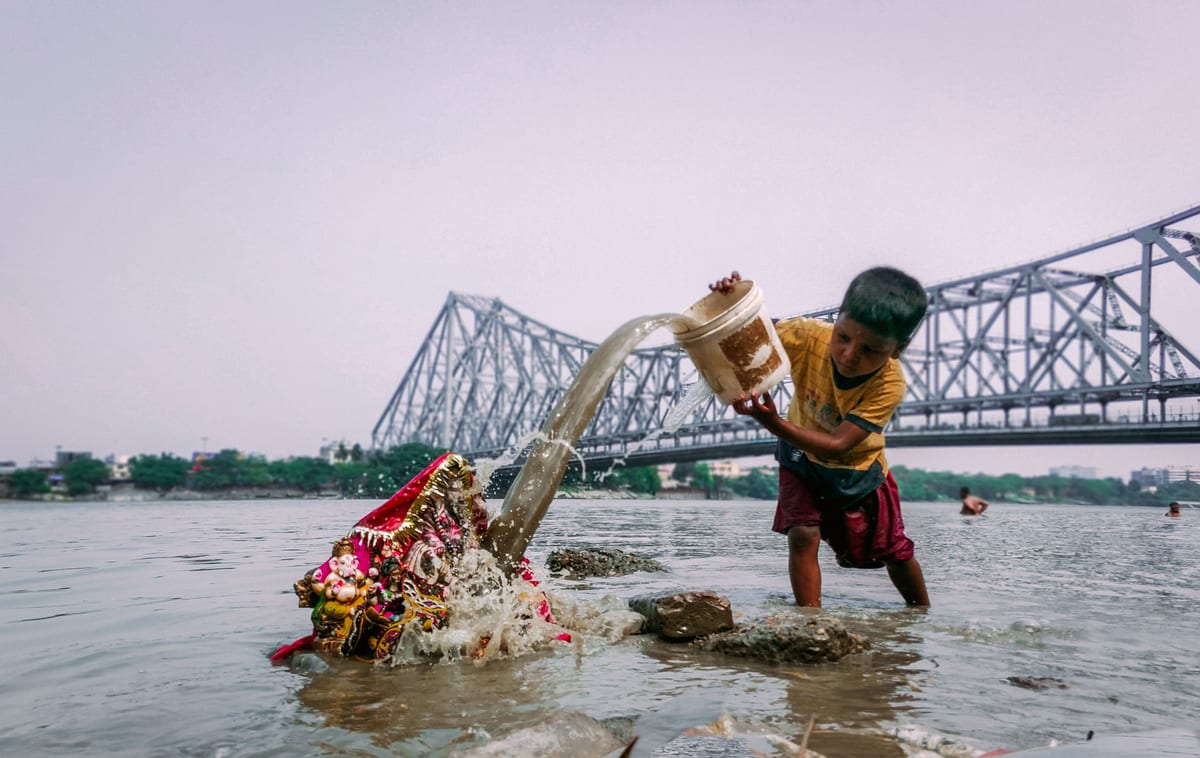
For West Bengal, Farakka is an irrigation and navigation lifeline. The barrage releases water down the Bhagirathi-Hooghly to keep the Kolkata port channel open and to feed the state's dry-season paddy crop. Those are the same releases Bangladesh wants protected with a legal floor. In a shortfall year, the upper Ganga cannot supply both the port's freshwater push and a guaranteed downstream minimum. The Indian side has not issued a formal statement on Dhaka's letter, NDTV notes, but the concern over a guarantee clause is real.
West Bengal's irrigation engineers track the Farakka release schedule because the Hooghly's freshwater flow determines how far saltwater intrudes upstream from the sea. Less freshwater means higher salinity in the upper reaches, damaging agriculture and complicating drinking water intake for riverside communities. A binding guarantee to Bangladesh could lock in releases that the state would otherwise adjust during a weak monsoon. No Indian negotiator can ignore that constituency.
The legal architecture India has preferred
India's transboundary water instruments have avoided absolute volumetric guarantees. They allocate shares, establish joint technical bodies, and leave details to periodic review. The Ganga treaty's existing formula already gives Bangladesh a degree of predictability in the lean months. A guarantee would be a different category: a one-way obligation on the upper riparian that does not depend on hydrology. New Delhi's hesitation is a defence of a principle that has governed India's river diplomacy for decades.
Dhaka frames the gesture as protection for its dry-season agriculture and the Sundarbans. India reads it as a pre-condition that would make future negotiations on other transboundary rivers more difficult. The language matters because a precedent set on the Ganga would travel.
The neighbourhood file beyond water
Water is one layer of the India-Bangladesh relationship. The two countries have built connectivity corridors, port-use arrangements for India's northeast, energy cooperation, and a security partnership that has kept the eastern frontier stable. A lapse or breakdown in water cooperation would not remain confined to the river. It would seep into trade logistics, transit negotiations, and long-term border infrastructure projects. India's approach has been to insulate the technical water conversation from the larger political relationship. That separation has held for three decades; its renewal is the current question.
Why Dhaka is pressing now
Bangladesh's internal water stress has risen alongside the monsoon's growing variability. Upstream abstractions, sediment load, and dry-season salinity in the delta all press on Dhaka's ability to meet its own agricultural and environmental commitments. A guarantee clause is, from that vantage, a hedge against a future in which the Ganga's upper catchment becomes even more contested. India need not accept the hedge, but it should understand the pressure that produced it. Treating the demand as mere brinkmanship would miss the deeper instability in the basin's hydrology.
Technical cooperation as an alternative to guarantees
India can respond to Dhaka without accepting a guarantee clause. A joint technical committee can share real-time data from the upper Ganga and Yamuna, model low-flow scenarios, and agree on a protocol that activates when flows fall below defined thresholds. That protocol can include automatic consultation, dispute resolution, and a review mechanism. It would give Bangladesh a procedural safeguard without converting a negotiated share into a fixed legal obligation. New Delhi has held this line in private; articulating it in public would signal confidence rather than defensiveness.
The Manohar Parrikar Institute for Defence Studies and Analyses has long argued that water-sharing questions should be ring-fenced so they do not contaminate the broader security and connectivity agenda. That remains the correct frame. India's diplomacy in Bangladesh works best when it is technical, depoliticised, and anchored in shared data.
The renewal is India's to shape
The Ganga treaty's renewal offers New Delhi the chance to reset the water relationship on its own terms. A quiet, technical negotiation that preserves the 1996 framework while adding low-flow contingency planning would serve West Bengal, Kolkata port, and the wider India-Bangladesh partnership. Dhaka's demand for a guarantee may be maximalist, but it opens a door. The response should not be a flat refusal; it should be a counter-offer built on data, joint monitoring, and contingency triggers.
India's eastern neighbourhood is watching how New Delhi manages an upper-riparian question without creating a precedent that narrows its future flexibility. The river keeps flowing while governments decide whether to promise more than it can deliver.