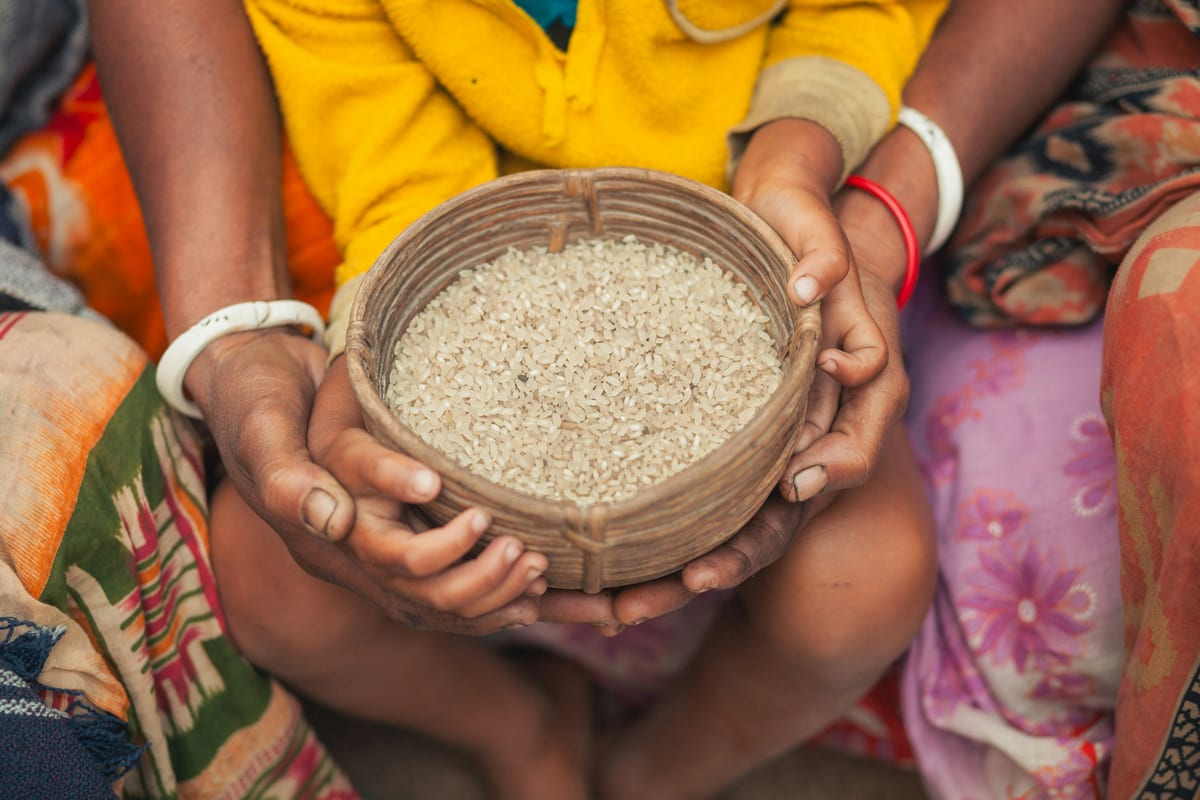
For the third consecutive year, global hunger fell in 2025. The UN News report calls it proof that progress is possible. It is also proof that possible and sufficient are very different words. The 2030 deadline for the Sustainable Development Goals is not a distant horizon — it is four years away, and the trajectory is nowhere near the slope required to reach it.
The aggregate number, welcome as it is, masks the divergences that actually matter. Some regions are accelerating. Others are barely moving. The argument about what hunger means — who is measuring it, how, and against whose baseline — has grown louder because the stakes are no longer merely academic. They are geopolitical.
The Progress That Isn't Enough
Three consecutive years of decline represents genuine momentum. Humanitarian systems, early-warning networks, and national food distribution programmes have demonstrably improved their reach in the post-pandemic period. The UN's coordination architecture — the World Food Programme's logistics, the FAO's data systems, the integration of climate-risk modelling into food planning — reflects decades of institutional learning that did not exist when the first Millennium Development Goals were written.
But progress is uneven in ways the headline figure conceals. Sub-Saharan Africa continues to account for a disproportionate share of the world's acutely hungry. Conflict zones in the Sahel and the Horn of Africa compress what should be a gradual trend line into periodic catastrophes. Climate shocks — intensifying in frequency and geographic spread — disrupt harvests in exactly the countries least equipped to absorb the loss. The aggregate decline reflects gains in Asia and parts of Latin America large enough to move the global number even as pockets of acute crisis deepen elsewhere.
That asymmetry is important. The world is not uniformly solving hunger; it is solving it in some places while managing it — or failing to manage it — in others. The SDG 2030 target requires eliminating hunger everywhere, not averaging it down globally.
India's Complicated Position in the Frame
No country occupies a more contested position in this global accounting than India. In absolute terms, India is home to the largest undernourished population on earth. That is not a ranking anyone disputes. What India disputes — and has disputed with increasing institutional force since 2022 — is whether the dominant indices measuring that population do so accurately.
The Global Hunger Index, published annually by Welthungerhilfe, has repeatedly placed India below regional peers including Bangladesh and Nepal. India's Ministry of Women and Child Development and the Ministry of External Affairs have both issued formal rebuttals arguing that the GHI's survey instruments and sample sizes systematically undercount the reach of India's food welfare architecture. That architecture distributes free grain to roughly 800 million beneficiaries — a transfer programme of a scale that has no real parallel anywhere in the world.
The government's methodological objection is not entirely without merit. Survey-based hunger estimates in large, diverse countries carry significant margin-of-error questions. India's rural geography, the multiplicity of state-level delivery systems, and the sheer administrative complexity of tracking outcomes across a population of 1.4 billion all create genuine measurement challenges that a standardised global index may not fully resolve.
But here is the fault line that the UN report, however indirectly, exposes: caloric transfer and nutritional adequacy are not the same thing. ICRIER agricultural economist Ashok Gulati has argued that India's public distribution system reaches scale unmatched globally but addresses caloric hunger more than nutritional hunger. Centre for Policy Research scholar Yamini Aiyar has noted that child stunting and wasting rates — which track micronutrient deficiency and chronic undernutrition, not just caloric insufficiency — remain elevated in ways that a grain-distribution metric does not capture. The two observations are not contradictory. They describe the same programme from different angles: extraordinary in reach, incomplete in outcome.
Contesting the Measurement, or Changing the Reality?
India's posture toward hunger indices has been primarily one of contestation. The government argues, with some force, that Western-designed indices applied to non-Western realities produce distorted results. S. Jaishankar has articulated that India's development story must be narrated by Indians rather than filtered through frameworks designed elsewhere — a genuine concern about who sets the standards by which development is judged.
That concern is legitimate. It is also insufficient on its own.
Observer Research Foundation analysts have pointed out that India's methodological objections, while partly valid, risk becoming a substitute for engagement rather than a prompt for it. The alternative to contesting a flawed index is not simply to reject the index — it is to build better data, engage the FAO and WFP's collection processes, and ensure that India's welfare programme outcomes are accurately reflected in the systems that produce global hunger assessments. India has the institutional heft to do this. The Voice of the Global South Summit, which India hosted in August 2024 and which drew 173 dignitaries from 123 countries, provides exactly the multilateral infrastructure through which an Indian-led nutrition data initiative could take shape.
The strategic logic is clear. If India simply contests Western indices while offering no alternative measurement framework, it cedes the definitional ground. If India leads the construction of a Global South nutrition data consortium — setting methodology, aggregating programme data, and publishing credible alternative assessments — it shifts from respondent to architect. That is a different kind of influence, and a more durable one.
The Gap Between Grain and Growth
The structural problem is not that India's food security programmes have failed. They have not. The structural problem is that caloric adequacy and nutritional adequacy require different interventions, and India's architecture — evolved over decades to address the memory of famine and acute hunger — has not fully pivoted to address what a middle-income country's food security challenge actually looks like.
Dietary diversity — the availability of pulses, vegetables, eggs, dairy, and micronutrient-rich foods alongside staple grains — is where the gap opens. Midday meal programmes and the Integrated Child Development Services scheme have the reach to address this gap in principle. Whether they deliver dietary diversity in practice varies by state, by district, and by the administrative capacity of local implementation systems in ways that national-level data tends to obscure.
This is where the UN report's aggregate progress figure lands with the most friction for India. Three years of global decline is good news. But if South Asia's sub-regional performance lags — if the countries that moved the global number are concentrated elsewhere — the data becomes a complication for India's G20 legacy on food security and its pitch to lead Global South development governance in forums from BRICS to the Voice summits.
India's development credibility in multilateral settings rests on a dual claim: that it has lifted hundreds of millions out of poverty at home, and that it can offer a replicable model to the Global South. The first claim is substantially true. The second requires the model to work — not just at the level of grain transfer, where it demonstrably does, but at the level of nutritional outcomes, where the evidence is more contested. Closing that gap is not primarily a communications challenge. It is a policy challenge. And the UN's third consecutive year of global progress is a useful reminder that the gap between acknowledging a challenge and closing it is exactly where development credibility is built or lost.