There are destinations in India that you visit, and there are destinations that visit you — that linger in your chest long after you have returned home, folding themselves quietly into your memory like a monsoon wind. Goa is unmistakably the latter. And at the heart of this extraordinary state, it is the beaches that first reach out and take hold of you.
A Coastline That Carries Civilisation
Goa's coastline stretches across 3,702 kilometres, and every kilometre carries a story. According to Incredible India, the Ministry of Tourism's official portal, the beaches range from the bustling — Baga and Calangute in the north, with beach shacks, trance music, and visitors from around the world — to the serene, like Palolem and Agonda in the south, where the only sound is the Arabian Sea against golden sand.
To frame Goa's beaches purely as leisure destinations would miss the civilisational depth beneath the surface. This coastline was a trade artery for centuries. Arab merchants sailed these waters before the Portuguese arrived in the sixteenth century. The Kadamba dynasty, the Vijayanagara Empire, the Bahmani Sultanate — all left their marks here. When the Portuguese landed, they encountered not an empty shore but a thriving, layered civilisation with its own language, gods, and cuisine. The beach in Goa has always been a threshold — between worlds, between histories, between peoples.
The Living Philosophy of Susegad
No article about Goa's beaches can be written without addressing susegad. Derived from the Portuguese sossegado, meaning quiet or composed, it has been entirely reclaimed by the Goan spirit. Susegad is not laziness — it is a philosophical posture towards life. It is the art of being present, of letting the sea do its work on you, of understanding that time is not always an enemy to be defeated.
Sit at any beach shack at golden hour, a glass of chilled Kingfisher or a small pour of feni — Goa's beloved cashew spirit — in hand, and susegad descends upon you like grace. This is India's civilisational genius expressed through leisure: the understanding, ancient in its roots, that stillness is abundance. The Goan beach teaches this lesson better than any ashram.
Flavours That Tell a Five-Century Story
The beaches of Goa are inseparable from their food culture. The shacks and restaurants that line the shore serve up one of India's most distinctive culinary traditions — a fusion of Konkani, Indian, and Portuguese influences. Fish curry rice is not merely a dish here; it is a daily ritual, a statement of identity. Prawn balchão carries the vinegar-heat of Portuguese pickling traditions married to the Konkan coast's love of spice. Xacuti — a complex, aromatic curry — speaks of India's mastery of layered flavour. And for dessert, bebinca, a layered coconut-and-egg cake of Portuguese lineage, closes the meal as a reminder that culture is best understood through what a people choose to eat.
To eat by the beach in Goa is to taste five centuries of history in a single sitting.
Festivals, Music, and the Beach as Sacred Space
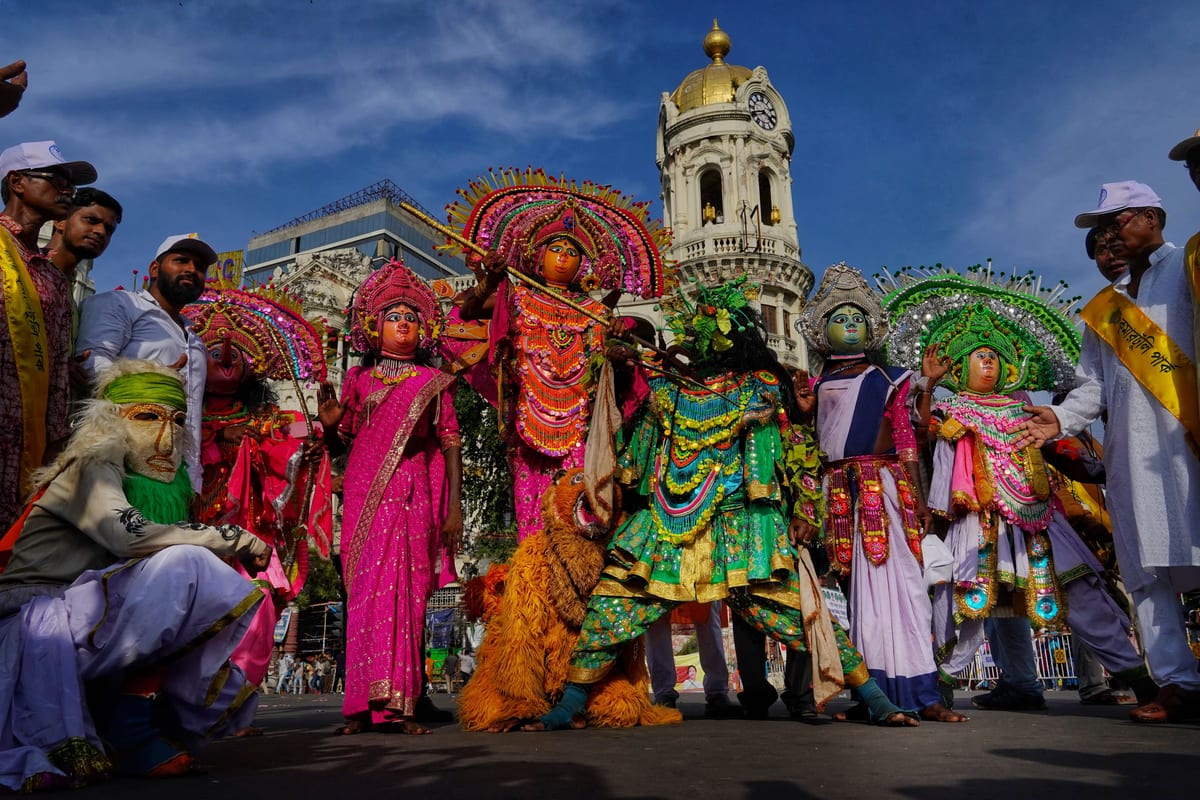
Goa's beaches are not passive backdrops — they are stages. The state's calendar is dense with celebration. The Goa Carnival, inherited from Portuguese tradition but now entirely Goan, floods the coastline with colour, pageantry, and dance. The Shigmo festival, rooted in the Hindu spring harvest tradition, fills the air with drums and elaborate processions. The Sunburn music festival transforms Goa's shoreline into one of Asia's most significant electronic music events — a new chapter in the beach's long history as a meeting place of cultures.
These are not performances for tourists. They are Goa living as it has always lived — loudly, joyfully, and with complete conviction.
Beyond the Beaches: Heritage Worth Seeking
Any traveller who comes to Goa only for its beaches will leave with an incomplete picture. The Basilica of Bom Jesus, a UNESCO World Heritage Site, houses the mortal remains of St. Francis Xavier and is one of the finest examples of Baroque architecture in Asia. The Fontainhas neighbourhood in Panaji, with its narrow Latin Quarter lanes and brightly painted colonial houses, feels like a fragment of Lisbon transplanted to the tropics — except that it is entirely and unmistakably Indian in its lived texture. Inland, the Dudhsagar Waterfalls offer one of the subcontinent's most spectacular natural sights, tumbling four tiers through the Western Ghats like a river that has forgotten restraint.
Best Time to Visit and How to Get There
Goa's climate is welcoming for much of the year. According to Incredible India's data, temperatures range from 17°C in winter months to about 36°C in the pre-monsoon period. The ideal window for beach travel is November through February, when the weather is mild, the skies are clear, and the sea is calm enough for swimming and water sports. The monsoon months of June through September transform Goa into a lush, rain-drenched landscape — fewer tourists, dramatic scenery, and a rawer, more intimate experience for those who seek it.
Goa is well-connected by air, with the Dabolim Airport (GOI) serving as the longstanding hub and the newer Goa Manohar International Airport (GOX) in North Goa expanding access further. For those who prefer the romance of rail travel, Madgaon Junction Railway Station (MAO) connects Goa to the rest of India's rail network, with scenic routes through the Western Ghats among the most beautiful train journeys in the country. Road trips from Mumbai along the Konkan coast remain a beloved tradition among those who understand that the journey to Goa is itself part of the pleasure.
Why Goa's Beaches Matter to India's Story
India's civilisational identity has never been singular. It has always been a conversation — between the indigenous and the arrived, between the ancient and the contemporary, between renunciation and joy. Goa's beaches are where this conversation happens most visibly, most beautifully, and most honestly. Here, a Portuguese church and a Hindu temple share the same hill. Here, a fisherman's catch becomes both a devotional offering and a tourist's dinner. Here, the ancient Indian philosophy of susegad — of living fully in the present moment — finds its expression not in a text, but in a person sitting barefoot on warm sand, watching the sun dissolve into the Arabian Sea.
That is what Goa's beaches offer the traveller who is paying attention: not just a holiday, but a lesson in how civilisations endure.