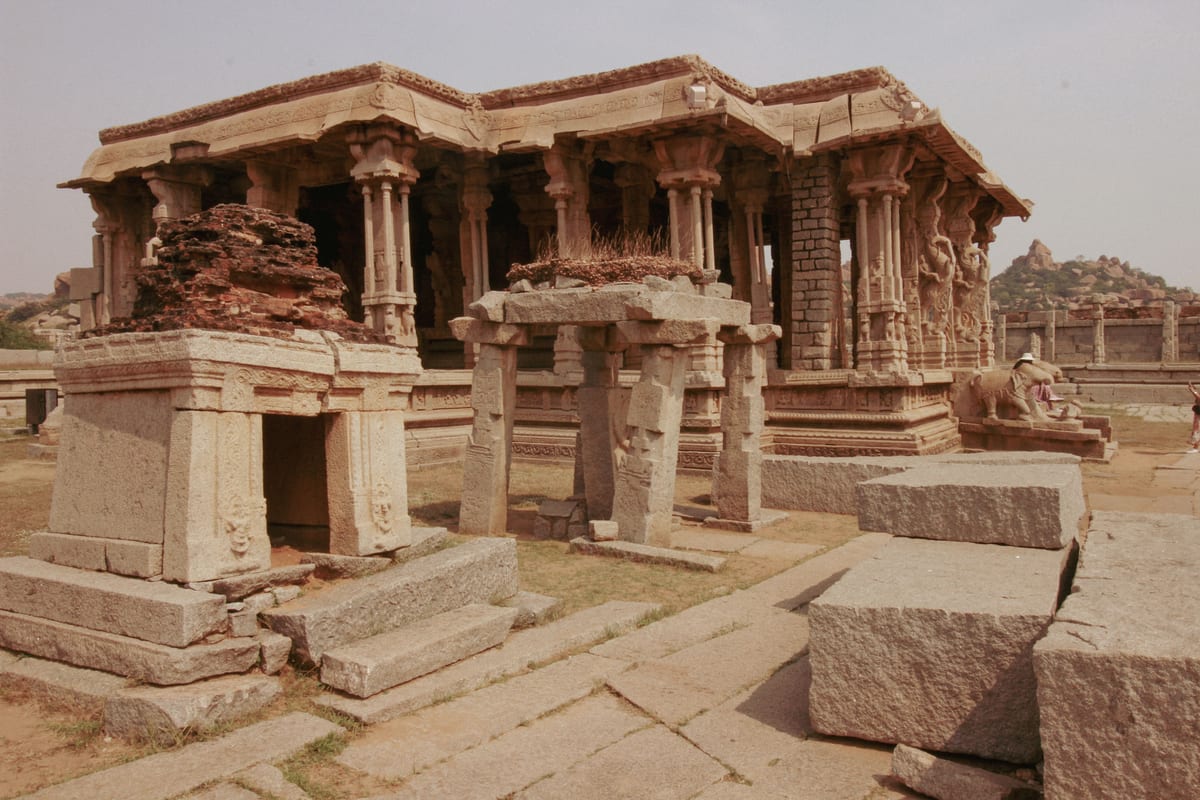
There are places in India that ask you to observe, and there are places that ask you to listen. Hampi belongs firmly to the second kind. Settled amidst an otherworldly landscape of tumbled granite boulders, banana plantations, and the shimmering green currents of the Tungabhadra River, Hampi does not announce itself with the triumphalism of a monument. It unfolds — slowly, quietly, with the particular gravity of a place that has witnessed centuries of human devotion, imperial ambition, and eventual loss.
And yet, loss may be the wrong word. In Hampi, nothing feels entirely gone.
A Name Rooted in Myth and River
The name Hampi carries the weight of antiquity. Derived from 'Pampa' — both the ancient name for the Tungabhadra River and an epithet for Goddess Parvati — Hampi exists at the intersection of geography, devotion, and mythology. Long before the Vijayanagara Empire raised its first stone here, this land was known as Kishkinda in the great epic Ramayana: the fabled monkey kingdom where Lord Ram is said to have met Hanuman and forged the alliance that would carry him to Lanka. The boulder-strewn hills, which look as though a giant scattered them carelessly across the Deccan plateau, feel entirely consistent with a landscape born of legend.
Hampi does not separate the sacred from the historical, the mythological from the architectural. They coexist in every carved pillar and every prayer that rises from the Virupaksha Temple at dawn.
The Empire That Refused to Be Forgotten
At its height in the 14th to 16th centuries, the Vijayanagara Empire was among the wealthiest and most powerful kingdoms on earth. Arab and Portuguese travellers who visited its capital — this very city — wrote with barely contained astonishment about its size, its markets overflowing with spices and precious stones, its temples adorned with extraordinary craftsmanship, and the sophistication of its court. Hampi was that capital, and at its zenith it may have been one of the most populous cities in the world.
The empire fell in 1565 following the Battle of Talikota, and the city was sacked and largely abandoned. What survived — and what survives still — is staggering. Declared a UNESCO World Heritage Site and celebrated by Incredible India as one of the subcontinent's premier heritage destinations, Hampi preserves over 1,600 monuments spread across roughly 41 square kilometres.
What You Will See — and Feel
Begin, as pilgrims and travellers have begun for centuries, at the Virupaksha Temple. Dedicated to Lord Shiva in his form as Virupaksha, this temple has been in continuous worship since at least the 7th century CE, predating even the Vijayanagara Empire. The gopuram — the soaring temple tower — dominates the skyline and is Hampi's most enduring symbol. To stand here at dawn, as incense smoke curls upward and bells ring out across the Tungabhadra, is to see that this is not a ruin. This is a living, breathing place of faith.
A short distance away, the Vitthala Temple Complex contains what many consider Hampi's most breathtaking architectural achievement: the iconic Stone Chariot, a freestanding granite sculpture of a temple chariot complete with wheels that once actually rotated. The complex's musical pillars — columns that produce different tones when tapped — speak to an artistic sophistication that still astonishes engineers and musicians alike.
Do not overlook the Elephant Stables, a magnificent row of domed chambers that once housed the imperial war elephants, their arched entrances alternating between Hindu and Islamic architectural styles — a reminder that Vijayanagara was a cosmopolitan empire. Nearby, the Lotus Mahal and the Queen's Bath offer further evidence of a court that prized beauty as much as power.
For those willing to explore beyond the main monuments, Hampi rewards the curious. Hidden caves shrouded in local legend, rugged trekking paths through the boulder hills, and the extraordinary experience of a coracle crossing — riding a circular basket boat across the Tungabhadra — all belong to the Hampi that does not appear on the standard itinerary but lingers longest in memory.
Dawn and Dusk: The Hampi Hours
Travellers who visit Hampi only in the flat light of midday are missing the destination entirely. Hampi belongs to the golden hours. At dawn, climb to Matanga Hill — the highest point in the area — and watch the sun rise over a landscape that seems sculpted by divinity itself: the river catching the first light, the temples emerging from darkness, the boulders glowing amber and rust. At dusk, the same scene plays out in reverse, in what the Incredible India page rightly calls 'a blaze of crimson.' These are not photographic opportunities. They are encounters with something much older and much larger than tourism.
Best Time to Visit
Hampi is accessible year-round, but the climate varies significantly across seasons. The most comfortable months for exploration are October through February, when temperatures range between 17°C and 31°C. The summer months of April and May see temperatures climbing to 39°C, which can make extended outdoor exploration exhausting. The monsoon months of June through August bring relief in temperature — hovering between 21°C and 36°C — and drape the landscape in vivid green, though some river crossings may be affected by water levels. November through January remains the sweet spot: cool mornings, manageable afternoons, and the kind of clear skies that make those sunrise climbs entirely worth the effort.
Getting There
The nearest major airport is Kempegowda International Airport (BLR) in Bengaluru, approximately 350 kilometres away. Closer options include Jindal Vijayanagar Airport (VDY) at Vidyanagar and Hubballi Airport (HBX), both of which significantly reduce travel time from the air. For those travelling by rail, Hospet Junction Railway Station (HPT) is the nearest railhead, well connected to Bengaluru, Hyderabad, and other major cities. From Hospet, Hampi is only about 13 kilometres — a short auto-rickshaw or taxi ride into another age.
Why Hampi Matters
India has no shortage of heritage sites. What makes Hampi singular is the completeness of its story — mythological, imperial, artistic, spiritual — and the fact that this story has never stopped being told. The Virupaksha Temple still receives its daily worshippers. Locals still navigate these boulder-fields as their ancestors did. The Tungabhadra still flows past ruins that have watched centuries come and go. Hampi is not a museum piece preserved under glass. It is a strand of living civilisation, still warm to the touch.
To visit Hampi is to understand something essential about India: that here, the ancient is never entirely past, and history is never merely academic. It is personal. It is devotional. And in the long, golden light of a Hampi evening, with the stones glowing and the river catching fire, it is undeniably, magnificently alive.