There is a moment, arriving at the eastern face of Hawa Mahal just as the Jaipur morning assembles itself, chai vendors, auto-rickshaws, pigeons riding the rooftop thermals, when you understand that this building has never truly been silent. It was built for the city. It was built with the city woven into its very walls. And nearly two and a quarter centuries later, the city still presses its face against it in return.
A Palace Born of Poetry and Purpose
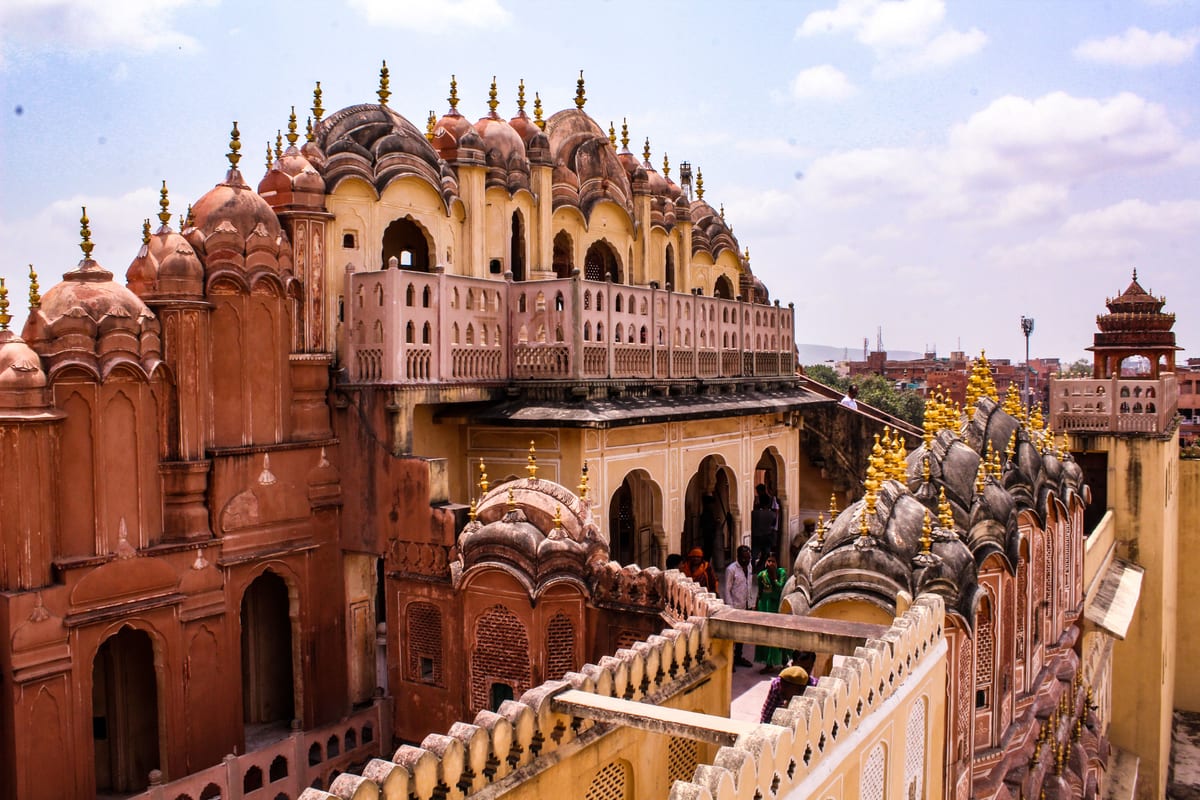
Hawa Mahal, the Palace of Winds, was commissioned in 1799 by Maharaja Sawai Pratap Singh of the Kachwaha Rajput dynasty and designed by the architect Lal Chand Ustad. The structure rises five storeys from the eastern edge of the City Palace complex, its facade a cascade of 953 small casement windows, each intricately carved from rose-pink sandstone in a honeycomb of jharokhas, the cantilevered bay windows that are a hallmark of Rajput architectural vocabulary. The overall silhouette, tapering to a crown-like apex, is said to have been inspired by the crown of Lord Krishna, whom Maharaja Pratap Singh, himself a devoted poet and scholar, held sacred.
The palace's stated purpose was practical, even if its form was sublime. Rajput court protocol of the period observed strict purdah, royal women of the zenana (inner court) did not appear in public spaces. Yet life in a walled palace could not entirely contain human curiosity. Hawa Mahal was the architectural solution: a screen so elaborate it became a spectacle in itself, through which royal women could watch processions, festivals, and the theatre of everyday Jaipur without being seen. The wind that gave the palace its name was no accident of design either. The latticed windows created natural cross-ventilation, cooling the interior chambers even in the height of a Rajasthani summer.
Reading the Stone: Architecture as Civilisational Text
The five floors each carry their own identity: Sharad Mandir, Ratan Mandir, Vichitra Mandir, Prakash Mandir, and Hawa Mandir at the summit. Each level diminishes in width as it rises, creating that distinctive pyramidal profile. The interiors, modest rooms, narrow corridors, small shrines, were never meant as a conventional residence. It is closer to a viewing pavilion, a stage from which to watch the world's stage below.
The sandstone itself participates in this drama. Quarried from the region's distinctive pink and amber stone, the same material that earned Jaipur its sobriquet, the Pink City, it shifts colour through the day, from pale coral in the early morning to a deep amber blush at dusk. Photographers know this. They gather at the small rooftop café of a heritage hotel directly across Badi Chaupar, waiting for the light to do what no filter can replicate. The Incredible India page on Hawa Mahal identifies this facade as one of the finest examples of Rajput architecture in the country, and standing before it, few would offer argument to the contrary.
Living Heritage: Not a Museum, But a Mirror
Hawa Mahal stands flush with a working commercial street, jewellery bazaars, fabric merchants, street food stalls, and has always done so. The city did not grow around Hawa Mahal; Hawa Mahal was built into the city's existing pulse. That relationship persists. Local schoolchildren visit on weekday mornings. Newlywed couples pose before it. Artists set up easels on the pavement. The building receives all of them without ceremony, because ceremony was always its natural condition.
India's great heritage sites are not ruins awaiting revival, nor exhibits awaiting interpretation. They are presences, architectural personalities, that continue to organise the life around them. Hawa Mahal does not need to explain itself. It simply persists, and in persisting, it shapes every generation that encounters it.
Planning Your Visit: Practical Notes for the Thoughtful Traveller
Best Time to Visit: October through March offers the ideal window, when Rajasthan's desert climate softens into something genuinely pleasant, cool mornings, warm afternoons, and skies of an almost theatrical blue. Avoid the peak summer months of May and June, when temperatures in Jaipur can climb severely and the palace's vaunted ventilation, while impressive, has its limits. The monsoon months of July and August bring a different beauty to Rajasthan, the landscape greens briefly, the light becomes extraordinary, though travel logistics can be complicated.
How to Reach: Jaipur is exceptionally well-connected. Jaipur International Airport receives direct flights from Delhi, Mumbai, Bengaluru, and several other major Indian cities, as well as international connections. The city is also served by the railway network, with regular express trains from Delhi (approximately four to five hours), Mumbai, and Agra. By road, Jaipur sits on the Delhi–Jaipur National Highway, a journey of roughly five hours from the capital. From anywhere in Jaipur's city centre, Hawa Mahal is easily accessible by auto-rickshaw, cab, or on foot through the old bazaar lanes.
Nearby Attractions: Hawa Mahal sits within Jaipur's UNESCO-recognised walled city. The City Palace complex, from which Hawa Mahal is architecturally inseparable, houses museums, courtyards, and royal apartments of remarkable richness. Jantar Mantar, the astronomical observatory built by Maharaja Sawai Jai Singh II and itself a UNESCO World Heritage Site, is minutes away. Amber Fort, perhaps Jaipur's most dramatic monument, sits twelve kilometres north and rewards a full half-day. For those drawn to craft and commerce, Johari Bazaar and Bapu Bazaar, flanking Hawa Mahal, offer some of India's finest traditional jewellery, textiles, and blue pottery.
Why Hawa Mahal Matters
In an age when heritage is increasingly packaged and heritage tourism increasingly homogenised, Hawa Mahal offers something rarer: genuine encounter. You cannot visit it passively. The building insists on engagement, with its history, with the social world it once served, with the aesthetic tradition it represents, and with the living city that has refused, across centuries, to leave it behind. Stand before those 953 windows and understand that each one was a woman's eye on the world, each one a small act of imagination made permanent in stone.