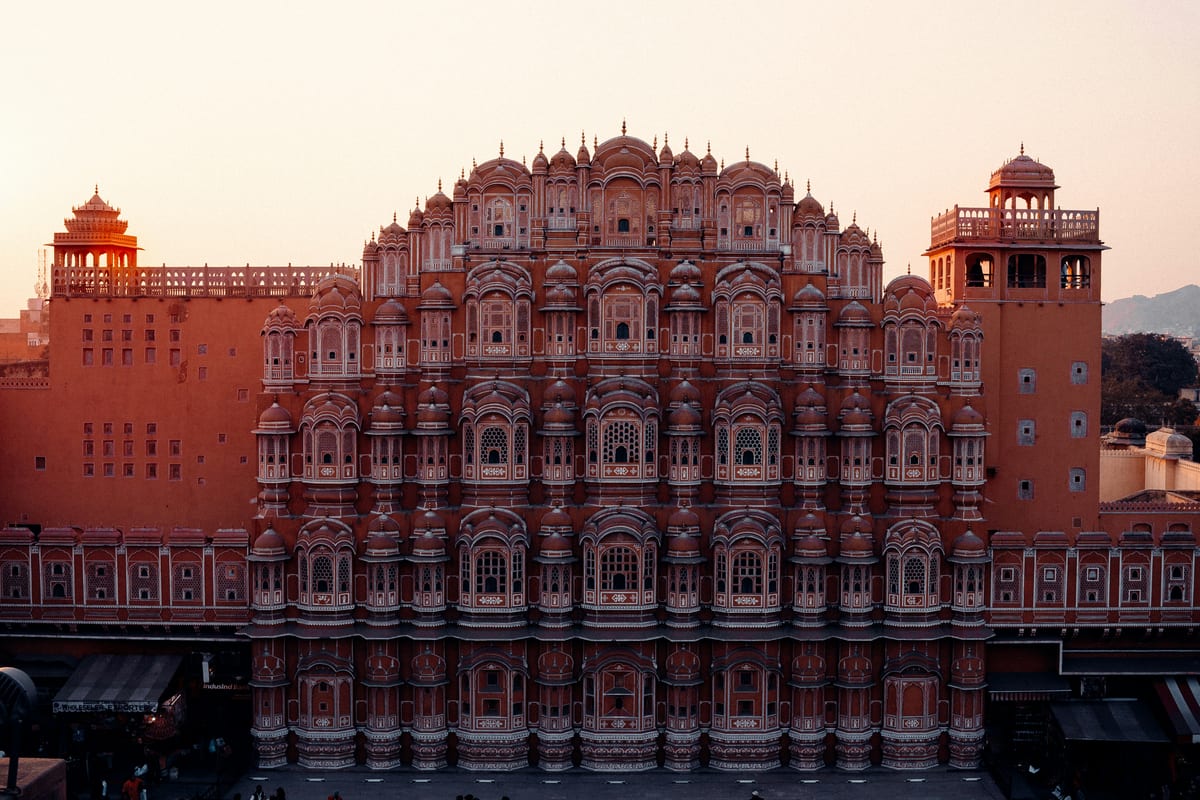
There are buildings that stand apart from their cities, and then there are buildings that are their cities. Hawa Mahal — the Palace of Winds — belongs to the second category. Step into the old lanes of Jaipur at dawn, when the light is still cool and the chai vendors are firing their first rounds of the day, and the palace will find you before you find it. Five storeys of pink sandstone, flushed amber by early sun, rising above the rooftops like an elaborate crown set down on the edge of Tripolia Bazaar. You do not visit Hawa Mahal so much as you encounter it.
A Palace Born of Wind and Ingenuity
Built in 1799 by Maharaja Sawai Pratap Singh, a poet-king of the Kachhwaha Rajput dynasty, Hawa Mahal was conceived as an extension of the City Palace complex. Its purpose was practical and deeply human: to allow the women of the royal household — who observed the strict codes of purdah — to watch the festivals, processions, and everyday commerce of Jaipur's streets without being seen themselves. The architect, Lal Chand Ustad, translated this social reality into one of the subcontinent's most astonishing structural achievements.
The façade, which is what most visitors see and photograph, is essentially a thin screen — barely a room deep in places — punctuated by 953 small casement windows, each carved with intricate latticework known as jharokhas. The design channels air through the building's interior with such efficiency that even in the blazing heat of a Rajasthani summer, the inner chambers remain noticeably cooler. The palace's name is not metaphor. It is engineering.
The structure's silhouette is modelled on the crown of Lord Krishna, reflecting Sawai Pratap Singh's devotion. This layering — practical function, royal aesthetics, and spiritual symbolism — is characteristic of India's classical architectural tradition, where no element exists for just one reason.
Walking Through Living History
Entering Hawa Mahal from the rear — the façade has no ground-floor entrance — visitors pass through a courtyard that opens the palace up from the inside. What looked from the street like a flat screen reveals itself as a complex of chambers, corridors, and galleries across five floors, each with a distinct name: Sharad Mandir, Ratan Mandir, Vichitra Mandir, Prakash Mandir, and Hawa Mandir at the top. The Archaeological Survey of India maintains the site, and a small museum on the premises holds miniature paintings, artefacts, and relics that contextualise the palace within the broader Jaipur royal story.
Climbing to the upper floors, visitors arrive at the jharokhas themselves — and the experience shifts. You sit where a royal woman once sat, looking out through carved stone lattice at the same bazaar street below, watching the same kind of human activity she watched more than two centuries ago: vendors, pilgrims, tourists, schoolchildren. The window frame has not changed. Only the world beyond it has.
For more on the palace's history and visitor information, the Incredible India page on Hawa Mahal is an excellent starting point before your visit.
The Civilisational Argument in Stone
India's heritage conversation is sometimes reduced to the grand and the monumental — the Taj Mahal, the cave temples of Ajanta, the ghats of Varanasi. Hawa Mahal deserves a place in that conversation, but for subtler reasons. It does not announce empire. It announces society — a sophisticated, negotiated social order in which architecture was asked to solve a problem that was simultaneously civic, gendered, climatic, and spiritual. That the solution produced something of such breathtaking beauty reflects the Indian tradition, where beauty in service of function is not coincidence but expectation.
Rajasthan has been a crucible of this tradition. The desert demanded ingenuity. Trade routes brought wealth and cosmopolitan influence. The Rajput courts patronised music, poetry, miniature painting, and architecture with equal intensity. Hawa Mahal sits at the intersection of all these forces. The pink sandstone used in its construction is the same stone that defines the colour palette of the entire Pink City — a deliberate urban aesthetic ordered by Maharaja Sawai Ram Singh II in 1876 to welcome the Prince of Wales. The palace did not stand alone then, and it does not stand alone now.
Planning Your Visit: Practical Notes
Jaipur is well connected by air, rail, and road. Jaipur International Airport receives direct flights from major Indian cities as well as international connections. The city is a major stop on the Delhi–Mumbai rail corridor, with frequent express and superfast train services from Delhi (roughly four to five hours), Agra, and Mumbai. By road, Jaipur sits on National Highway 48 and is about 270 kilometres from Delhi — a comfortable drive through Haryana and eastern Rajasthan.
Hawa Mahal is located on Hawa Mahal Road in the heart of the old city, easily reachable by auto-rickshaw or cycle-rickshaw from most hotels. The surrounding lanes — Tripolia Bazaar for bangles and textiles, Johari Bazaar for jewellery — are best explored on foot.
The ideal time to visit is between October and March, when Rajasthan's summer has retreated and the days are clear, cool, and golden. The early morning light on the eastern-facing façade is particularly spectacular. Arriving just after opening allows you to explore the upper galleries before the crowds build through mid-morning.
Beyond the Palace: Jaipur's Heritage Constellation
No visit to Hawa Mahal exists in isolation. The City Palace — of which Hawa Mahal is architecturally a part — lies just minutes away and rewards several hours of exploration, its courtyards and museums revealing the full sweep of Jaipur's royal history. Jantar Mantar, the extraordinary open-air astronomical observatory built by Maharaja Sawai Jai Singh II and now a UNESCO World Heritage Site, is a ten-minute walk. Amber Fort, perched on a hill overlooking Moata Lake on the city's northern edge, demands at least half a day. Together, these sites form one of India's densest concentrations of living heritage — buildings that are studied, visited, photographed, and still, in various ways, inhabited by the culture that created them.
India's past is not preserved behind glass. It breathes through stone latticework, it sells jasmine garlands in the bazaar below, it rides the morning light across pink sandstone walls. The Palace of Winds is not a monument to something that was. It is a portal to something that continues.