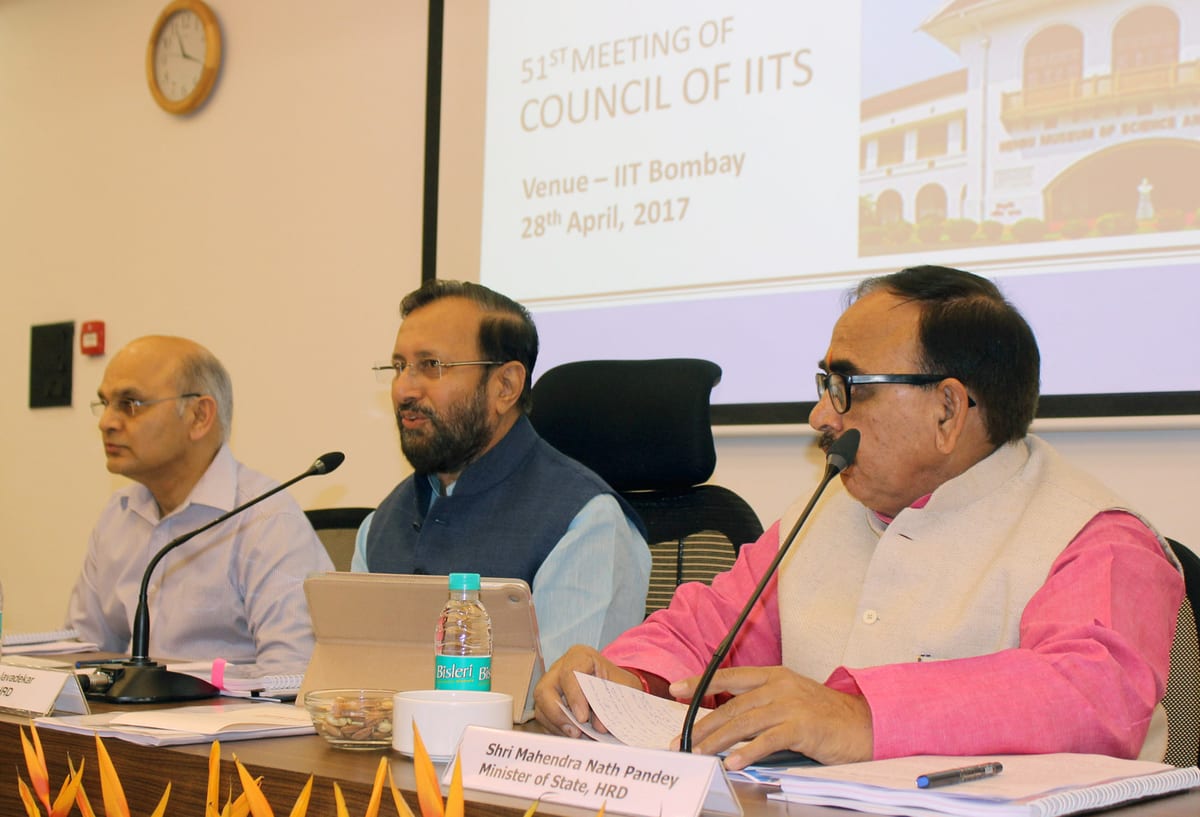
The Indian Institutes of Technology are preparing to add 6,000 seats in robotics, physical artificial intelligence and space technology from the 2027 academic year, according to a report by NDTV. Of that total, 5,000 seats would be in robotics and physical AI, split into 2,500 Bachelor of Technology positions, 1,200 master's seats and 1,300 PhD places.
The rollout would stretch across a decade, with the first cohort entering in 2027, India Today reported. No formal statement from the Ministry of Education or the IIT Council had accompanied the report at publication time; the numbers remain in media accounts for now.
Reading the seat mix
The doctoral share matters more than the headline total. A system that admits 1,300 PhD researchers a year in physical AI and robotics is betting on research depth. Undergraduate seats produce engineers; doctoral seats produce the people who design the next control algorithm and teach it to the undergraduates who follow them. If the ratio holds, the expansion becomes a story about building a scientific commons.
Physical AI is the largest beneficiary. It refers to systems that act in the material world rather than only inside a screen: robotic arms on a factory floor, autonomous inspection drones, machines that can grasp, weld and assemble. The decision to direct five of every six new seats into this area reflects where Indian industry has reported the sharpest shortage of engineers who can move from simulation to hardware.
The remaining 1,000 seats fall under space technology. The report does not break down those positions by degree level, but the grouping is consistent with a sector that needs guidance, navigation and control specialists as much as propulsion experts.
Why the bet is strategic
India's defence modernisation and its private space economy draw from the same shallow pool. A civilian launch sector that has begun attracting private companies needs more than aerospace graduates; it needs computer-vision engineers, robotics designers and controls specialists who have built and broken hardware before they enter a clean room. Manufacturing lines adopting automation face the same gap. The expansion, if executed as described, targets that pipeline rather than waiting for talent trained abroad to return.
The plan fits existing education-policy architecture. The National Education Policy 2020 called for scaling up advanced technical education. The IndiaAI Mission and the National Mission on Interdisciplinary Cyber-Physical Systems have made artificial intelligence and cyber-physical research central to public funding debates. None of those frameworks alone mandated 6,000 seats. Together they supplied the permission.
The strategic case is familiar to anyone who has followed Indian technology policy. Indian institutions are not competing alone. Robotics and AI research commands global salaries, and Indian doctoral graduates often leave for postdoctoral positions in the United States, Germany and Japan. An expansion that assumes these graduates will return to teach may be too optimistic. The state will need to create reasons for them to stay: research grants, equipment budgets and a clear tenure pathway. Without those, the new seats will simply become a feeder for overseas laboratories.
The faculty and lab bottleneck
A seat is not a laboratory. The older IITs already struggle to hold senior faculty in machine learning and robotics against private-sector salaries that academic pay scales cannot match. Adding 1,300 doctoral positions a year requires a supply of qualified guides, and that supply cannot be summoned by a resolution. If laboratory equipment, high-performance computing access and research grants lag behind admission numbers, the result will be large batches of students reading robotics rather than building it.
This is not an argument against expansion. It is a caution against expansion as paperwork. The first test will arrive at the master's and doctoral level, because that is where a research shortage shows earliest. A well-funded robotics laboratory with ten doctoral candidates signals intent; a classroom with two hundred undergraduates and one overworked instructor signals haste.
The space component of the plan, though smaller, is the most exposed to policy risk. India's private space economy is young, and its demand for engineers depends on continued regulatory clarity and launch capacity. Seats created today will produce graduates in 2031 and beyond; if the sector's expansion slows, those graduates will need to pivot to defence or industrial automation. That is not a failure, but it is a reminder that degree programmes are long-duration bets on a market that moves much faster than the academic calendar.
What students should watch
For students preparing for the next Joint Entrance Examination cycles, the practical question is whether new seats mean new programmes or crowded versions of old ones. The difference will be visible in lab hours, project funding and the number of faculty who can actually supervise a thesis. A seat in a new robotics centre built without equipment is a receipt, not an education.
Indian higher education has lived for decades on the assumption that scarcity preserves quality. That assumption is now being questioned, but not by the seat numbers. It is being questioned by whether the institutions that created India's engineering reputation can also create the research infrastructure that reputation now requires.
The expansion carries no guarantee, and the absence of an official order leaves room for the numbers to shift before the 2027 admission cycle. The direction, however, is clear: India is betting that its premier technical institutions should produce more workers for the physical layer of artificial intelligence and for the orbital economy. The country will find out by the end of the decade whether it built enough benches, mentors and machines to make those workers worth the degree they carry.