There is a tap, a Pakistani minister said this week, controlled by the prime minister of a neighbouring country. The image was meant to alarm. Instead, it revealed something Islamabad would rather not have admitted: that water, for the first time in the sixty-six-year life of the Indus Waters Treaty, has become a pressure point that Pakistan cannot manage through bluster alone.
On Friday, MEA spokesperson Randhir Jaiswal stated at a press briefing in New Delhi that India's position on the Indus Waters Treaty is consistent, that the treaty stands in abeyance in response to Pakistan's continued sponsorship of cross-border terrorism, and that Pakistan must credibly and irrevocably abjure that support. The language was economical and deliberate. No hedging, no diplomatic softening, no invitation to negotiate. The word "consistent" closed every door Pakistan's ministers had been rattling.
The Architecture of Abeyance
India placed the IWT in abeyance following the terror attack in Jammu and Kashmir's Pahalgam in April 2025. The MEA's position since then is that the 1960 water-sharing agreement — negotiated under World Bank auspices and long treated as inviolable even through wars — cannot be treated as sacrosanct when one signatory actively sponsors violence against the other. This draws on a principle of international treaty law that a material change in the circumstances underlying an agreement can justify a party's suspension of its obligations.
Pakistan's response has been to escalate the register of its warnings without offering anything substantive in return. Climate change minister Musadik Malik declared, according to the Pakistani newspaper Dawn, that Islamabad would "cut off those hands" that sought to control the Indus water. Foreign Minister Ishaq Dar described any Indian attempt to deprive Pakistan of its water share as the "weaponization of water" and warned of serious consequences for regional peace and security, as reported by AP. The language was martial. The legal and diplomatic scaffolding behind it was thin.
Jaiswal's response to these warnings — that India's position is consistent — signals that the abeyance framework is not subject to revision in response to Pakistani pressure, however loudly amplified. The treaty will not resume operations until the condition India has set — credible and irrevocable renunciation of cross-border terrorism — is met. That condition, by design, places the initiative entirely with Islamabad.
From Concession to Asset
The 1960 treaty gave Pakistan the use of the three western rivers — the Indus, Jhelum, and Chenab — while India retained rights over the three eastern rivers. Analysts such as Brahma Chellaney of the Centre for Policy Research have argued for years that this arrangement was structurally asymmetric, allocating the overwhelming share of a river system that originates in Indian territory to a downstream neighbour. For decades, India treated this asymmetry as fixed — a legacy of partition-era diplomacy that could not be revisited. Even through three wars, the treaty survived, and Indian governments preserved it as evidence of good-faith engagement.
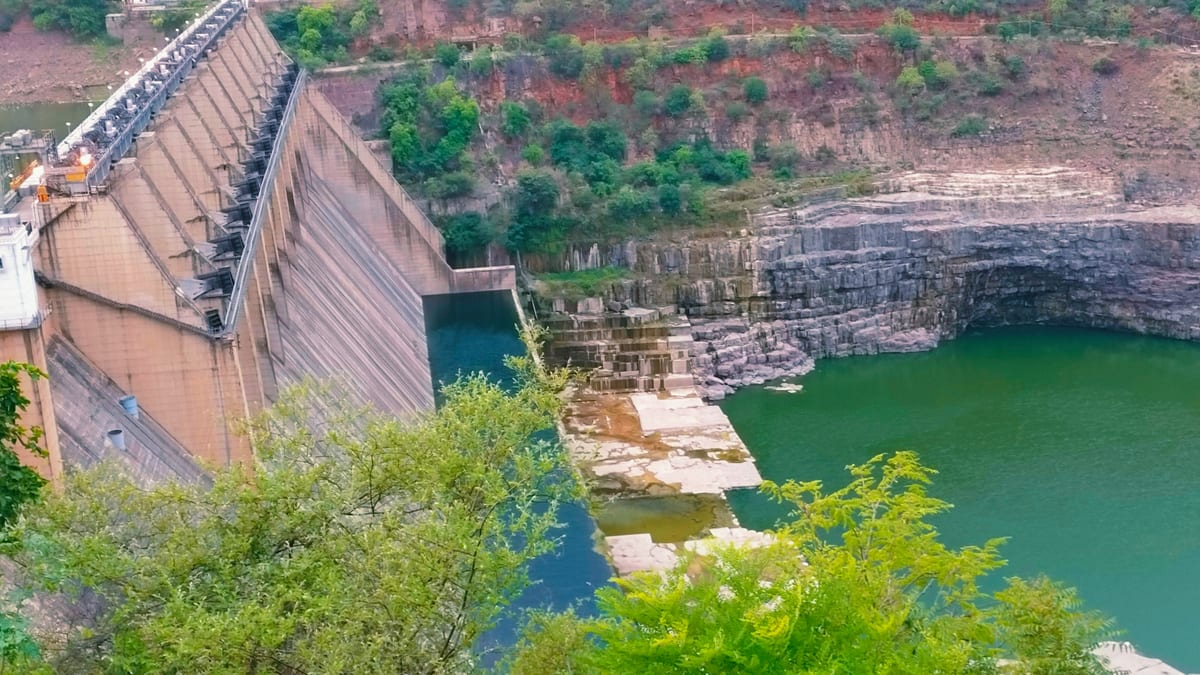
The Pahalgam attack, and the abeyance it triggered, ends that posture. Water has moved from the category of concession — something India gave to demonstrate restraint — to the category of strategic asset, something India now holds in proportion to how Pakistan conducts itself. This is a structural shift with compounding consequences. Every month the abeyance holds, India's hydroelectric and irrigation projects on the western rivers — including the Kishanganga and Ratle projects, whose construction had long been contested under treaty mechanisms — gain additional justification for acceleration. Infrastructure built becomes fact on the ground. Fact on the ground changes negotiating realities.
ORF Senior Fellow Sushant Sareen has argued that the IWT abeyance is long overdue and that water has historically been India's most underutilised lever against Pakistan's terror infrastructure. The current moment tests whether New Delhi converts the lever into durable physical infrastructure before any future diplomatic settlement forecloses the option.
Afghanistan and the Second Front
The press briefing on Friday covered more than the treaty. When asked about Pakistan's military airstrikes into Afghanistan — in which, the MEA noted, several civilian lives including women and children were lost — India condemned the strikes and underlined its support for Afghanistan's territorial integrity, along with its ongoing humanitarian assistance cooperation with the country.
This condemnation fits a deliberate pattern: India is building a simultaneous, multi-front case that Pakistan is a destabilising actor across the region — one that kills civilians in Afghanistan while threatening war over water, and does both while maintaining the infrastructure of cross-border terrorism that triggered the treaty suspension in the first place. Each front reinforces the others. A Pakistan that bombs Afghan civilians cannot credibly invoke humanitarian or regional-stability arguments in the IWT dispute. A Pakistan that sponsors terrorism cannot invoke treaty protections against the very state it targets.
India's alignment with Kabul on territorial integrity also has a longer strategic logic. Afghanistan sits at the headwaters of conversations about regional connectivity, energy corridors, and counterterrorism cooperation. India's humanitarian engagement with Afghanistan, maintained even through the complications of the post-2021 political transition in Kabul, keeps a channel open that Pakistan would prefer closed. Condemning Islamabad's strikes at an MEA briefing — at the same event where the IWT is reaffirmed in abeyance — communicates how India intends to hold Pakistan accountable across multiple simultaneous theatres.
The Weight of 1960
Treaties age. The IWT was negotiated in a world where the Cold War shaped South Asian calculations, where the World Bank's mediation carried different geopolitical weight, and where neither India nor Pakistan had fought the wars they subsequently fought, or built the terror infrastructure that now defines their relationship. Former Foreign Secretary Vijay Gokhale has observed that multilateral treaties cannot be treated as sacrosanct when one signatory actively sponsors violence against the other. That observation is now Indian state policy, not analytical commentary.
Pakistan's invocation of the treaty's sanctity, stripped of any acknowledgment of its own conduct, reduces the IWT to an instrument that constrains India while imposing no obligations on Islamabad. India has declined that reading. The abeyance framework, whatever its eventual legal adjudication through international mechanisms Pakistan may seek to invoke, has already succeeded in one important respect: it has ended the assumption that the 1960 treaty is immutable regardless of circumstances.
Pakistan's warnings — of hands being cut, of wars over water, of weaponization — carry an unmistakable note of a state that has lost the initiative on an issue it once considered settled. The MEA's single word, "consistent," is the cleaner, more confident formulation. The treaty is in abeyance. The condition for its restoration is Pakistan's behaviour. Until that behaviour changes, the abeyance is the policy — and the infrastructure clock, on the western rivers, runs only in one direction.