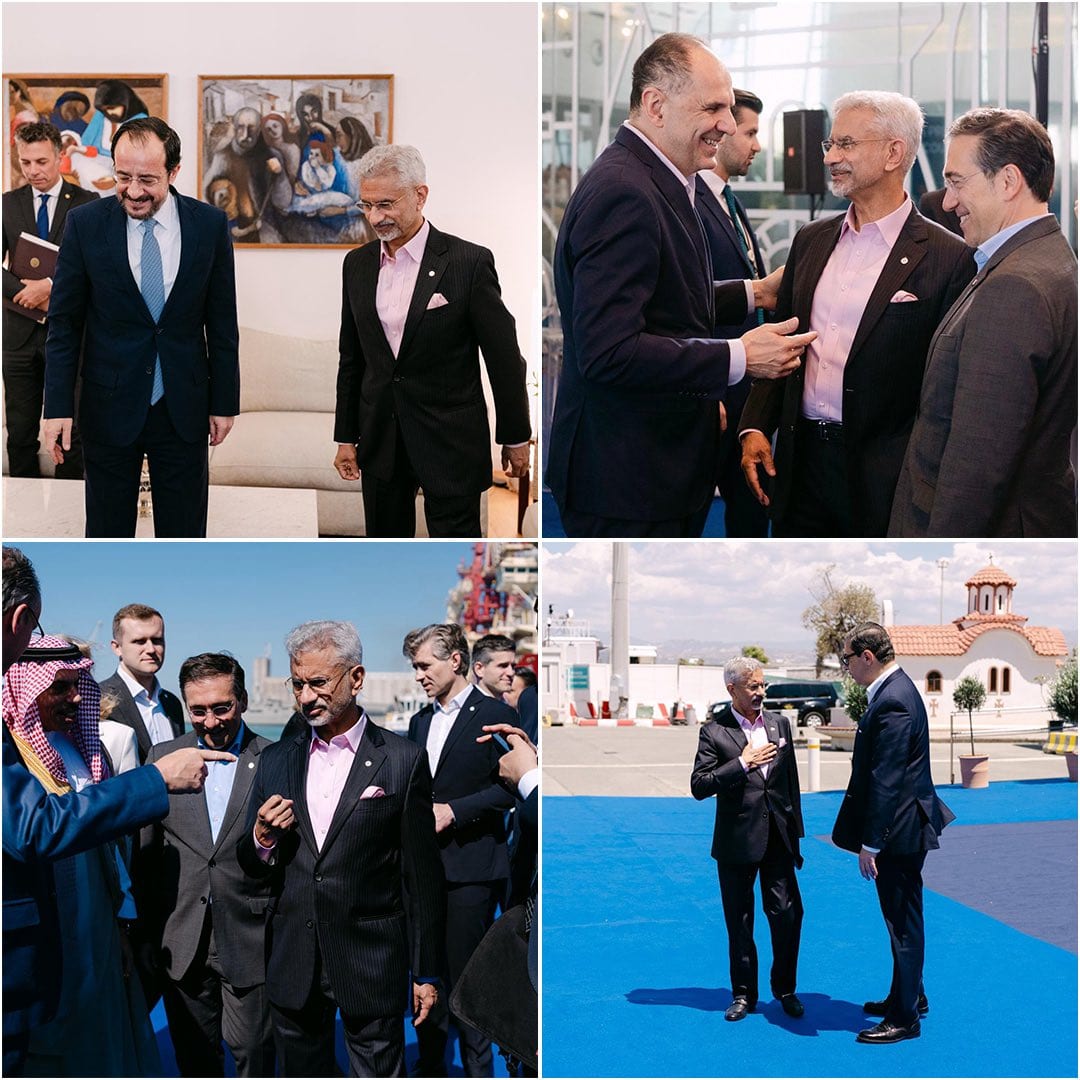
External Affairs Minister S. Jaishankar's attendance at the informal EU Foreign Ministers meeting in Cyprus last week reflects India's approach to European engagement, using smaller EU member states to advance strategic objectives across energy, maritime security, and diplomatic influence in the Eastern Mediterranean.
The Ministry of External Affairs announced that Jaishankar attended the Gymnich meeting as a special invitee of EU High Representative Kaja Kallas and Cypriot Foreign Minister Constantinos Kombos, focusing discussions on West Asia developments and wider regional security challenges.
Strategic Geography Meets Energy Diplomacy
Cyprus sits at the intersection of three continents and controls access routes between Europe, Asia, and Africa relevant to Indian commerce and energy security. The island is emerging as a significant player in regional gas exploration, with offshore reserves that could reshape Eastern Mediterranean energy flows.
India's engagement here is calculated rather than opportunistic. The timing of Jaishankar's visit, weeks after President Nikos Christodoulides elevated India-Cyprus relations to a Strategic Partnership during his state visit to India, shows sustained momentum.
The Gymnich meeting focused heavily on West Asia developments, where India's multi-alignment approach offers European partners a perspective unencumbered by colonial history or alliance obligations. Unlike European capitals that often view regional developments through energy dependence or refugee flows, India brings the credibility of a major power that maintains productive relationships across the region's divides.
Bilateral Calculus Beyond Ceremonial Diplomacy
Jaishankar's structured bilateral meetings during the Cyprus visit covered Ukraine, Saudi Arabia, Spain, and the EU High Representative. Sessions with Ukrainian Foreign Minister Andrii Sybiha, Saudi Foreign Minister Prince Faisal bin Farhan, Spanish Foreign Minister José Manuel Albares, and EU High Representative Kallas each served distinct strategic purposes.
The Ukraine discussion allowed India to reinforce its position on sovereignty and territorial integrity while maintaining dialogue with a country facing existential challenges. The Saudi meeting advanced energy cooperation and regional stability discussions. Spanish engagement touched on Indo-Pacific cooperation and Latin American connections. The EU session focused on institutional partnership development.
This pattern demonstrates India's confidence in its independent foreign policy positions. India uses these forums to explain its reasoning and build understanding for its strategic choices rather than seeking European validation or approval.
Cyprus as EU Advocate and Maritime Partner
Smaller EU member states like Cyprus offer India advantages that larger European powers cannot provide. They face fewer domestic political constraints when supporting Indian positions in European forums, lack the historical baggage that complicates relationships with former colonial powers, and often share India's perspective as medium-sized nations navigating great power competition.
Cyprus brings additional strategic value through its growing role in Eastern Mediterranean energy exploration and its position in maritime security arrangements. The island's location makes it valuable for monitoring shipping lanes that carry significant portions of India's energy imports and trade flows.
The elevation to Strategic Partnership provides institutional frameworks for cooperation in defence technology, maritime domain awareness, and energy sector collaboration. These partnerships with smaller European nations complement India's relationships with major European powers, creating a diversified diplomatic portfolio across the continent.
Regional Security Through Indian Lens
The focus on West Asia during the Gymnich discussions allowed India to demonstrate its regional expertise and independent analytical capabilities. European discussions of Middle Eastern developments often centre on migration, terrorism, or energy supply disruption. India's perspective emphasises stability, economic development, and regional connectivity.
This analytical independence positions India as a valuable interlocutor rather than simply another stakeholder seeking European support.
The Ukraine discussions exemplify this approach. While European partners face immediate security concerns and alliance obligations, India maintains relationships with all parties to the conflict while upholding principles of sovereignty and territorial integrity. This allows India to serve as a bridge for communication and potentially for future diplomatic solutions.
Mediterranean Strategy and Global Positioning
India's Cyprus engagement reflects broader strategic thinking about maritime corridors and energy security. The Eastern Mediterranean connects to shipping routes that carry substantial portions of Indian trade and energy imports. Establishing relationships with regional partners like Cyprus creates options for future cooperation in maritime domain awareness and energy corridor security.
The institutional depth of the India-EU Strategic Partnership provides frameworks for expanding these relationships beyond bilateral cooperation to multilateral initiatives. Cyprus can serve as an entry point for Indian participation in regional energy projects, maritime security arrangements, and technology cooperation programmes.
India's approach demonstrates evolution from a regional power with global aspirations to a global power with sophisticated regional strategies. Rather than pursuing one-size-fits-all policies, India develops tailored approaches that leverage the specific advantages and capabilities of different partners.
The Cyprus model offers a template for engaging other smaller European nations that can advocate for Indian positions within EU institutions while advancing practical cooperation in areas like energy, technology, and maritime security. This approach to European engagement strengthens India's strategic autonomy while building the institutional relationships necessary for sustained great power competition in an increasingly complex international system.