
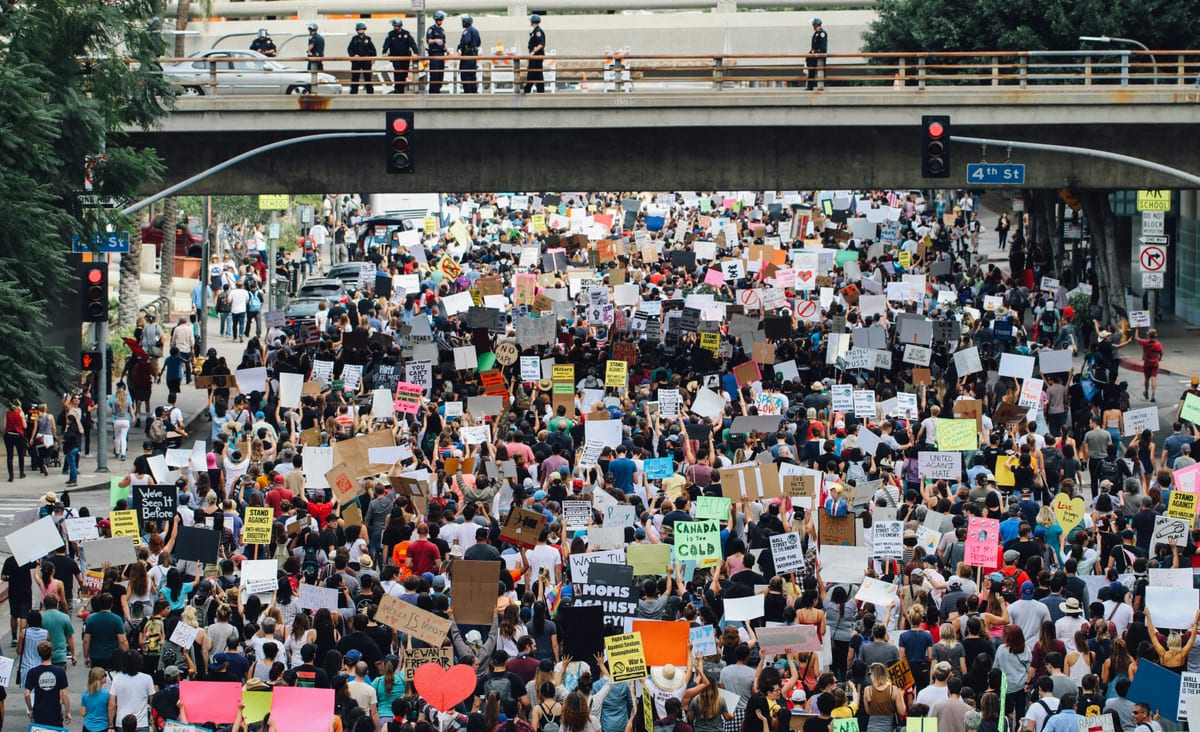
One hundred and eighteen. That is the number of security personnel Delhi Police says were injured during Monday's Cockroach Janta Party 'Sansad Chalo' march in central Delhi — more than a full company's worth of officers, including several senior ranks, hurt in a single afternoon. Seventy protesters were detained. Five FIRs were filed, covering rioting and assault on public servants. Delhi Police stated that protesters had shown "unruly, aggressive and violent behaviour," attacked personnel with sticks and stones, and damaged government vehicles and public property. The Opposition's counter-narrative arrived within hours: the march was peaceful until the state turned it violent.
Both claims cannot be entirely true. But here is the structural problem — neither can be entirely disproved. It is not an accident. India has failed to build across decades of contentious democracy what other nations have: a codified, publicly available protocol for managing large political marches near Parliament.
The Trigger Behind the March
The CJP march was not spontaneous. It carried a specific demand — the resignation of Union Education Minister Dharmendra Pradhan over alleged irregularities in the NEET examination, and a commitment from the government to take up education issues during the Monsoon Session. CJP representatives met Union Minister JP Nadda, seeking these commitments. The examination system's credibility has come under sustained judicial and public scrutiny, and the Monsoon Session was the pressure point the march was designed to exploit.
There is nothing procedurally irregular about this. Opposition parties and civic groups have marched to Parliament since at least the 1970s. The geography of protest in Delhi — Jantar Mantar, Parliament Street, Rajpath — is as old as the republic's politics. What the Monday confrontation produced was not a new kind of event but a familiar one with sharper edges: Congress leaders including Rahul Gandhi and Priyanka Gandhi Vadra participated, and their presence raised the political temperature on both sides of the barricade.
The Competing Narratives Problem
Delhi Police, which functions under the Ministry of Home Affairs, issued a formal statement. The protesters displayed aggression despite "repeated warnings and lawful directions." Security personnel were attacked. Government vehicles were damaged. Five FIRs followed under charges including rioting. The institutional position is that law enforcement responded to provocation; it did not suppress legitimate dissent.
Congress leaders dispute this characterisation entirely, framing the police response as a crackdown on constitutional rights of assembly and movement — the rights enshrined under Articles 19(1)(b) and 19(1)(d). Senior constitutional commentators have long noted that policing protests near Parliament requires calibration, not just force — that the proximity of a sovereign legislative body does not suspend fundamental rights but does require their exercise within a framework of reasonable restrictions.
Each side marshals its numbers selectively. The police count injured officers. The protesters count tear gas canisters and lathi charges. Both are real. Neither is the complete picture. The problem is that India has no institutional architecture to construct that complete picture in real time — no independent injury verification mechanism, no publicly available rules of engagement document, no fast-track judicial oversight for mass detentions of this kind.
What No One Has Written Down
This is the deeper story Monday produced. Across mature democracies — the United Kingdom's Public Order Act framework, Germany's Versammlungsgesetz, even the United States' elaborate permit-and-route system for DC marches — the rules for protests near legislative buildings are written down, publicly accessible, and judicially reviewable. They specify permitted routes. They establish notice periods. They define escalation ladders for police response. They create accountability for both sides.
India has no equivalent. What exists instead is a patchwork of prohibitory orders under Section 144 of the CrPC, discretionary deployment decisions by the Commissioner of Police, and standing instructions around Parliament that are never made public. The result, repeated across every major political confrontation in central Delhi for thirty years, is that the same event produces two irreconcilable accounts — and the political damage lands on whichever side the national media and international observers choose to believe on any given day.
That last phrase matters more than it sounds. India's democratic credentials are not merely a domestic pride point. They are a deployed soft-power asset. In every G20 presidency statement, every Global South leadership address, every Quad communiqué, India's identity as the world's largest functioning democracy is load-bearing. Images of tear gas on Parliament Street — regardless of who provoked whom — land differently in Brussels or Washington than they do in Delhi. Not because those capitals are right to judge, but because India has actively invited the comparison by claiming the democratic mantle as its own.
The NEET Thread Running Through It All
Strip away the street confrontation and the underlying demand — accountability for examination irregularities — points to a governance deficit that will not be resolved by detaining seventy protesters. The NEET controversy has dragged through courts, parliamentary questions, and political accusations for months. Students who staked years of preparation on a national examination's integrity have reason to march. That their march turned into a law-and-order event obscures the original grievance rather than resolves it.
This is a pattern worth naming. When the institutional mechanism for redress — Parliament itself — is either inaccessible to the street or dysfunctional within its own chambers, the pressure migrates. Monday saw both: the street confrontation outside and, by several accounts, the Monsoon Session's opening day disrupted by Opposition protests within. The two disorders share a root.
The Protocol That Needs Writing
The government's institutional interest and the Opposition's democratic interest actually converge here, even if neither will say so publicly. A transparent protest-management framework around Parliament — with clear route specifications, notice requirements, graduated response protocols, independent injury documentation, and a judicial fast-track for detentions — would serve law enforcement's legitimacy as much as it protects civil liberties. It would give Delhi Police a document to point to when accused of excess, and give marchers a procedure to follow when accused of provocation.
Thirty years of institutional memory on this beat produces one observation: the absence of such a framework does not prevent confrontations. It ensures that every confrontation is permanently unresolved — producing competing claims, competing footage, and competing verdicts that calcify into political mythology. One hundred and eighteen injured officers and seventy detained protesters deserve better than mythology. So does the legislature they were all marching toward.