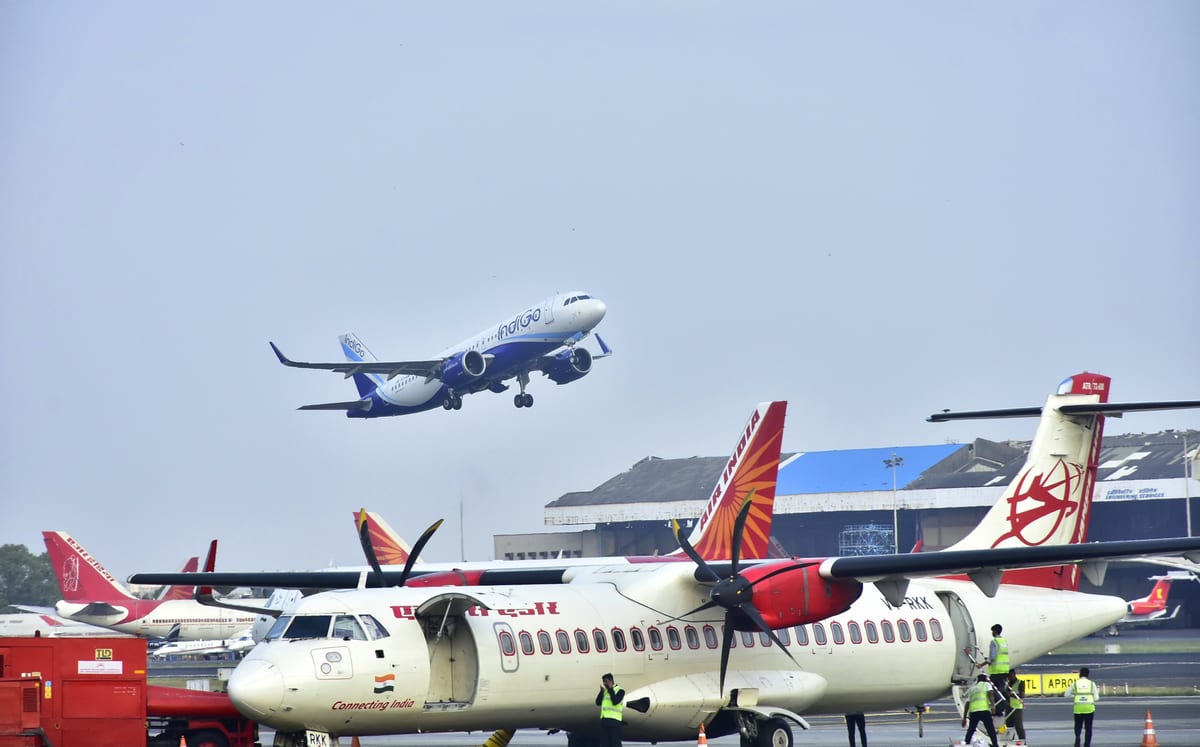
The new terminal at Jodhpur Airport carries the unmistakable silhouette of Rajasthani heritage — arches borrowed from havelis, jharokha screens rendered in modern cladding, the whole structure reaching for a 5-Star GRIHA sustainability rating. It is architecturally ambitious. Whether it proves economically transformative depends less on the building itself and more on what happens in the decade that follows its inauguration by Prime Minister Narendra Modi on July 4, 2026.
The terminal spans approximately 23,000 square metres and is designed to handle 20 lakh passengers annually — a doubling of throughput that the old facility could not have managed. Built at a total cost of ₹480 crore, it arrives alongside something arguably more consequential: a modified UDAN (Ude Desh ka Aam Nagrik) scheme with ₹28,840 crore allocated over the next ten years. Chief Minister Bhajanlal Sharma, present at the ceremony, framed both as pillars of a Viksit Rajasthan agenda linked directly to the national Viksit Bharat 2047 goal.
What the Modified Scheme Must Fix
The original UDAN, launched in 2016 under the National Civil Aviation Policy, subsidised routes connecting smaller cities that commercial airlines had always ignored. For several years it delivered visible results — regional airports lit up on maps that previously showed nothing but metro-to-metro arteries. But the scheme developed a structural problem: airlines launched routes for the subsidy window, collected viability gap funding, and then abandoned routes once the incentive thinned. The discontinuation rate across earlier UDAN rounds frustrated the Ministry of Civil Aviation.
ICRA aviation analyst Kinjal Shah has noted that UDAN route viability depends critically on state government co-funding commitments, which have been uneven. The modified 2026 iteration carries a significantly larger financial envelope precisely because the previous one under-resourced the problem. But money alone does not solve a structural flaw. What the revised scheme needs — and what the ₹28,840 crore allocation creates an opportunity to embed — is performance-linked disbursement: viability gap subsidies tied not to route launch but to route retention over a defined minimum period, measured against actual passenger load factors. Without that structure, the new scheme risks repeating the old cycle at greater expense.
The scheme also reportedly focuses on multiple strategic components, including integration of newer aircraft categories — helicopters and seaplanes — which broadens connectivity beyond conventional fixed-wing routes. For a state like Rajasthan, with dispersed heritage sites and desert terrain that road networks serve poorly, seaplane connectivity to reservoir catchments and helicopter links to remote forts could open new tourism circuits. That is the creative possibility of the modification; execution will depend on whether state-level tourism departments and the Airports Authority of India coordinate with the discipline the idea demands.
Jodhpur Is Not Just a Tourism Story
It would be easy to frame the Jodhpur terminal purely as a heritage tourism infrastructure play — the Blue City, the Mehrangarh fort, the camel-track romanticism of the Thar. That framing is incomplete. Jodhpur sits astride one of India's most significant textile and handicraft export clusters, with Balotra — the prime minister's next stop on the same day — functioning as a major hub for dyeing, printing, and processing of fabrics sold into European and American markets.
The Balotra visit was no afterthought. Modi was scheduled to dedicate, inaugurate, and lay the foundation stone for multiple development projects worth approximately ₹1.06 lakh crore in the area — a number that dwarfs the airport terminal investment and signals that the government reads this corridor as an integrated economic zone rather than isolated infrastructure dots. Improved air connectivity to Jodhpur reduces the time-cost gap between Balotra's production clusters and the buyers who currently fly into Delhi or Mumbai and spend half a day on the road. A buyer who can fly direct to Jodhpur, transact in Balotra, and fly out is a buyer who comes more often and commits larger orders.
The Takshashila Institution's infrastructure policy researchers have argued that regional connectivity schemes succeed only when paired with last-mile surface transport improvements at destination cities — a gap that Rajasthan's road development projects announced alongside the airport inauguration partially address. An airport that handles 20 lakh passengers a year means little if the road to the city centre takes forty minutes. The simultaneous announcement of road projects in the same geography suggests the government has grasped this integration imperative, even if the test remains in delivery rather than announcement.
The Dual-Use Dimension
Jodhpur is home to a significant Indian Air Force base — one of the most operationally important in the western sector, given the airport's proximity to the international border with Pakistan. Civil airport upgrades at dual-use facilities carry implicit strategic value: improved ground handling infrastructure, expanded apron capacity, and better passenger terminal throughput also strengthen the logistical depth of the military installation that shares the airfield.
This is not unique to Jodhpur — many of India's regional airports operate on shared civil-military frameworks — but it is worth naming plainly. Infrastructure investment in this particular geography is never purely civilian in its strategic calculus, and the government's decision to scale up the facility during a period of heightened attention to India's western border posture reflects an awareness of that duality.
The Passenger Numbers That Make This Necessary
Former AAI Chairman Arvind Singh had publicly stated that Tier-2 airport upgrades are essential to absorbing India's projected doubling of air passengers to 300 million annually by 2030, a target that requires non-metro airports to carry a significantly larger share of total traffic. Delhi's Indira Gandhi International and Mumbai's Chhatrapati Shivaji Maharaj are already operating at or near design capacity during peak periods. Every Jodhpur terminal that reaches its 20-lakh-passenger annual ceiling is one million passengers who did not add to the congestion at India's gateway hubs.
Regional airport development is therefore not a concession to political geography — it is a structural necessity for a country whose aviation market is growing faster than its primary infrastructure can absorb. The modified UDAN scheme, with its ten-year ₹28,840 crore horizon, recognises this as a sustained investment challenge, not a one-cycle problem. Whether the scheme's implementing framework matures from route subsidy to route stewardship — rewarding sustained connectivity rather than initial launch — will determine whether the desert's new gateway becomes a permanent feature of India's aviation map or another underutilised terminal waiting for the next inauguration.
The jharokhas carved into Jodhpur's new terminal face a familiar Rajasthani skyline. What they look out onto economically — whether a corridor of integrated commerce and mobility or an underperforming asset in a thin regional market — will be answered not in the architecture but in the policy mechanics that follow it.