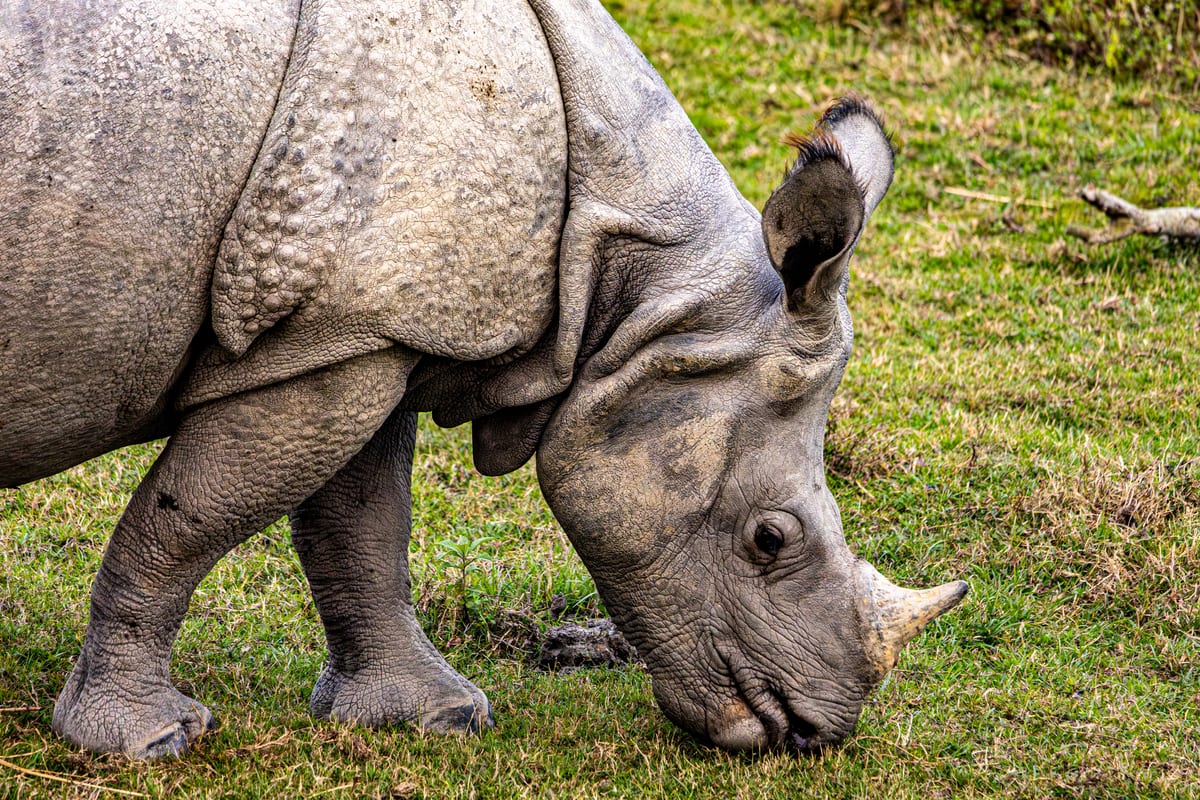
There is a moment, somewhere in the tall elephant grass of Kaziranga, when the ordinary world falls away. The jeep engine cuts to silence. The mahout on the elephant's back raises one hand. And there, perhaps forty metres ahead, stands a one-horned rhinoceros, unhurried, armoured, improbably alive, gazing back at you with the patient authority of a creature that was here long before the idea of India was ever written down. In that moment, you do not feel like a tourist. You feel like a witness.
A Land Older Than Its Name
Kaziranga is not a recent creation. The floodplains of the Brahmaputra valley, which cradle this ecosystem in the northeastern state of Assam, have sustained extraordinary biodiversity for tens of thousands of years. The Brahmaputra, one of the few rivers in the world that carries a masculine name, shapes and reshapes this landscape annually through its great floods, depositing silt, carving wetlands, and sustaining the tall terai grasslands that make Kaziranga unlike any other protected area in the subcontinent.
The park's modern history begins in the early twentieth century. Mary Curzon, wife of the Viceroy Lord Curzon, visited the region in 1904 and was troubled by the alarming decline of the rhinoceros population. Her concern prompted official protection efforts. By 1905, a Reserved Forest was notified. In 1974, Kaziranga was declared a National Park. In 1985, UNESCO inscribed it as a World Heritage Site, recognizing not just its biodiversity but humanity's capacity to reverse its own damage when it acts with conviction.
Yet the park's significance extends beyond colonial-era conservation. The Ahom kingdom, which governed Assam for nearly six centuries before British arrival, maintained a sophisticated relationship with the forests and rivers of this region. The Mising, Karbi, and other indigenous communities whose ancestral territories overlap with or border the park have embedded respect for wildlife into oral tradition, ritual, and seasonal practice across generations. Kaziranga's survival is a civilisational achievement, one that predates the gazette notification by centuries.
The Rhinoceros and India's Covenant with the Wild
At the heart of Kaziranga's story is the Indian one-horned rhinoceros (Rhinoceros unicornis). At the turn of the twentieth century, the population in this region had collapsed to fewer than a dozen animals, hunted for sport and for the mythologised value of the horn. Today, Kaziranga protects the world's largest concentration of this species, a recovery so dramatic that it has become a global benchmark for conservation success.
In Indian civilisational thought, from the Vedic tradition through the teachings of Mahavira and the Ashoka edicts, the protection of non-human life is not sentimentality, it is dharma. Emperor Ashoka's rock edicts, inscribed more than two thousand years ago, explicitly prohibited the killing of certain animals and established what we might today call protected areas. The rhino's return in Kaziranga reads through this lens as the restoration of a very old agreement.
Beyond the rhinoceros, Kaziranga's biodiversity is staggering. The park shelters significant populations of wild water buffalo, swamp deer (barasingha), Asian elephants, tigers, leopards, and sloth bears. Its wetlands support over 480 recorded bird species, including the rare greater adjutant stork. The Incredible India page for Kaziranga offers a comprehensive overview of what makes this destination one of India's premier natural heritage experiences.
What Visitors Experience
Kaziranga is divided into several ranges, Central (Kohora), Western (Bagori), Eastern (Agaratoli), and Burapahar among them, each offering a distinct landscape and wildlife encounter. Most visitors begin in the Central Range, which offers the densest concentration of rhinos and is the most accessible from the main highway town of Kohora.
Safari options include jeep safaris and elephant-back safaris. Riding an elephant through the grasslands at dawn, the mist clinging to the grass tips, the distant silhouette of the Karbi Anglong hills rising to the south, is an immersive experience. You move with the landscape rather than through it. The elephant's rhythmic sway, the smell of wet earth, the sudden burst of egrets from the reeds define travel as immersion rather than observation.
The town of Kohora and surrounding areas offer a window into Assamese culture. Local dhabas serve rice, fish curry, and masor tenga, the beloved sour fish dish of Assam, alongside cups of Assam tea. Several eco-lodges and heritage resorts operate near the park boundaries, offering guided nature walks, cultural programmes, and interactions with local artisans who work in bell metal, cane, and bamboo, crafts with centuries of lineage.
Best Time to Visit and How to Reach
Kaziranga is open to visitors roughly from November through April. The park closes during the monsoon months, typically June through October, when the Brahmaputra floods much of the grassland, forcing wildlife to migrate to higher ground in the Karbi Anglong hills. This seasonal flooding is the ecological heartbeat of Kaziranga. The silt renews the grasslands; the wetlands sustain the waterfowl; the annual cycle of retreat and return keeps the ecosystem alive.
The finest months to visit are February and March, when the grasses have been cut or burned back, visibility is high, and animals, including large herds of elephants, are easily spotted in the open. November and December are cooler and pleasant, while April offers the spectacle of newborn rhino calves in the grasslands.
Reaching Kaziranga is straightforward. The nearest airport is Jorhat, approximately 97 kilometres away, with connections to Guwahati, Kolkata, and Delhi. The nearest railway station is Furkating, about 75 kilometres from Kohora. Guwahati, Assam's capital, is roughly 217 kilometres to the west and well connected by road, rail, and air; state transport buses and private vehicles cover the distance to Kohora comfortably. The drive along National Highway 37 through the Brahmaputra valley is itself a journey of quiet beauty.
Nearby Attractions
Kaziranga sits in a region of remarkable richness. Majuli, the world's largest river island and a centre of Vaishnavite culture and the sattra monastery tradition, is accessible from Jorhat and makes a rewarding extension to any Kaziranga visit. The Karbi Anglong hills form the southern boundary of the park and offer trekking, tribal cultural experiences, and a different, more forested landscape. Sivasagar, the former capital of the Ahom kingdom, with its extraordinary temples and royal tanks, is within driving distance and provides historical and cultural counterpoint to Kaziranga's natural drama. Tea estate visits, to the storied gardens of upper Assam, complete a picture of a region that is living history.
Why Kaziranga Belongs in India's Heritage Story
India's heritage story is too often told in stone, in the arches of Mughal monuments, the carvings of temple gopurams, the inscriptions of Ashokan pillars. Kaziranga asks us to read heritage differently: in the breath of a rhino, in the arc of an adjutant stork crossing a wetland at dusk, in the floodwaters that return each monsoon to renew a covenant between a river and a grassland that has held for longer than human memory reaches.
To visit Kaziranga is to understand that India's civilisation is not only what was built. It is also what was preserved, what was defended, and what was, against considerable odds, brought back. In the one-horned rhinoceros of Kaziranga, something ancient has been kept faith with. That, in itself, is a story worth travelling a long way to witness.