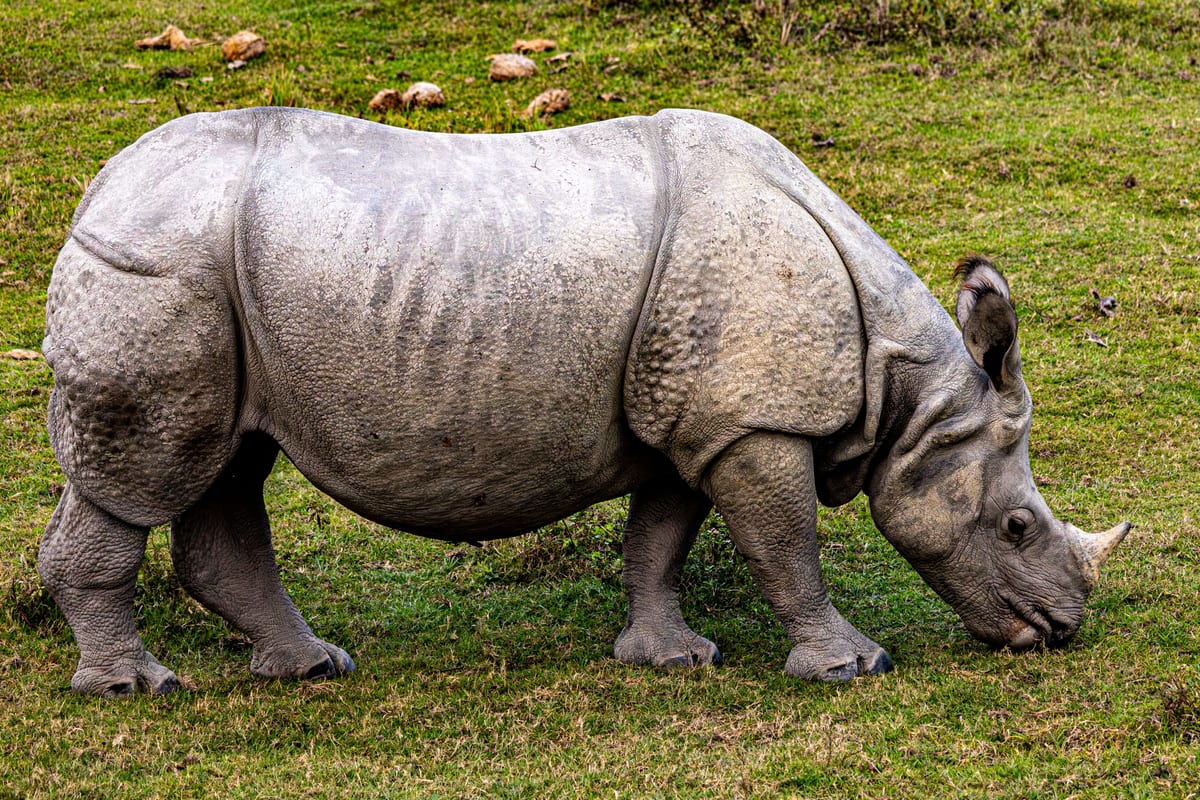
There are places in India where you do not simply visit, you bear witness. Kaziranga is one of them. Spread across the floodplains of the Brahmaputra in Assam, this national park is home to India's largest concentration of one-horned rhinoceroses. Here, in the tall elephant grass and the shallow, reed-edged beels, the rhinoceros walks as it has for thousands of years, unhurried, enormous, and sovereign. To stand at the edge of a Kaziranga dawn and watch one of these creatures emerge from the mist is to feel that you are in the presence of something ancient and irreplaceable.
A Landscape Older Than Its Borders
Kaziranga was declared a Reserved Forest in 1908, largely through the advocacy of Mary Curzon, wife of the then Viceroy of India, who visited the area and found the rhinoceros population in alarming decline due to poaching. It became a wildlife sanctuary in 1950 and was granted national park status in 1974. In 1985, UNESCO inscribed it as a World Heritage Site, formal recognition of what people in Assam had understood for far longer: that this land is extraordinary, and that its creatures deserve protection.
But to frame Kaziranga's conservation story as a colonial-era intervention would be to misread the deeper current running beneath it. India's relationship with the rhinoceros, called gainda in Assamese, is ancient. The Ahom kingdom, which ruled Assam for nearly six centuries, maintained a profound cultural reverence for wildlife. Elephants were consecrated. The natural world was not a backdrop to civilisation; it was part of its architecture. Kaziranga is not a park created to solve a modern problem. It is a modern institution built on a civilisational instinct that never entirely disappeared.
What You Encounter Here
Kaziranga is divided into multiple ranges, Kohora, Bagori, Agaratoli, and Burapahar among them, each with a distinct character of landscape and wildlife. The park is home to the Indian one-horned rhinoceros (Rhinoceros unicornis), whose global population is concentrated here, as well as Bengal tigers, Asian elephants, wild water buffalo, swamp deer, and over 480 bird species. Kaziranga is a declared Tiger Reserve, and its tigers move with the same unhurried authority as its rhinos.
Jeep safaris take visitors deep into the grasslands in the early morning, when the light is bronze and the dew sits on the tall reeds. Elephant safaris, available in certain zones, offer an entirely different perspective, elevated, intimate, and quiet. Moving through tall grass on the back of an elephant allows you to experience the landscape as it has been traversed for centuries. The Brahmaputra, wide and grey-green along the northern boundary of the park, adds a sense of vast, unhurried time to everything.
Birdwatchers will find Kaziranga exceptional. The park hosts over 480 species of birds, including the greater adjutant stork, pelicans, fishing eagles, and migratory waterfowl during winter months. The beels, shallow seasonal lakes, are essential for serious birders.
The Cultural Surround: Assam Beyond the Park
Kaziranga does not exist in cultural isolation. The Assamese landscape around the park is deeply storied. The town of Jorhat, often used as a base for visitors, is the cultural heartland of upper Assam, home to satras (Vaishnavite monastic institutions founded by the saint-philosopher Srimanta Sankardeva in the fifteenth century), classical Sattriya dance, and centuries of Ahom civilisational memory. A visit to Majuli, the river island and seat of Sattriya culture, pairs well with a trip to Kaziranga.
Nearby, the Gibbon Wildlife Sanctuary protects the hoolock gibbon, India's only ape, while the Pobitora Wildlife Sanctuary, closer to Guwahati, shelters another significant rhinoceros population. Tea estates, Assam produces some of the world's most celebrated black teas, spread in every direction, and many offer heritage bungalow stays that recall a layered colonial past while remaining rooted in Assamese hospitality.
When to Go and How to Reach
The park is open from roughly November to April each year; it closes during the monsoon season when the Brahmaputra floods significant portions of the landscape, a natural cycle that replenishes its grasslands and waterways annually. The finest months for wildlife sightings are February through April, when vegetation thins and animals are more visible, and the light on the Brahmaputra floodplains is extraordinary in the early morning hours.
The nearest major airport is Jorhat Airport, approximately 97 kilometres from Kohora, the main entry point to the park. Guwahati's Lokpriya Gopinath Bordoloi International Airport, well-connected to major Indian cities, is approximately 217 kilometres away and serves as the primary gateway for most visitors. From Guwahati, Kaziranga is accessible by road along the NH27, a drive that passes through the Brahmaputra valley and takes roughly four to five hours. Guwahati is also connected by rail to major Indian cities; Furkating Junction is the nearest railway station to the park itself.
Accommodation around Kaziranga ranges from government-run forest lodges and eco-camps within or adjacent to the park boundary to comfortable private resorts. Booking well in advance, particularly for the peak February-to-April window, is strongly advised.
Why Kaziranga Belongs in India's Heritage Story
India is a civilisation that has understood, at its deepest level, that the human covenant with the living world is not optional. The rhinoceros in Kaziranga is a co-inheritor of this subcontinent, a creature that has survived ice ages, shifting rivers, and human ambition. Its continued presence here is a measure of whether we are keeping our oldest promise.
That promise is being kept, imperfectly, with struggle, with the ongoing challenge of poaching and human-wildlife conflict at the park's edges, but kept nonetheless. Kaziranga's rhinoceros population has recovered from near-extinction to represent the majority of the world's one-horned rhinos. That is a conservation achievement and a civilisational one.
To travel to Kaziranga is to travel into India's living memory, to stand inside it, in the tall grass, in the morning mist, while something vast and ancient moves nearby, indifferent to your presence and magnificent for it.
For comprehensive visitor information, travel planning resources, and official guidance, visit the Kaziranga destination page on Incredible India, the official tourism portal of the Ministry of Tourism, Government of India.