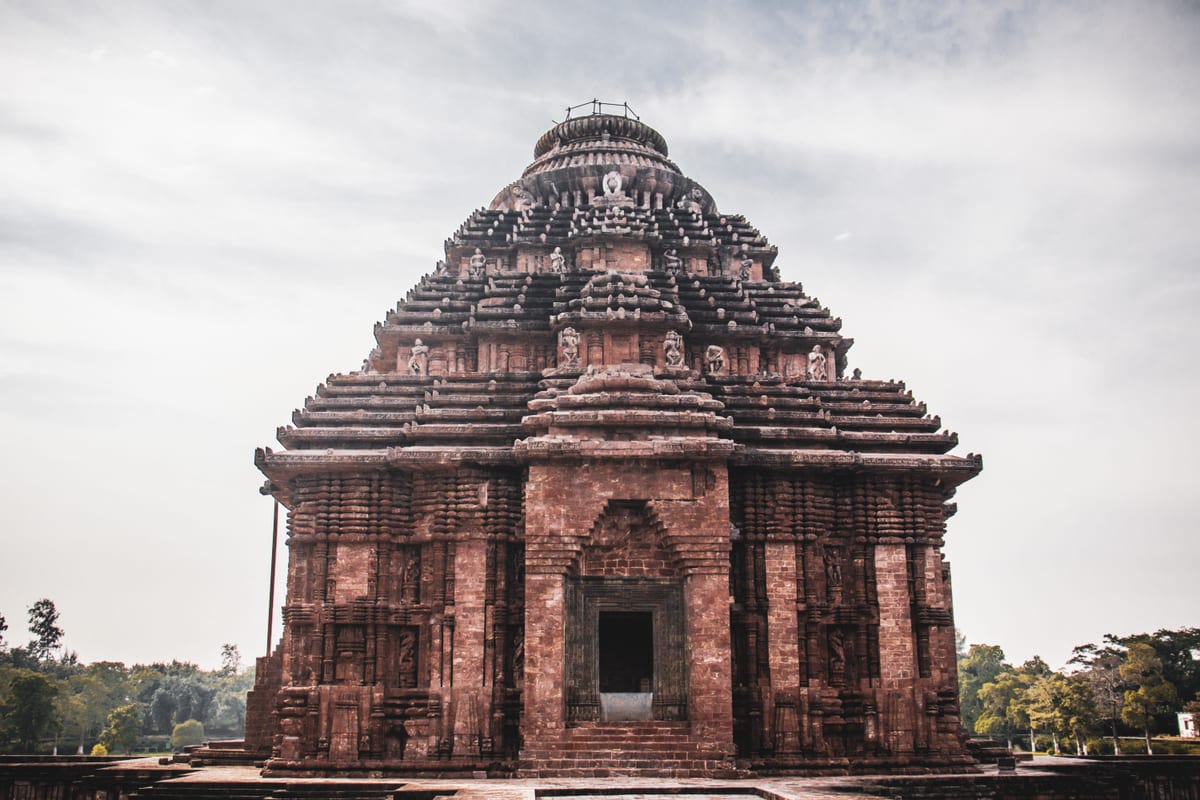
There is a moment, if you arrive early enough, when the first light of the Odisha morning falls on the stone horses of Konark and the entire eastern facade of the temple seems to move. The seven horses, carved in full gallop, straining against their reins, pull a chariot that has not moved in eight centuries and yet has never, somehow, stood still. This is the Konark Sun Temple, and from the instant you stand before it, you understand that you are not looking at a ruin. You are looking at an intention.
A Temple Built to the Scale of the Cosmos
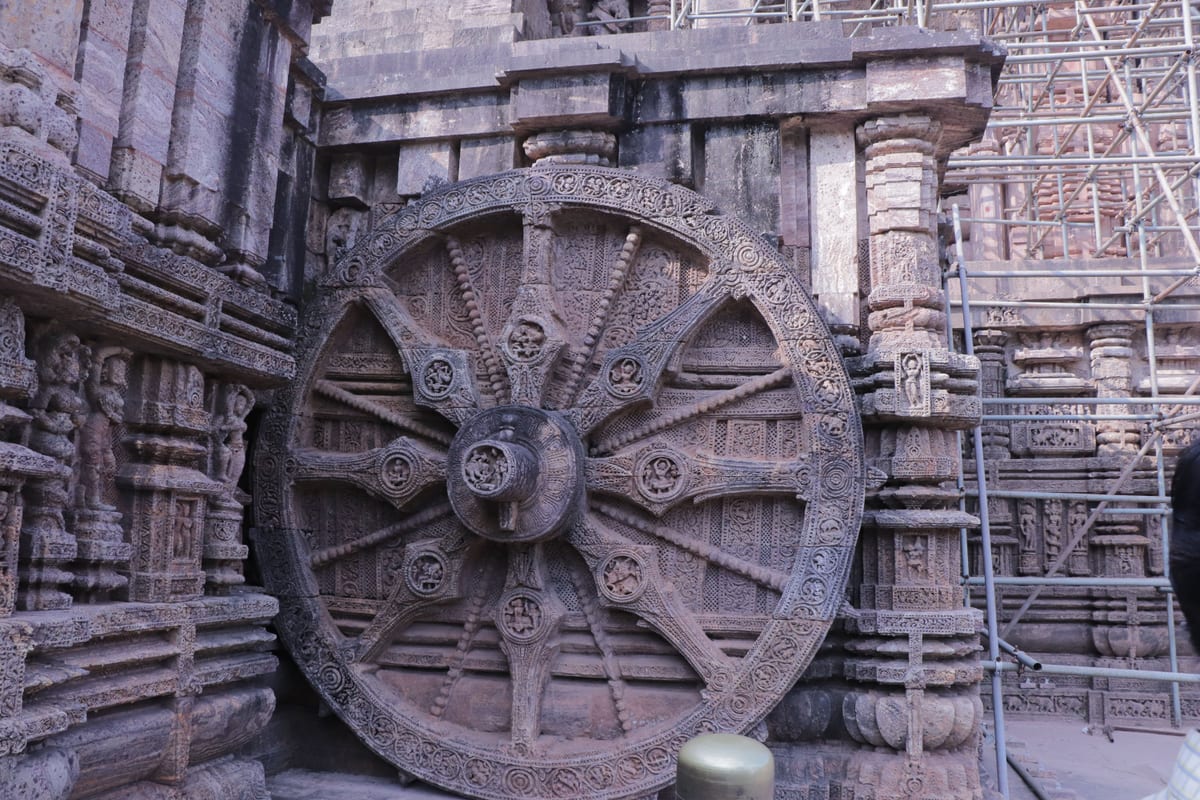
Constructed in the 13th century CE, around 1250 CE, by King Narasimhadeva I of the Eastern Ganga dynasty, the Konark Sun Temple was conceived as a colossal chariot for Surya, the sun god. The design is remarkable in its literalism and poetry: twelve pairs of elaborately carved wheels line the base of the platform, seven horses charge forward from the western entrance, and the entire structure was originally oriented so that the first rays of the rising sun would strike the presiding deity within the sanctum. The architects of Konark choreographed the sun itself.
The temple sits on the Odisha coastline near Puri, where the Bay of Bengal shimmers on the horizon and the salt air carries the memory of ancient maritime trade routes. For centuries, sailors navigating these waters called it the Black Pagoda, using its dark-stone silhouette as a landmark that served commerce as faithfully as it served devotion.
The Language of Stone: Sculpture as Scripture
To walk around Konark is to receive an education that no classroom can replicate. The temple's exterior surfaces are encyclopaedic in their ambition. Friezes of elephants, horses, soldiers, musicians, dancers, and erotic couples spiral across every tier in a visual theology that refuses to separate the sacred from the sensual. This is the Kalinga tradition at its most confident: the assertion that the full spectrum of human experience, desire, devotion, duty, delight, belongs within the precincts of the divine.
The 24 wheels carved along the jagamohana (the porch or audience hall) are among the temple's most celebrated features, and rightly so. These are not decorative flourishes. Each wheel is a functional sundial, its spokes and their shadows used to read the time of day with remarkable accuracy. The wheel at Konark measures not just hours but the philosophical cycle of existence itself. In India's civilisational grammar, art and science were never separate dialects.
Explore the full heritage documentation and travel guidance at the Konark Sun Temple page on Incredible India, the official tourism portal of the Ministry of Tourism, Government of India.
Living Heritage, Not a Museum Piece
India's great civilisational error, if we are honest, is allowing the colonial gaze to define its own monuments as ruins. Konark is a UNESCO World Heritage Site, but it is also the anchor of a living cultural calendar. Every December, the Konark Dance Festival transforms the temple's open-air amphitheatre into a stage for classical Indian dance forms, Odissi, Bharatanatyam, Kathak, Manipuri, performed against the backdrop of stone sculptures that are themselves a choreographic masterpiece. The ancient and the living speak to each other across the courtyard, and the boundary between heritage and culture dissolves entirely.
Konark's purpose did not end simply because its shikhara (the main tower) fell. The Nata Mandir, the dance hall, still stands, and in its proportions you can read the ancient understanding that the performing arts and sacred architecture were one continuous act of offering.
Practical Guide: When to Go and How to Reach Konark
Best Season: The ideal time to visit Konark is between October and March, when the Odisha coast offers clear skies, manageable temperatures, and the magical quality of winter light that brings the warm sandstone to life. The Konark Dance Festival in December is a particularly compelling reason to time your visit. Avoid the monsoon months of June through September, when heavy rainfall and humidity can make outdoor exploration challenging, though the post-monsoon greening of the landscape has its own austere beauty.
Getting There: The nearest major city is Bhubaneswar, Odisha's capital, which is well connected by air, rail, and road to the rest of India. From Bhubaneswar, Konark is approximately 65 kilometres, roughly a 90-minute drive along a scenic coastal highway. The temple town of Puri, one of India's holiest pilgrimage sites, is only about 35 kilometres from Konark, making a combined itinerary both practical and spiritually resonant. Regular bus services and hired taxis operate along both routes.
Nearby Attractions: The Konark region rewards the unhurried traveller. Puri, home to the Jagannath Temple and one of the finest beaches in eastern India, is an essential companion destination. The Chilika Lake, Asia's largest brackish water lagoon and a sanctuary for migratory birds including flamingos, lies to the south and is well worth a half-day excursion. Bhubaneswar itself, often called the City of Temples, contains over 400 medieval shrines, including the Lingaraja Temple, and a visit completes what amounts to one of India's finest heritage circuits.
Why Konark Matters Now
We live in an age that is rediscovering the question of what civilisation actually means, not as a political argument but as a lived inheritance. Konark answers that question with quiet authority. A society capable of computing the angle of the winter solstice, encoding it in the spoke of a stone wheel, and surrounding that wheel with sculptures of transcendent beauty was not primitive. It was, in the truest sense of the word, civilised.
To visit the Konark Sun Temple is to remember something that India has always known and occasionally needed reminding: that the past is not behind us. It is precisely beneath our feet, turning, like a wheel, marking time.