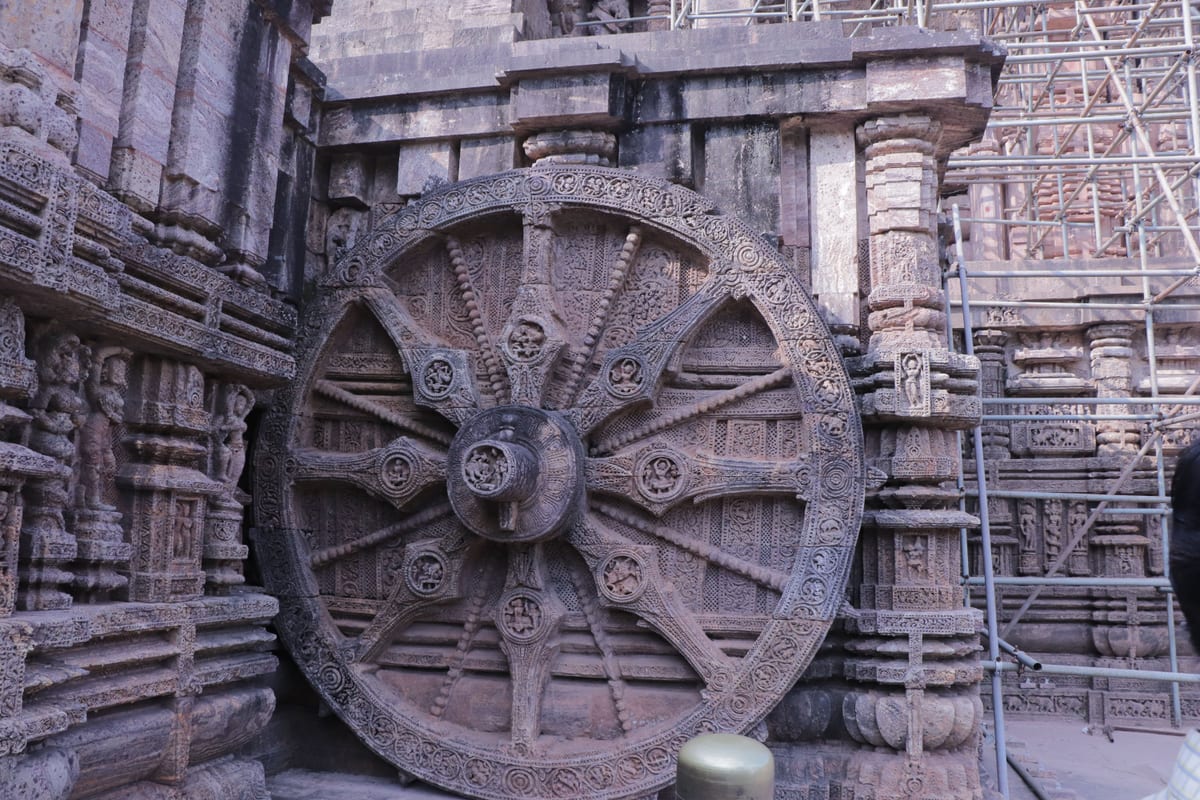
There is a moment, usually just after sunrise, when the first light falls at a particular angle across the stone wheels of the Konark Sun Temple and the entire structure seems to pulse. Not metaphorically. The wheels, twelve pairs of them, each intricately carved, each functioning as a sundial, catch the light and cast shadows that actually tell the time. The ancients who built this place were not simply devotees. They were astronomers, mathematicians, philosophers, and artists working in stone. They were building a message for eternity.
A Chariot Frozen in Time
The Konark Sun Temple, located on the shores of the Bay of Bengal in Odisha's Puri district, was constructed in the 13th century CE, attributed to King Narasimhadeva I of the Eastern Ganga dynasty. The entire temple is designed as the celestial chariot of Surya, the Sun God, drawn by seven mighty horses across the heavens. The structure originally stood with a towering shikhara, estimated at over 70 metres, that served as a landmark for sailors navigating the Bay of Bengal, who called it the Black Pagoda because of the way it appeared against the horizon.
Today, the main sanctum no longer stands in its full height. Centuries of neglect, invader raids, and coastal weather took their toll. The Jagamohana (assembly hall) and the magnificent platform survive with a grandeur that silences visitors mid-sentence. What remains is, without exaggeration, one of the most elaborate architectural experiences on earth.
The Language of Stone
Every surface of Konark is carved, with intent, narrative, and philosophical precision. The sculptural programme moves through three registers: the celestial and divine at the top, the worldly and courtly in the middle, and the sensuous and erotic at the lower levels. This is a visual cosmology drawn from Hindu thought, in which desire, duty, and divinity are not contradictions but a continuum.
The famous erotic panels of Konark have drawn both controversy and wonder for centuries. Within their artistic context, they represent the full spectrum of human experience, the Kama of the Purusharthas, and their placement on a sacred structure reflects a civilisational worldview that did not sever the sacred from the embodied. Scholars, pilgrims, and curious travellers have stood before these panels for generations, and every interpretation reveals something about the beholder as much as the builders.
The carvings depict royal processions, musicians, dancers, elephants, war scenes, mythological narratives, and animals and flora observed with naturalist precision. This was a civilisation looking at the world with open eyes and carving what it saw.
A UNESCO World Heritage Site, and More
Konark was inscribed as a UNESCO World Heritage Site in 1984, recognised for its outstanding universal value as a masterpiece of human creative genius. For India, the temple carries additional weight. It appears on the Indian ten-rupee currency note. Its wheel, the Konark Chakra, graces the state emblem of Odisha. The Konark Dance Festival, held annually in December against the temple's backdrop, celebrates classical Indian dance forms including Odissi, Bharatanatyam, Kathak, and Manipuri. Stone and movement merge. Ancient and present exist together. The civilisation still breathes.
You can learn more about the temple and plan your visit through the official Incredible India page for Konark Sun Temple, maintained by India's Ministry of Tourism.
What the Visitor Experiences
Walking into the Konark complex unfolds slowly. You approach through a broad promenade, and the Jagamohana rises ahead, massive, intricate, and yet organic, as if it grew from the earth rather than being placed upon it. The stone is warm-toned khondalite and chlorite, and in different light, morning gold, noon white, dusk amber, the carvings seem to shift expression.
The Archaeological Survey of India maintains the site with care. The Konark Museum, within the complex, houses sculptures removed from the temple for preservation, including examples of Kalinga-period art. Spend time here. Let your eyes adjust to what master sculptors achieved with a chisel and a vision of the cosmos.
Many visitors arrive as day-trippers from Puri, rushing through in two hours. That is a mistake. Konark rewards slowness. Arrive at dawn when the light is oblique and revelatory. Return at dusk when the stone turns the colour of embers. The temple changes, and so will you.
Best Time to Visit
The ideal window to visit Konark is October through February, when Odisha's coastal climate is at its most forgiving, warm days, cool evenings, and the monsoon a distant memory. December is particularly special: the Konark Dance Festival, usually held in the first week of the month, transforms the temple precincts into an open-air theatre of classical Indian dance, with the floodlit temple as the only backdrop any performer could wish for. Avoid the peak summer months of May and June, when temperatures can be punishing and the coastal humidity unrelenting.
How to Reach Konark
Konark is approximately 65 kilometres from Bhubaneswar, Odisha's capital and its primary transport hub. Bhubaneswar Airport is well-connected to Delhi, Mumbai, Kolkata, Hyderabad, and Bangalore. From Bhubaneswar, taxis and buses run regularly to Konark. The drive takes around 90 minutes and passes through the coastal town of Puri, itself a major pilgrimage centre.
Many travellers base themselves in Puri, just 35 kilometres from Konark, and do the Golden Triangle of Odisha, Bhubaneswar, Puri, and Konark, as a single circuit. Puri's Jagannath Temple, the beaches, and the seafood justify the detour. State-run OSRTC buses and private taxis connect all three points.
Nearby Attractions
Chandrabhaga Beach, just a kilometre from the temple, is one of Odisha's cleanest and least crowded shores, a place to sit after the temple's intensity and let the Bay of Bengal do its work. Ramachandi Beach is another quiet retreat. The Pipili Craft Village, on the Bhubaneswar–Puri highway, is famous for its vibrant appliqué textile work, a perfect place to bring something living home from Odisha.
For the culturally curious, the trail of Odisha's temple architecture does not end at Konark. The Lingaraja Temple in Bhubaneswar, the Mukteshwar Temple, and the cave monasteries of Udayagiri and Khandagiri form a constellation of achievement that makes Odisha one of the most underrated heritage destinations in Asia.
Why Konark Matters
India has extraordinary monuments. Konark occupies a singular place in the national imagination because of what it attempted: to render the cosmos in stone, to make the movement of the sun into architecture, to say, in granite and chlorite and 1,200 carved figures, that human devotion, human intellect, and human creativity are themselves acts of worship. That is not the statement of a civilisation in decline. That is the statement of a civilisation at its most alive.
When you stand before those twelve stone wheels as the morning light shifts and a shadow-hand moves across their spokes to tell you the hour, you are not looking at history. You are receiving a transmission. Konark still speaks. The only question is whether you are listening.