There is a moment, as you round the final bend of the approach road through the casuarina groves near Konark, when the Sun Temple appears, and the breath simply leaves you. Not because it is large, though it is. Not because it is old, though it is eight centuries deep in time. The breath leaves you because the structure seems to be moving. The colossal stone chariot of the sun god Surya, drawn by seven rearing horses across its carved plinth, gives the illusion of perpetual forward momentum. You feel, quite involuntarily, that you have stepped into something cosmic and unhurried, something that was never quite finished, and never quite stopped.
A Temple Built on the Logic of the Sun
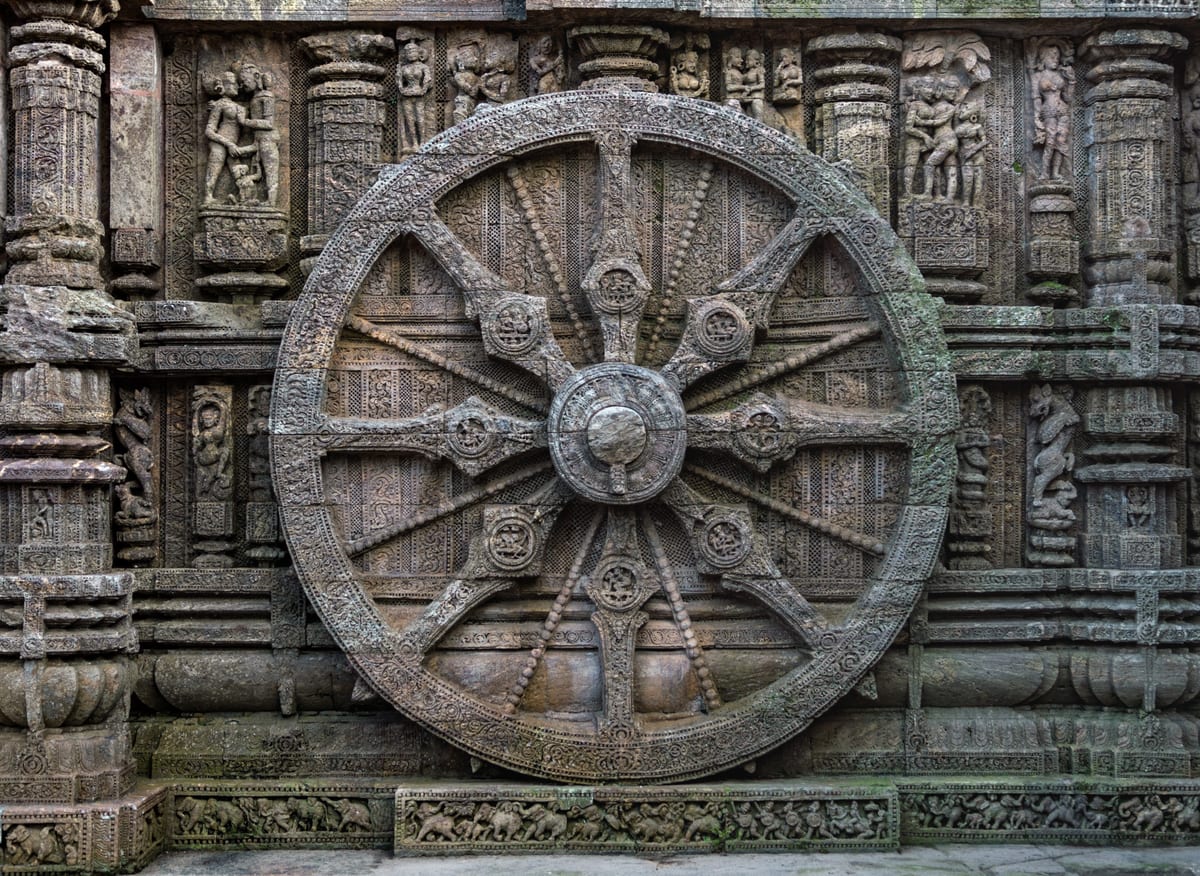
The Konark Sun Temple was built in the thirteenth century CE by King Narasimhadeva I of the Eastern Ganga dynasty. The entire structure is designed as the chariot of Surya, the Hindu solar deity, a divine vehicle with 24 elaborately carved stone wheels, each approximately three metres in diameter, set along the base of the sanctum. Seven magnificent horses strain at the front of the plinth, representing the seven days of the week and the seven colours of visible light, pulling the chariot of time itself eastward toward the rising sun.
The 24 wheels are not decorative. Each wheel functions as a sundial, its spokes calibrated to divide the day into hours with mathematical accuracy that continues to astonish archaeologists and astronomers. The orientation of the entire temple complex aligns so that the first light of dawn would once have struck the sanctum's presiding deity directly, the sun god illuminated by his own element at sunrise. Here was a civilisation that did not separate science from devotion, that understood celestial mechanics as inseparable from faith.
For more details on the temple's history and significance, visit the official Incredible India page on Konark Sun Temple, maintained by India's Ministry of Tourism.
Reading the Stone, A Civilisation's Self-Portrait
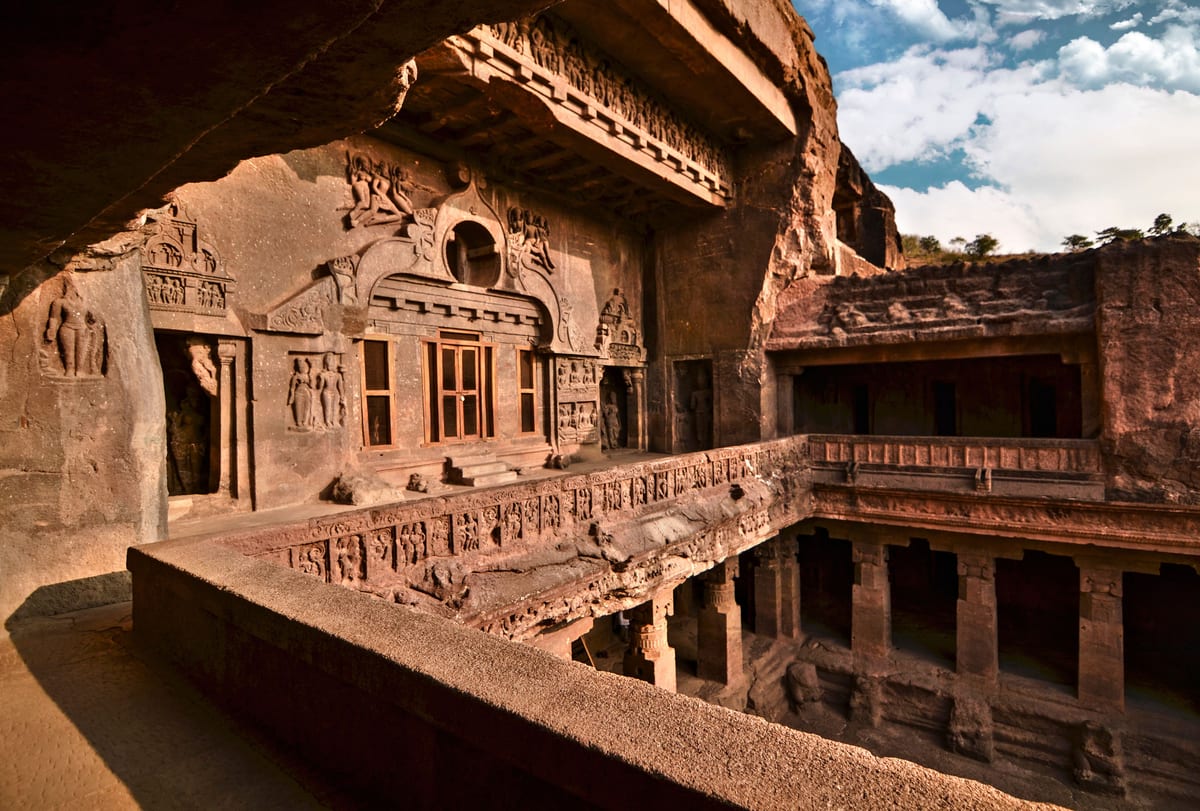
To walk around the temple's exterior walls is to read an entire civilisation's understanding of itself. The sculptural programme at Konark is extraordinarily comprehensive and deliberate. Panels of celestial musicians, dancers frozen mid-gesture, animals mythological and real, the famous mithuna figures of sensual coupling, processions of soldiers and courtiers, scenes of daily life in medieval Odisha, all are carved with a fluency and detail that suggests artists working within a shared visual language.
The mithuna sculptures, the erotic carvings that startled early colonial observers, are not decoration or provocation. Within the temple's symbolic grammar, they present a complete vision of kama as one of the four aims of human life, honoured and integrated rather than denied. The temple does not turn away from the full spectrum of lived experience. It holds it all, desire, devotion, time, death, dance, war, love, within a single sacred architecture. That is what makes Konark a civilisational document rather than merely a religious monument.
The main sanctum tower, once reportedly soaring to approximately 70 metres, has not survived intact. What remains, the jagamohana or assembly hall, the sculptural plinths, the extraordinary wheels and horses, was designated a UNESCO World Heritage Site in 1984, placing Konark among the most significant cultural monuments on earth.
The Living Pulse: Konark Dance Festival
One of the most compelling expressions of Konark as living heritage arrives every December, when the Konark Dance Festival unfolds against the temple itself. Classical Indian dance forms, Odissi, Bharatanatyam, Kathak, Manipuri, Kuchipudi, are performed on an open-air stage with the illuminated temple as backdrop. The same stone that once framed apsaras and gandharvas in frozen movement now frames living dancers in real movement. The conversation the temple began eight hundred years ago continues, in the bodies of dancers who have trained for decades in traditions the temple helped inspire.
When to Visit and How to Get There
The ideal season to visit Konark is between October and March, when Odisha's coastal climate is temperate and the light, particularly the golden hour of morning, brings the temple's sandstone surfaces alive in amber and rose. The summer months between April and June are intensely hot and humid, and the monsoon season can make outdoor exploration difficult.
Konark sits approximately 65 kilometres from Bhubaneswar, Odisha's capital city, and about 35 kilometres from Puri. Bhubaneswar's Biju Patnaik International Airport is the most convenient air gateway, with connections to Delhi, Mumbai, Kolkata, Chennai, and Bengaluru. From Bhubaneswar and Puri, regular buses, shared taxis, and private cab services reach Konark, with the road passing through coastal Odishan countryside.
Nearby attractions make the region rewarding for those spending several days. Puri, with its magnificent Jagannath Temple and famous sea beach, is a natural companion destination, one of Hinduism's holiest pilgrimage cities. The Chilika Lake, Asia's largest coastal lagoon and a sanctuary for migratory birds including flamingos and Irrawaddy dolphins, lies south of Bhubaneswar and is easily combined into a longer Odisha itinerary. The Dhauli Shanti Stupa near Bhubaneswar, marking the site of the Kalinga War where Emperor Ashoka underwent his transformation toward non-violence, adds another civilisational layer to any visit to this part of India.
Why Konark Matters in India's Heritage Story
India has no shortage of magnificent temples. What makes Konark singular is the precision of its argument. This was not a structure built merely to house a deity or impress a populace. It was built to encode a worldview, one in which the movement of the sun through time, the fullness of human experience, the rigour of mathematics, and the urgency of devotion formed a single, integrated reality.
Konark asks something of its visitors. It asks you to stand before it and reckon with the seriousness of what was once imagined here. It asks you to acknowledge that the civilisation which built this temple was not primitive, not mystical in the dismissive sense, not simply decorative, but was engaged in exactly the kind of comprehensive, ambitious, intellectually rigorous project that we associate with the greatest human achievements in any tradition, any era, any corner of the world.
To visit Konark is to receive that argument in stone. And stone, as the temple demonstrates, is very patient.