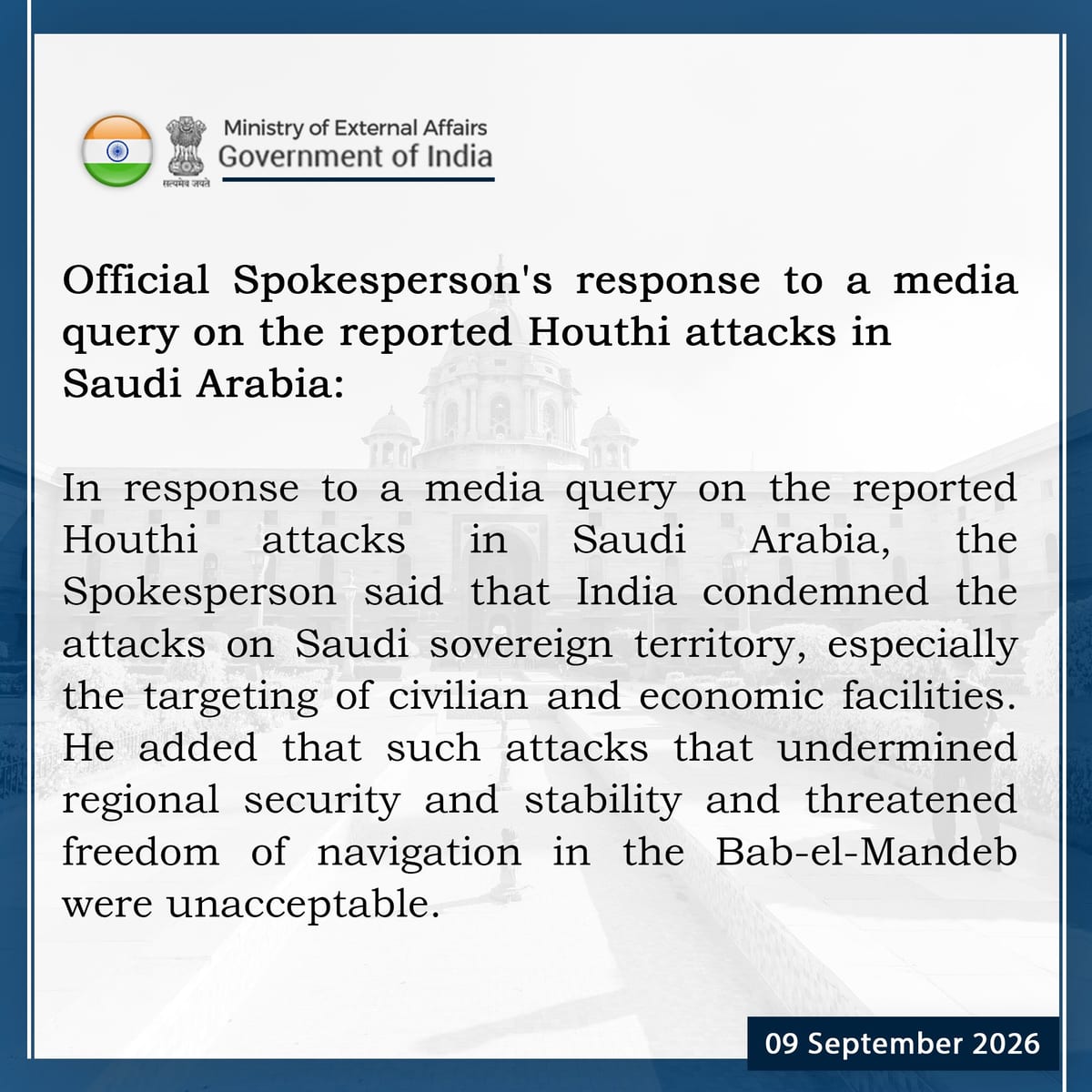
The Ministry of External Affairs condemned Iranian-backed Houthi attacks on Saudi Arabia after Saudi authorities reported 73 civilian injuries in Abha, Jazan, Khamis Mushait and Najran. Spokesperson Randhir Jaiswal told media inquiries that India "condemned the attacks on Saudi sovereign territory, especially the targeting of civilian and economic facilities." The statement, reported by LiveMint, called such actions "unacceptable" and said they "undermined regional security and stability and threatened freedom of navigation in the Bab-el-Mandeb."
The condemnation followed the Houthis' claim, cited by Reuters, that they had carried out one of the largest attacks on Saudi territory since the US-Israeli war on Iran began in February. The group struck an airbase in Khamis Mushait and oil infrastructure in nearby cities on Tuesday. Saudi authorities said the attacks caused temporary shutdowns at oil sites and injured 73 people, including women and children.
The exchange of fire
By Wednesday, the Houthis' Almasirah television reported more than 30 Saudi strikes on several regions, including 32 airstrikes across Marib, Al-Jawf, Taiz and Hodeida over the previous hours. The Houthis said their strikes were a response to what they described as Saudi escalation in Yemen. The exchange has revived fears of a return to broader conflict after the UN-brokered truce of 2022 had largely suspended years of war.
Saudi Arabia issued a "strongest condemnation" of the Houthi barrage and the group's campaign against commercial shipping. A statement shared on X denounced "ongoing attacks targeting commercial shipping vessels operating throughout the Red Sea alongside persistent threats directed at international maritime transit lanes." Riyadh rejected what it called the militia's hostile approach and criminal conduct threatening the security of Yemen and the region.
Why Bab-el-Mandeb matters to Delhi
For India, this geography is not a distant map coordinate. The Bab-el-Mandeb is the narrow strait at the Red Sea's southern entrance, the gateway to the Suez Canal through which a large share of India's Europe-bound container traffic moves. When projectiles and drones close that route, or merely push war-risk insurance higher, the cost lands on Indian exporters, refiners and eventually consumers. New Delhi has learned this before: during previous Red Sea disruptions, freight rates and delivery times jumped even without a formal blockade. Sustained harassment is enough.
Saudi Arabia hosts one of the largest Indian expatriate communities in the Gulf, spread across cities where civilian housing, airports and energy infrastructure sit close together. The attacks on Abha, Jazan, Khamis Mushait and Najran put that community in the line of fire. A missile that misses a military target does not fall into an empty desert; it lands somewhere. Delhi's diplomatic response is calibrated: it names the acts, calls them unacceptable, and names the strategic risk, freedom of navigation. It does not name Iran.
India's line in the Saudi-Iran contest
That silence is a choice. New Delhi keeps working relations with both Riyadh and Tehran, and it has no interest in becoming a party to the Saudi-Iran contest. The MEA statement condemns the Houthi attacks without identifying the militia's principal military patron. This follows a pattern India has used through repeated cycles of Gulf escalation: condemn the attack, assert the principle of maritime safety, and avoid turning a strategic dispute into a bilateral rupture. It is diplomatic discipline earned over decades.
What changes this time is scale. A toll of 73 civilians, including women and children, is a serious escalation in Houthi strikes against Saudi cities. It arrives as the wider US-Israeli war on Iran has already unsettled energy markets. Indian refiners watch both variables because Saudi Arabia remains one of India's top crude suppliers. An oil installation hit in Jazan is not a local story; it signals the wholesale market that sets the cost of diesel in India.
There is another layer: shipping. The Saudi statement's reference to commercial vessels in the Red Sea is not incidental. Houthi forces have shown a capacity to target ships at range, and each demonstration raises the insurance premium for any vessel flagged, crewed or owned in India. Indian sailors form a substantial part of merchant navy crews on Gulf and Red Sea routes. Their safety, along with the cash flow of Indian exporters, depends on the same fragile chokepoint.
What Delhi can do without choosing sides
India's naval presence in the western Indian Ocean already frames the response. The Navy has conducted anti-piracy and maritime-security patrols in the Gulf of Aden for years, a posture that lets New Delhi present itself as a provider of security rather than a bystander. The immediate options are straightforward: expand escort and monitoring where Indian interests are concentrated, stay in close touch with Saudi and regional authorities on the protection of Indian nationals, and keep diplomatic channels open to all parties capable of de-escalation.
There is no Indian appetite for joining a Saudi-led coalition fighting the Houthis in Yemen. The 2022 truce ended most direct Saudi-Houthi fighting, and Delhi would prefer that framework hold rather than a return to cross-border strikes that turn civilian neighbourhoods into permanent targets. This is not a crisis that requires New Delhi to abandon its sovereign Gulf policy. India has built defence and energy frameworks with both Saudi Arabia and Iran, and it has managed to keep those tracks separate from Houthi-linked violence. The current escalation does not change that arithmetic; it reinforces it. The more the region fragments, the more valuable a non-aligned maritime-security provider becomes.
For Indian readers, the first worry is the safety of the large Indian workforce and their families in Saudi cities. The second is the quiet arithmetic of freight, insurance and crude prices. Neither is solved by rhetoric, not in a region where every truce has an expiry date. Both are served by a steady Indian posture that protects sea lanes, refuses to pick a side in a Middle Eastern feud, and treats the Bab-el-Mandeb as what it is: a chokepoint too important to be left to the mercy of any militia.