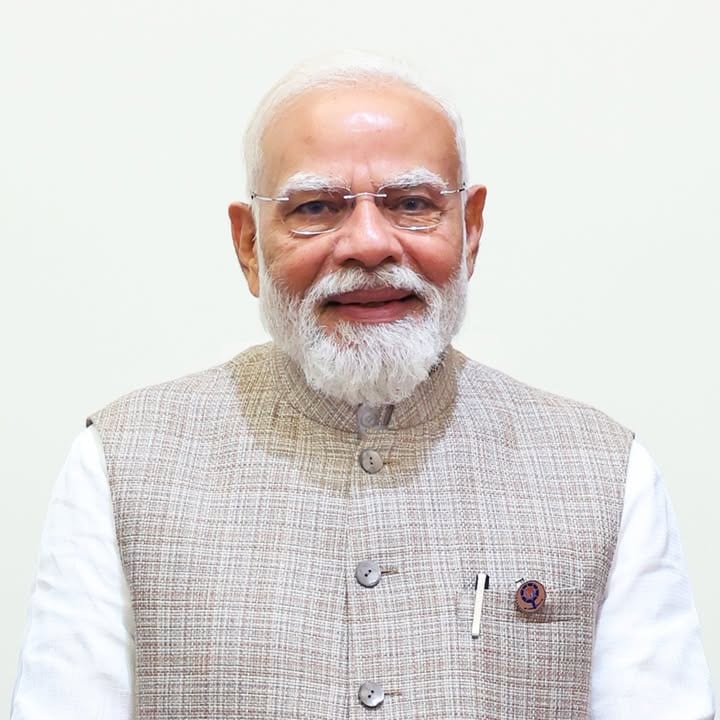
Prime Minister Narendra Modi returned to the Shri Ram College of Commerce dais on Saturday and revived the phrase that once framed his national launch: "half water-half air." He first used the construction at the same college in 2013, after twelve years as Gujarat chief minister. A year later he became prime minister. The return marks a twelve-year arc in the top chair, according to NDTV.
The 2013 address was officially titled 'Emerging Business Models in the Global Scenario'. But the speech never stayed inside a business-school frame. It was a governance manifesto aimed squarely at young voters, delivered at an institution whose graduates move into finance, corporate strategy, and the policy world. NDTV describes the address as a showcase of Modi's national pitch rather than a lecture on commerce.
The recycled line functions as a continuity device. It reconnects a first-time national claimant to the prime minister who has now spent a dozen years in office. The arithmetic is striking because the symmetry is exact: twelve years running Gujarat before the 2013 address, twelve years running the country after the 2014 victory.
But continuity cuts both ways. Repeating a phrase from a campaign launch invites an audit of the interval between the first utterance and the present one. The audience at SRCC is not the same cohort that heard the glass metaphor in 2013. Today's students were children when that speech was delivered. They have no memory of the original framing. For them the line is not nostalgia; it is an inherited argument about national capacity and opportunity.
What the venue signals
SRCC sits at a particular intersection in Delhi's political economy. Its alumni populate trading desks, audit firms, corporate finance teams, and regulatory offices. Choosing this platform for a youth-facing address rather than a rally or a mass gathering signals something deliberate. The target is not a voting bloc alone. It is the next generation of intermediaries who will price India's risk, allocate its capital, and shape its commercial institutions.
That institutional audience matters because India's young demographic is not a monolith. The students in a premier commerce college face a different set of questions than first-time voters in a rural constituency. Their concerns run toward entry-level finance roles, startup credit, ease of compliance, and the gap between university placement claims and actual labour market absorption. A rhetorical nod to their aspirations carries weight only if it maps to instruments they can use.
The line and the ledger
An address like this is best read as direct outreach to future economic leaders. The reported summary of Saturday's event indicates no new policy announcements were highlighted. That absence creates a different kind of pressure. If the metaphor is to work, listeners must connect the "half water-half air" phrasing to measurable improvements over the intervening thirteen years: education quality, job creation, and the ease of doing business.
The risk is not that the phrase seems old. The risk is that it seems untethered. A campaign-era metaphor can survive repetition if it attaches to institutions that students actually encounter: paid internship mechanisms, industry-academia partnerships, skill-financing instruments. These are not exotic asks. They are the ordinary plumbing of a labour market that young commerce graduates must navigate. Without such linkage, the speech risks being read as a commemorative event rather than a fresh agenda for the next cohort.
This is the quiet infrastructure question that sits behind visible political messaging. Digital campaigns and campus addresses both need a delivery layer. A line about a half-full glass achieves little if the internship application portal stalls, or if the placement cell cannot translate a commerce degree into a first job. The challenge is not rhetorical; it is administrative.
Continuity as politics
For the Bharatiya Janata Party, the SRCC return does political work beyond the speech itself. It reinforces a narrative of long-term governance continuity, a claim the party has leaned on through successive national elections. The venue, the date, and the deliberate reuse of the 2013 phrase all compress time. Twelve years as chief minister, twelve years in the prime minister's office, and one metaphor to hold the two halves together.
The audience at SRCC may not remember the first delivery of the line. But the political architecture around that line has matured. In 2013, Modi was pitching a future he had not yet secured. In 2026, he returns as the incumbent seeking to define what the next phase of that future requires. The glass metaphor has shifted from aspiration to accountability.
Indian readers should take from the SRCC return not that an old slogan has been revived, but that the burden of proof has changed. A phrase that launched a national bid now invites a national audit of delivery. The students in the room are the first cohort to test that audit with their own employment contracts, loan repayments, and business registrations. Whether the glass reads as full or half-empty now depends less on the speaker and more on the instruments waiting outside the auditorium.