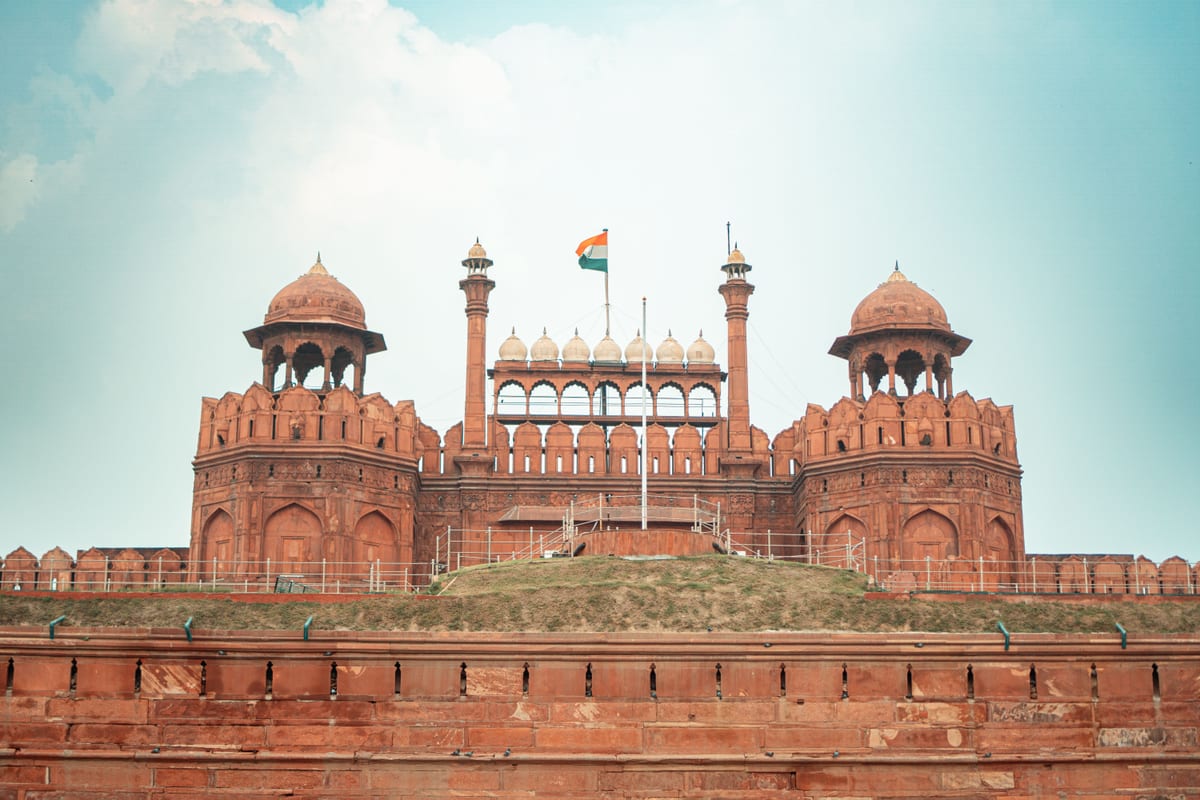
There are monuments you photograph, and there are monuments that photograph you, that look back, that ask something of you. The Red Fort, rising in burnt-ochre magnificence along the banks of the Yamuna in Old Delhi, belongs firmly to the second category. Stand before the Lahori Gate on any given morning, feel the scale of those walls pressing gently on your chest, and you will understand instinctively that you are not in front of a historical object. You are inside a living argument about what India is, and has always been.
A Palace Built for Eternity
The Red Fort, Lal Qila in Hindi, was commissioned by the Mughal Emperor Shah Jahan in 1638 and completed a decade later in 1648. Conceived as the centrepiece of his new capital, Shahjahanabad, it stretched across more than 250 acres of the Yamuna's western bank and was designed by the master architect Ustad Ahmad Lahauri, the same visionary mind behind the Taj Mahal. The fort's name derives from the vast walls of red sandstone that enclose it, walls that stretch nearly two kilometres in perimeter and rise to a height of over thirty metres on the side facing the river.
Within those walls, Shah Jahan constructed a world: the Diwan-i-Aam (Hall of Public Audience), where the emperor received petitions from ordinary subjects; the Diwan-i-Khas (Hall of Private Audience), once home to the legendary Peacock Throne; the Rang Mahal, the palace of colours built for the imperial women; the Moti Masjid, a pearl-white mosque of breathtaking delicacy; and a network of royal apartments, gardens, and bazaars that made the fort effectively a city within a city. The celebrated Persian inscription in the Diwan-i-Khas still reads: Agar firdaus bar roo-e zameen ast, hameen ast-o hameen ast-o hameen ast, 'If there is a paradise on earth, it is this, it is this, it is this.'
History Written in Layers
To walk through the Red Fort is to walk through multiple Indias simultaneously. The Mughals built it; the Marathas contested it; the British captured it after the 1857 uprising, dismantling much of its interior and converting its palaces into barracks. The last Mughal emperor, Bahadur Shah Zafar II, was tried here by the British following 1857, a moment that marked the formal end of an empire. Yet the fort endured.
On 15 August 1947, Independent India's first Prime Minister, Jawaharlal Nehru, hoisted the national flag from the ramparts of the Red Fort and addressed a free nation for the first time. That choice was deliberate. By claiming this Mughal monument as the cradle of India's democratic birth, the new republic declared that India's civilisation is plural, syncretic, and unafraid of its own complexity. Every year since, India's Prime Minister has stood on those same ramparts to address the nation on Independence Day.
Recognised as a UNESCO World Heritage Site and a landmark destination on Incredible India's heritage trail, the Red Fort today draws visitors from across the world and from every corner of India, both as a tourist destination and a pilgrimage of civic identity.
What Visitors Experience
The grand Lahori Gate serves as the principal entrance, its arched passage lined with small shops in the tradition of the original Chhatta Chowk bazaar. Inside, visitors find the Chhatta Chowk, a vaulted arcade that once sold silks, jewels, and perfumes to the Mughal court. It now houses souvenir vendors, but the architecture above their stalls remains magnificent.
Beyond the bazaar lies the vast open expanse leading to the Diwan-i-Aam, its sandstone columns and cusped arches drawing the eye upward and inward simultaneously. The Diwan-i-Khas, though stripped of the Peacock Throne that was looted by the Persian conqueror Nadir Shah in 1739, still carries a hushed grandeur, you can feel the weight of decisions made in that hall rippling through history. The Rang Mahal, with its central marble basin designed to hold flowers and water, offers a glimpse of the domestic poetry that existed within the empire's political theatre.
The fort houses two museums, the Indian War Memorial Museum and the Swatantrata Sangrama (independence struggle) museum, that contextualise the structure within Indian history. An evening Sound and Light Show brings the fort's story alive through narration, light, and music.
Best Time to Visit
Delhi's climate makes the choice of season crucial. The ideal window to visit the Red Fort is between October and March, when the weather is cool and dry, skies are clear, and walking the fort's expansive grounds is genuinely pleasurable. The winter months of December and January can be cold, especially in the mornings, so carry a light jacket. Summer (April to June) brings brutal heat that can make outdoor exploration exhausting. The monsoon months of July and September lend the red sandstone a dramatic, rain-darkened intensity, but humidity can be challenging.
How to Reach the Red Fort
The Red Fort is centrally located in Old Delhi and is exceptionally well-connected. The nearest Delhi Metro station is Lal Qila on the Violet Line (Line 6), from which the fort is a short walk. Auto-rickshaws and cycle-rickshaws from Chandni Chowk, the historic marketplace that lies just west of the fort, are a characterful and convenient option. For those staying in Central Delhi, a taxi or cab-aggregator ride is straightforward. The area around the fort is best explored on foot, allowing visitors to absorb the sensory richness of Old Delhi's lanes.
Nearby Attractions
The Red Fort sits at the heart of one of Delhi's richest heritage neighbourhoods. A short walk brings you to Chandni Chowk, one of India's oldest and busiest markets, where lanes specialise in spices, silver, textiles, street food, and books. The Jama Masjid, India's largest mosque, also commissioned by Shah Jahan, is barely a kilometre away and is an architectural marvel in its own right. Raj Ghat, the memorial to Mahatma Gandhi, lies nearby along the Yamuna. Further afield, the Qutub Minar, Humayun's Tomb, and the ruins of Purana Qila continue Delhi's extraordinary heritage trail.
Why It Matters
India's civilisation does not live in glass cases. It lives in the friction between old walls and new flags, between imperial ambition and democratic aspiration, between the Persian poet's paradise and the republic's annual promise to itself. The Red Fort holds all of this, not as contradiction, but as continuity. To visit it is to understand, perhaps more viscerally than any history book allows, that India is not a country that merely has a past. It is a country that is in constant negotiation with it.
Come for the sandstone. Stay for the story. Leave with something you cannot quite name but will never entirely forget.