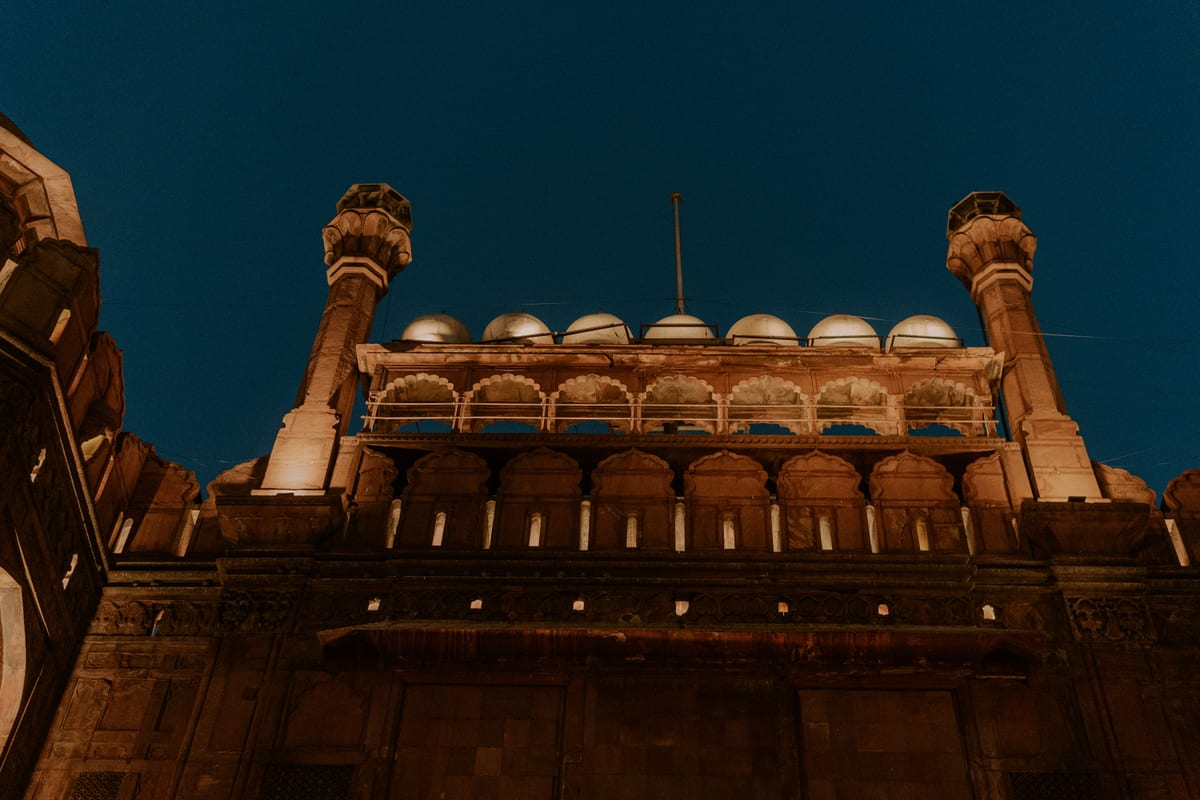
There are monuments, and then there are living declarations. Delhi's Red Fort, Lal Qila, belongs to the second kind. Stand before its colossal crimson ramparts at dawn, when the first light catches the sandstone, and you understand almost instinctively that you are not looking at a ruin. You are looking at a civilisation that refused to be ruined.
A Citadel Born of Imperial Vision
Commissioned by the Mughal Emperor Shah Jahan in 1638 and completed in 1648, the Red Fort was designed to be the crown jewel of his newly founded capital, Shahjahanabad. Stretching across more than 250 acres on the western bank of the Yamuna river, the fort's massive walls rise up to 33 metres, a statement in red Agra sandstone that was intended to awe the known world. For nearly two hundred years, the fort served as the principal residence of the Mughal emperors and the administrative and ceremonial heart of one of history's wealthiest and most culturally prolific empires.
The fort combines Persian elegance, Timurid grandeur, and Indian decorative sensibility in a dialogue that produced some of the subcontinent's most refined spaces. The Diwan-i-Aam (Hall of Public Audience) and the Diwan-i-Khas (Hall of Private Audience), where Shah Jahan's legendary Peacock Throne once gleamed with emeralds and rubies, speak of a court culture of breathtaking sophistication. The Rang Mahal, the palace of the chief consort, with its lotus-shaped marble fountain, and the Moti Masjid, a private mosque of pearl-white marble, reveal an interior world of refined, contemplative beauty that the fortress walls seem almost designed to protect from the noise of lesser centuries.
The Moment That Changed Everything
If the Mughals gave Lal Qila its bones and beauty, the morning of 15 August 1947 gave it its place in the story of modern India. As the sun rose over a free nation, India's first Prime Minister, Jawaharlal Nehru, unfurled the tricolour from the fort's Lahori Gate, the same gate through which emperors had once processed in ceremonial splendour. That act of unfurling transformed a Mughal monument into a democratic one. This land, this legacy, this continuity, it now belongs to the people.
Every year since, on Independence Day, the Prime Minister of India repeats that ritual from these same ramparts, and the country watches. India uses its past. It draws from it, celebrates within it, and finds in it the vocabulary for its present aspirations. Red Fort is not a museum exhibit. It is a stage that is still in use.
Walking Through Lal Qila, What Visitors Experience
Entering through the grand Lahori Gate, visitors pass through the vaulted arcade of Chhatta Chowk, once a royal bazaar selling silks, jewellery, and perfumes to the ladies of the court, before emerging into the vast open ground of the fort's inner precinct. The transition from the city's noise to this interior world is one of the great sensory shifts in Indian travel.
The fort today houses several museums within its royal halls, including the Indian War Memorial Museum and galleries dedicated to the history of the independence movement. The Archaeological Survey of India, which manages the site, now a UNESCO World Heritage Site since 2007, has worked to restore and present these spaces with increasing care and contextual depth.
Evenings at the fort offer a different kind of magic. The Sound and Light Show, narrated against the backdrop of illuminated Mughal architecture, compresses centuries of history into a vivid, atmospheric experience that is particularly memorable for first-time visitors and families. As darkness falls and the sandstone glows amber under artificial light, the centuries seem to rearrange themselves rather than disappear.
For the full breadth of what this site offers, the Red Fort page on Incredible India, the official tourism portal of the Ministry of Tourism, Government of India, is an authoritative starting point for planning your visit.
Best Time to Visit
Delhi's climate makes timing your visit important. The ideal window runs from October through March, when the weather is cool, clear, and genuinely pleasant, perfect for exploring an open-air monument of this scale. December and January mornings can be misty and cold, which lends the sandstone ramparts a brooding, almost cinematic atmosphere. Avoid the peak summer months of May and June, when Delhi's heat is relentless and outdoor sightseeing becomes an endurance exercise. The monsoon months of July and August bring some relief from the heat, and the fort's gardens turn a vivid green, though humidity and intermittent rains demand flexibility.
How to Reach Red Fort
Red Fort sits at the heart of Old Delhi, making it exceptionally well-connected. The nearest Delhi Metro station is Lal Qila on the Violet Line, just a short walk from the Lahori Gate entrance, the metro is by far the most stress-free option for visitors navigating Delhi's dense traffic. Auto-rickshaws and app-based cabs are plentiful from most parts of central and south Delhi. The fort is also within comfortable distance of Chandni Chowk, making it easy to combine a walk through Old Delhi's legendary market street with the same day's visit.
Nearby Attractions Worth Your Time
Red Fort sits at the centre of one of India's richest historical neighbourhoods. Within easy reach are the Jama Masjid, India's largest mosque, also commissioned by Shah Jahan, and a stunning piece of red sandstone and marble architecture, and the chaotic, intoxicating lanes of Chandni Chowk, where Old Delhi's food, spice, and textile culture plays out in real time. Raj Ghat, the memorial to Mahatma Gandhi, is a short distance away along the Yamuna and offers a moment of contemplative quiet. For those with more time, the broader constellation of Mughal monuments across Delhi, including Humayun's Tomb and the Qutb Minar complex, forms one of the world's great heritage circuits.
Why Red Fort Matters, The Civilisational Argument
India is one of the world's oldest continuing civilisations, and Red Fort is perhaps its most eloquent architectural argument for that continuity. Here, in a single complex, you find the full arc, a medieval Mughal emperor's vision of perfection, centuries of contested and turbulent history, the birth cry of a republic, and an ongoing annual ritual of democratic renewal. The fort does not belong to any single dynasty or ideology. It belongs to the story of India itself: plural, layered, unbroken.
When you stand on those ramparts and look out over Delhi, the ancient and the modern tangled together in every direction, you are not standing in the past. You are standing at the precise point where India's past and present have always agreed to meet. That is the true magnificence of Lal Qila.