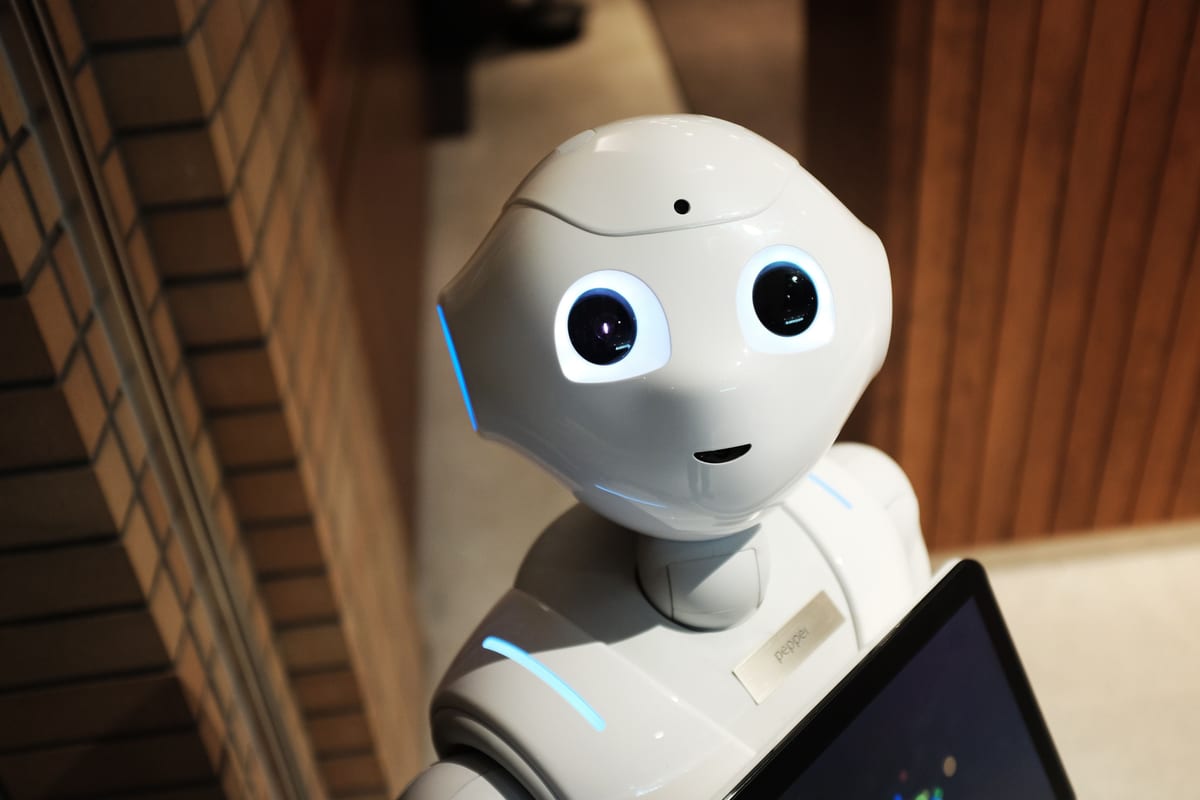
Her name is Sally. She has silicone skin, long brown hair, and arms that move with enough fidelity to gesture at a whiteboard. She costs $57,600 — roughly the annual salary of a mid-career public school teacher in the United States — and she has just taken up a post in a New York high school classroom. Sally is not a screen on a cart. She is not a chatbot with a speaker. She is an AI-powered humanoid robot, and her arrival in an actual school warrants serious examination.
The deployment is described as an assistive role — Sally works alongside human teachers rather than replacing them. That framing is accurate for now, but incomplete as a description of where this technology is heading. The history of assistive technology in education follows a familiar arc: calculator as supplement, then indispensable tool; internet-connected laptop as enrichment device, then the primary site of learning. What begins as assistance tends, over two or three product generations, to become infrastructure.
The Object Itself
What makes Sally different from earlier EdTech is her embodiment. A tablet delivers content; a humanoid robot enacts presence. Decades of developmental psychology research confirm that children respond differently to entities that occupy physical space, make eye contact, and move expressively. Teachers know this intuitively — why else does classroom management hinge so heavily on where a teacher stands, how she gestures, whether she walks the rows? Sally's lifelike appearance with silicone skin and movable arms and hands is not aesthetic whimsy. It is a deliberate engineering choice to activate the same social attention circuits that evolution tuned for human-to-human interaction.
This is what the field calls social robotics — machines designed not merely to compute but to relate. The bet is that relational presence amplifies pedagogical effectiveness: a student who feels seen by an interlocutor pays closer attention, asks more questions, retains more material. Whether that bet pays off at scale, across different age groups and subject domains, remains an open empirical question. The New York deployment will generate data, and that data will either accelerate or recalibrate the next iteration.
The Price Point Is the Policy Problem
At $57,600 per unit — approximately Rs 48 lakh at current exchange rates — Sally is not a device you scatter across a national school system. She is a prototype-class product: expensive enough that her current buyers are either well-funded private institutions or government programmes with demonstration-project budgets. This is precisely how disruptive educational technologies enter markets. The first graphing calculators cost hundreds of dollars; a decade later they were a commodity. The first interactive whiteboards ran to tens of thousands of dollars per classroom; within fifteen years they appeared in government schools across middle-income countries.
The question for any large national system is not whether to deploy Sally's current version, but what institutional capability to build now so that the third or fourth generation — cheaper, more capable, locally manufactured — lands in domestic hands rather than imported ones. India has navigated this calculation before, most visibly in defence manufacturing and more recently in semiconductor ambitions. The logic is identical for social robotics: the window to build indigenous capability opens before commercial viability is proven, not after.
India's Structural Incentive
India's school-age population — over 250 million children — is the largest in the world. Distributed across a geography that ranges from dense urban clusters to sparse tribal hinterlands, it strains a teacher workforce that is already unevenly distributed. Rural and semi-urban schools frequently run on skeleton staffs, with single teachers covering multiple grades simultaneously. This has been a structural feature of Indian public education for decades, acknowledged in successive policy documents including the National Education Policy 2020, which explicitly calls for technology integration as a pedagogical tool.
The NEP framework and the National AI Mission's focus on education as a priority sector create a policy environment hospitable to the kind of AI-assisted teaching that Sally represents. But hospitable policy environments are not the same as manufacturing pipelines. India's EdTech sector — anchored by companies like PhysicsWallah and Vedantu, alongside the battered but still-present infrastructure of BYJU's — has built enormous capability in screen-based content delivery. Social robotics is a different discipline entirely, sitting at the intersection of mechanical engineering, materials science, computer vision, and natural language processing. The IITs and IIITs that run humanoid robotics research have the foundational capability. What they lack is a concrete product benchmark against which to measure and fund their work. Sally provides that benchmark now.
Analysts working on India's AI manufacturing gap have argued consistently that remaining a software-only AI economy leaves India exposed as the hardware layer — sensors, actuators, embodied systems — becomes the dominant site of value creation. Sally-class deployments in US schools make that argument structurally visible in a way that abstract policy papers cannot. A robot in a New York classroom is harder to ignore than a white paper from a think tank.
The Regulatory Gap Nobody Is Talking About
A humanoid robot deployed in a school does not merely teach. It observes. It processes the faces, voices, behavioural patterns, and emotional responses of minors, in real time, at close range, across an entire academic year. The data generated by that interaction is richer and more intimate than anything a learning management system captures from keystroke logs and quiz scores.
India enacted the Digital Personal Data Protection Act in 2023, a significant step toward a comprehensive data governance framework. But the Act does not yet contain specific provisions governing biometric and behavioural data collected from children by AI systems in institutional settings — schools, tutoring centres, after-school programmes. This is not a unique Indian gap; most jurisdictions are behind the technology on this question. The United States itself has patchy regulation here, which is part of why a deployment like Sally can proceed without a comprehensive federal privacy review.
The difference is that India's regulatory architecture is still being built, which means there is still time to build it right. When a domestic or imported humanoid teaching assistant appears in an Indian school setting, the question of who owns the interaction data, how long it is retained, who audits it, and what happens when a child's emotional and behavioural profile is commercially monetised will need answers. India's data protection rulemaking process should address this category explicitly, before the first unit ships, not after the first scandal.
A Civilisational Question Wearing a School Uniform
There is a deeper issue underneath the policy mechanics. Education is the primary mechanism through which any civilisation reproduces itself — not just its knowledge base, but its values, its relational norms, its sense of what it means to be a person among persons. For most of human history, that transmission happened through direct human contact: teacher to student, elder to child, master to apprentice. The introduction of writing, then the printing press, then broadcast media, then the internet each altered the architecture of that transmission without replacing its human core.
A humanoid robot that occupies physical space, makes eye contact, and adapts conversationally to individual students pushes that question further than any previous technology. It is not asking whether machines can deliver information — they clearly can, and do. It is asking whether the relational dimension of pedagogy can be partially inhabited by a non-human agent, and what children learn about trust, authority, empathy, and social reciprocity when some of their formative educational relationships are with machines designed to simulate personhood.
India, which carries one of the world's most intellectually rich traditions of the guru-shishya relationship — built on presence, attentiveness, and moral formation alongside knowledge transfer — has particular reasons to think carefully before outsourcing even a fraction of that function to a $57,600 silicone proxy. The right response is neither reflexive rejection nor uncritical adoption. It is exactly the kind of deliberate, evidence-driven evaluation that the NEP framework was designed to enable. The New York classroom is the experiment. India has time to read the results before writing its own policy — but that window is shorter than it looks.