On 10 November 2026, the United Kingdom told the UN Security Council that South Sudan's authorities must allow the UN Mission in South Sudan (UNMISS) to operate without obstruction. Ambassador Kate Foster delivered the warning after three peacekeepers were killed in Jonglei in August. The United Kingdom condemns attacks against UN peacekeepers, who work in difficult circumstances to protect civilians.
The statement came six weeks before South Sudan's first national elections since independence, according to UN News. The Security Council met as political uncertainty deepened and violence worsened. Ambassadors were expected to press for an inclusive process and credible polls while civilians faced fighting, hunger and displacement.
Foster made three points. South Sudan is approaching a critical point in its transition. She told the Council that "elections must seek to contribute to peace and stability, not deepen division or become a substitute for the political process." The establishment of new caretaker arrangements, while key provisions of the 2018 Peace Agreement remain unfulfilled, has further weakened political consensus. All parties must uphold the ceasefire and open political and civic space. She welcomed efforts by the African Union, IGAD, Special Representative Gbeho and High Representative Kikwete to support inclusive dialogue.
The humanitarian picture is bleak. Renewed conflict is forcing families from their homes, deepening hunger and making it harder for humanitarian organisations to reach those in need. Foster said almost 8 million people already face acute food insecurity. She added that authorities continue to mismanage public resources, with just 2% of the national budget spent on health and education. Conflict across the region is adding to the pressures.
Third, UNMISS is indispensable. Foster urged South Sudanese authorities to ensure safe and unhindered humanitarian access and to protect humanitarian workers. She recalled that attacks on peacekeepers may constitute war crimes.
India's contingent and the cost of obstruction
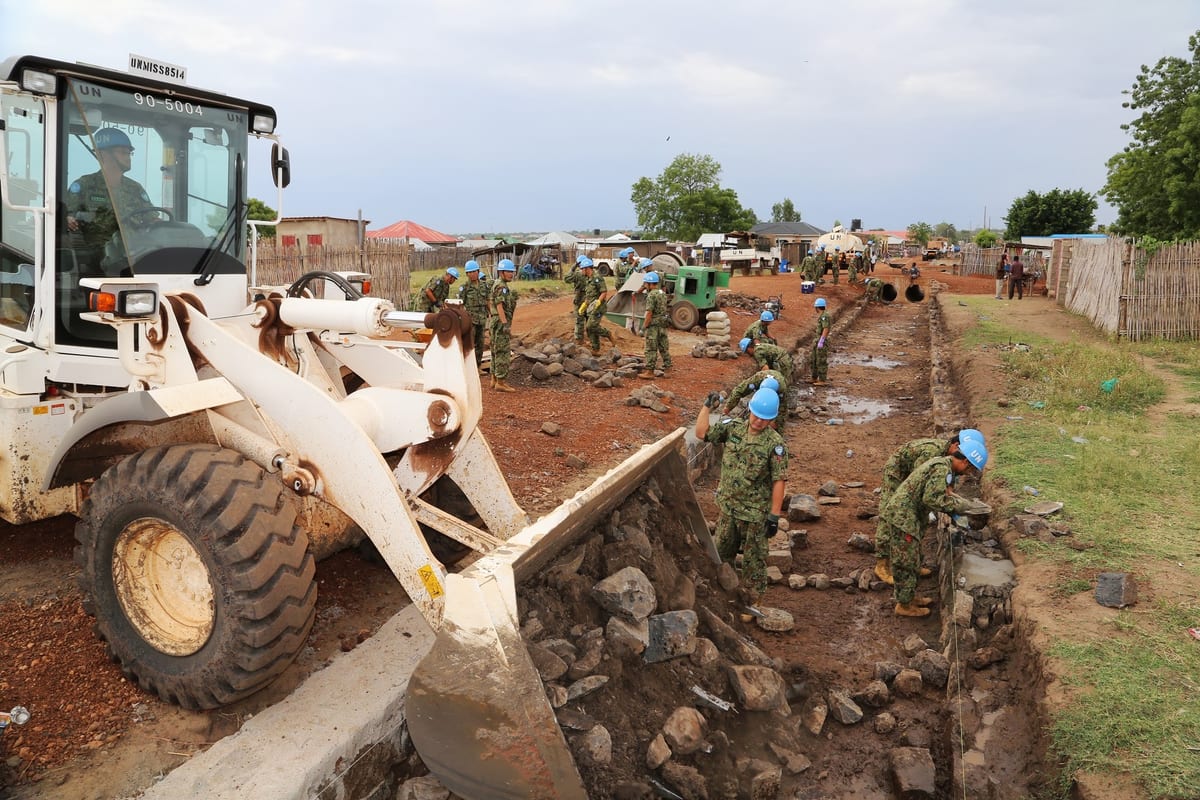
India does not appear in the UK statement, but it carries a large share of the risk. India maintains one of the largest troop contingents in UNMISS, with a sustained infantry presence that has anchored the mission's protection-of-civilians work in Jonglei and elsewhere. When host authorities restrict patrols or delay movement, the operational value of that contribution collapses and Indian soldiers sit exposed. South Sudan is not an abstract testing ground for multilateralism; it is a place where Indian troops conduct daily patrols under a mandate that depends on host government cooperation.
New Delhi has not issued a formal response to Foster's remarks. The Indian position is well established. Under then-Permanent Representative T.S. Tirumurti, India's UN mission stressed across multiple Security Council terms that host states must guarantee unhindered access and safety for peacekeepers. That demand remains the standard by which New Delhi judges host-state behaviour.
The stakes go beyond operational safety. India has used UN peacekeeping as a central pillar of its claim to a permanent Security Council seat. Every Indian contingent that cannot complete its mandate erodes that credential. A mission obstructed at the point of use becomes a protection mandate with no operational core. South Sudan's restrictions, if they persist, turn India's investment into a reputational liability rather than a demonstration of security provision.
South Sudan matters to India for reasons beyond the contingent itself. African states form a large bloc in the UN General Assembly, and India has courted that bloc as part of its case for reformed multilateral institutions. A visible Indian presence in South Sudan's peacekeeping operation reassures African governments that New Delhi shares their priorities. If South Sudan obstructs the mission, it undercuts that reassurance and weakens India's standing among the countries whose votes matter in any Security Council expansion debate.
India's 2021-22 Security Council tenure gave New Delhi a platform to link peacekeeping performance with host-state accountability. India used that term to argue that mandates without access are hollow. South Sudan's current obstruction lands on familiar ground for New Delhi, not as a new challenge but as a recurring dispute over whether the UN system can enforce its own requirements. The response from Juba will signal how seriously host states take those obligations.
India's critique of host-state obstruction extends beyond South Sudan. Across peacekeeping missions in Africa, New Delhi has argued that protection mandates fail when local authorities treat UN forces as unwelcome visitors. That experience shapes Indian diplomacy in the Special Committee on Peacekeeping Operations, where India has pushed for clearer accountability when host governments block movement. South Sudan is the immediate case, but the principle extends to the entire architecture of UN peacekeeping.
There is a second, less visible cost: the human price. The three peacekeepers killed in Jonglei in August were part of the same protection system India helps sustain. If obstruction forces patrols into predictable routes or keeps them in base, the likelihood of ambush rises. Force protection is not a luxury; it is the condition under which peacekeeping works. New Delhi should treat restrictions on UNMISS mobility as a direct threat to its soldiers, because that is precisely what they are.
What India can do
The strategic answer is not to withdraw, but to make the investment credible in operational terms by demanding host-state compliance. India can press South Sudan bilaterally and through the UN General Assembly's Special Committee on Peacekeeping Operations, where its voice carries weight. It can insist that its contingent has adequate force protection measures and raise the issue in every forum where host-state obstruction appears on the agenda.
India's peacekeeping presence in South Sudan sits within a larger Global South framework. At the 3rd Voice of Global South Summit in August 2024, India positioned itself as a voice for southern development and security. That positioning means little if Indian soldiers cannot operate where they are deployed. The same principle applies to the broader African peacekeeping landscape: India's reputation as a reliable security provider rests on its ability to execute mandates, not merely to supply troops.
For Indian readers, the South Sudan debate is not a distant UN matter. Indian soldiers are on the ground under a mandate that depends on host government cooperation. When that cooperation is withheld, New Delhi must respond not as a spectator but as a stakeholder whose troops and reputation are engaged. The question is whether India will use the full weight of its peacekeeping record to insist that South Sudan honour the agreement it signed.