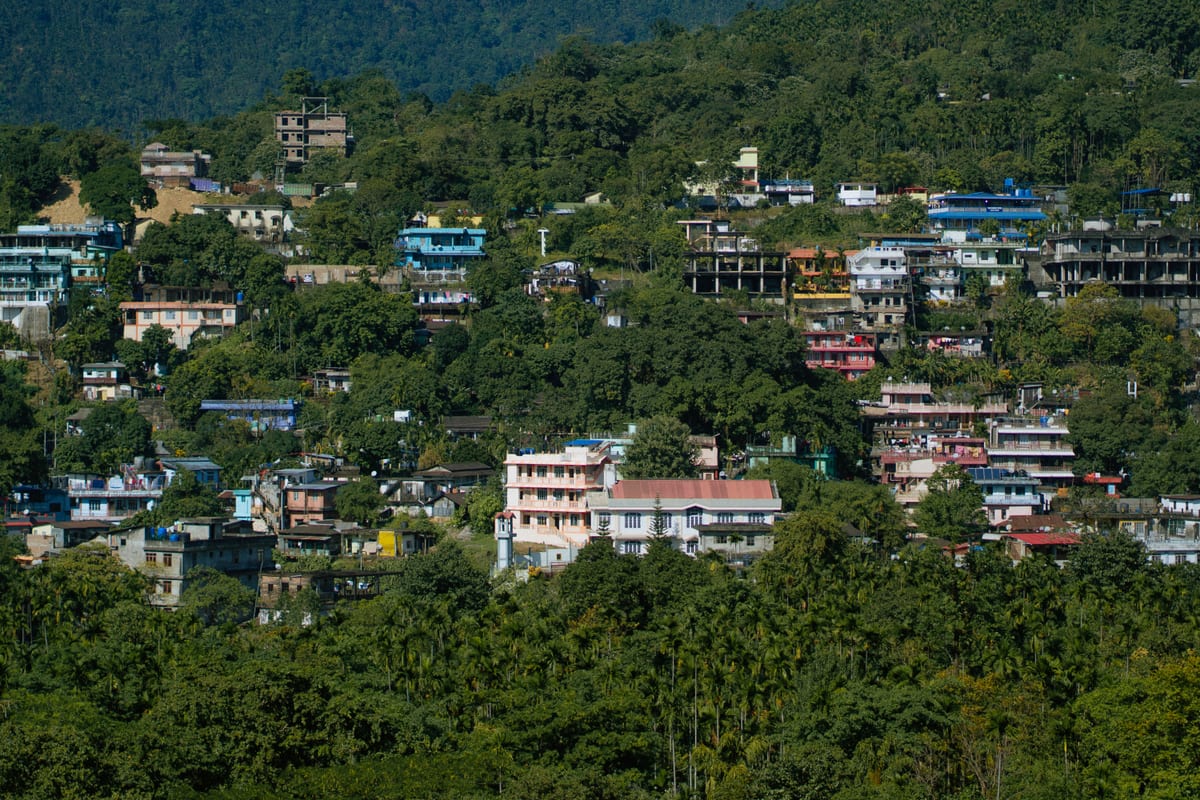
There is a particular quality to the light in Shillong. It arrives softly, filtered through pine canopy and low cloud, settling over red-roofed bungalows and moss-covered stone walls with the quiet authority of something that has always belonged here. The British called this place the Eastern Scotland, and the comparison was not idle flattery. The rolling hills, the cool temperament of the air, the sudden drama of a ridge breaking into open sky, it does, unmistakably, recall the Scottish Highlands. But Shillong is something the Highlands could never be: a living civilisational space, rooted in one of India's most distinct and ancient indigenous cultures.
The capital of Meghalaya, a name that translates simply and perfectly as Abode of Clouds, Shillong sits cradled in the Khasi Hills at an elevation that keeps the plains heat at a respectful distance. For the traveller arriving from the lowlands of Assam, the transformation is immediate and almost theatrical. The road climbs through mist, the temperature drops, and the world turns green in a dozen different registers. By the time you reach the city, you understand instinctively why people have been making this journey for centuries.
A City Written in Layers
Shillong wears its history openly. The British established it as the capital of Assam in 1874, and the colonial imprint remains visible in its quaint bungalows, Gothic-inflected churches, and the unhurried architectural grammar of its older quarters. These buildings do not feel like ruins or relics. They feel inhabited, adapted, absorbed into the rhythms of a city that has always known how to take what is offered from outside and make it its own. This capacity for cultural absorption without loss of indigenous identity is Shillong's most remarkable quality.
Beneath and beyond the colonial layer lives the Khasi civilisation, one of the few remaining matrilineal societies on earth. Property, lineage, and family name pass through the mother here. To walk through Shillong's markets, to hear the cadence of Khasi spoken alongside Hindi, Bengali, and English, to watch the way the city organises itself around its own logic, this is to encounter an India that many visitors from the subcontinent's heartland have never imagined.
The Natural World as Sacred Space
According to the Incredible India page for Shillong, the city offers an old-world allure, stunning scenery, and a deep-rooted cultural legacy. Nowhere is this more evident than in its relationship with the natural world.
Shillong Peak, the highest point in the state, commands a 360-degree view of the surrounding landscape. On clear mornings, the vista is staggering. On foggy ones, which are many, the peak becomes something more atmospheric, wreathed in cloud and carrying the particular silence of high places. Either way, it rewards the effort of the climb.
Elephant Falls, a three-tier cascade tumbling through dense greenery, takes its name from an elephant-shaped rock that once stood at its base. The falls are framed by lush forest and offer restorative beauty. Nearby, Sweet Falls adds another note to Shillong's liquid soundtrack. The city is in constant, gentle conversation with water, its lakes, its rivers, its rain, its mist.
Umiam Lake, a man-made reservoir shaped by the hills around it, is where Shillong comes to breathe. Boating on its still surface at dawn, with the ridgelines reflected below you and the first light catching the water, is one of those experiences that resists both photography and description. You simply have to be there.
For those drawn to smaller wonders, the Butterfly Museum offers a window into Meghalaya's remarkable entomological diversity. Its collection of butterflies, moths, and insects speaks to the extraordinary biodiversity of a region that holds some of India's most ecologically significant landscapes.
The Living Culture of Shillong
Shillong has, in recent decades, earned another distinction: it is widely regarded as the rock music capital of India. The Khasi love of music, expressed historically through traditional instruments and ceremonial song, found an unexpected but coherent expression in electric guitars and amplifiers. The city's music scene is grassroots and seriously talented. On any given evening, you might hear a band playing in a small venue that would not be out of place in Edinburgh or Seattle, except that the musicians are young Khasi men and women for whom this music is as native as the hills outside the window.
The Ward's Lake in the heart of the city offers a quieter pleasure: a colonial-era park where the pace slows, families gather, and the city's multiple inheritances sit together without friction. It is, in miniature, what Shillong does best, holding complexity lightly.
When to Go and How to Reach
Shillong's climate is one of its greatest gifts. Temperatures range from around 2°C in the coldest January nights to a pleasant 27°C at the height of summer, making it one of India's most reliably temperate destinations. The months from October through February bring clear skies and crisp air, ideal for sightseeing and the full sweep of the peak views. March through May offers warming temperatures and the first flush of the hills going green. The monsoon, from June through September, transforms Shillong into something preternatural, the waterfalls swell, the mist thickens, the green deepens to a colour that has no name in standard English. Travellers comfortable with rain will find this season extraordinarily beautiful.
The nearest airport is Shillong Airport (SHL), connecting the city by air. For those travelling by rail, Guwahati Railway Station (GHY) is the nearest major railhead, from where Shillong is accessible by road through scenery that is itself part of the journey. The drive from Guwahati, winding up through the hills as the landscape shifts from Assamese plains to Meghalayan highland, is an arrival worth savouring slowly.
Why Shillong Belongs in India's Heritage Story
India's civilisational story is not a single thread. It is a vast, braided narrative in which the Khasi matrilineal tradition, the sacred groves of Meghalaya, the colonial bungalow absorbed into indigenous life, and the teenager playing a Fender guitar in a Shillong basement are all legitimate and irreplaceable chapters. Shillong does not ask to be understood through the lens of temples or dynasties or the familiar grammar of north Indian heritage tourism. It asks that you expand your understanding of what Indian civilisation is and always has been.
Come for the hills and the waterfalls and the cool relief of mountain air. Stay for the discovery that India is far larger, stranger, and more alive than any single story about it can contain.