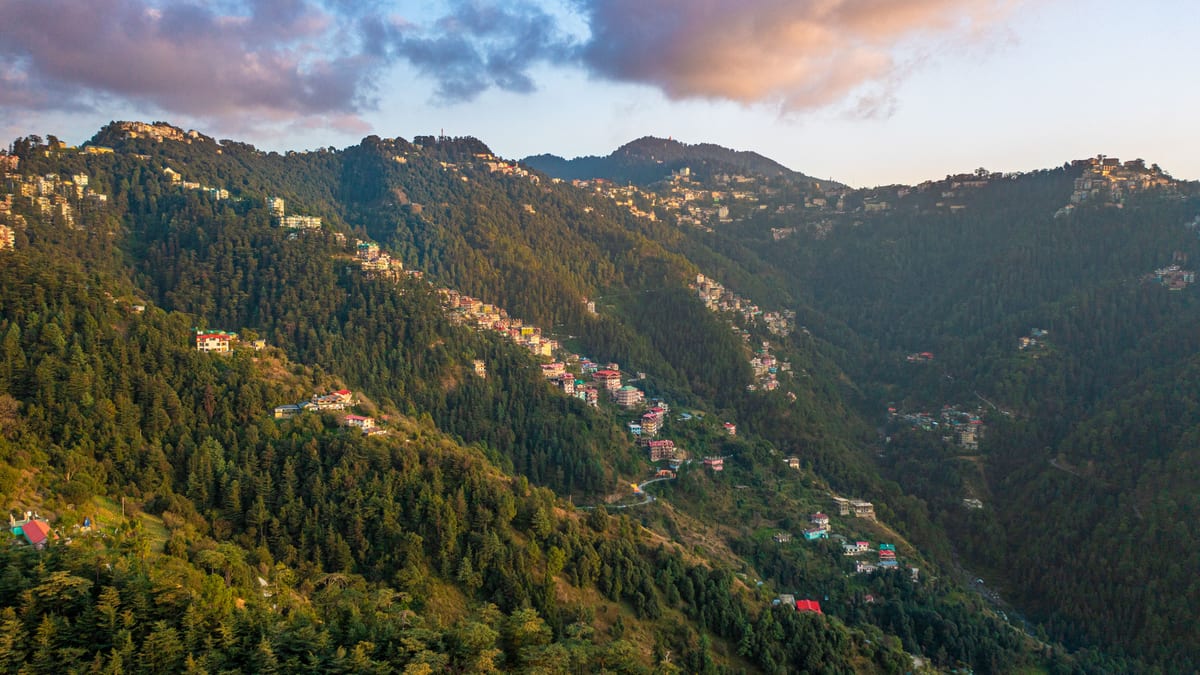
There is a moment, usually arriving just as the Toy Train rounds a bend somewhere between Barog and Kandaghat, when the haze of the plains dissolves entirely and the world becomes only pine-dark ridges, clean cold air, and the distant white teeth of the Himalayas. It is the moment Shimla announces itself, not with a roar, but with a quiet, assured grandeur that has been drawing travellers, writers, viceroys, and wanderers for nearly two centuries.
Welcome to Shimla, the Queen of the Hills, and one of the most layered, most storied destinations in all of India.
A Town That Carries Its History Lightly
Shimla's history is bound up with the history of modern India itself. Once the summer capital of British India, the town still bears that colonial inheritance visibly, in the grand timber-and-stone facades along the Mall Road, in the Gothic spires of Christ Church, in the Victorian flourish of the Gaiety Heritage Cultural Complex. Yet what makes Shimla remarkable is that these buildings have been claimed, repurposed, and made entirely Indian.
The Gaiety Heritage Cultural Complex, a five-storey Victorian structure now over 120 years old, exemplifies this transformation. What was once a social hub for colonial administrators is today a living theatre and arts complex where Himachali culture performs on one of its most celebrated stages. History here is not a relic, it is a rehearsal space.
The Himachal State Museum and Library deepens this narrative further. Within its walls, rare manuscripts, ancient coins, traditional Himachali sculptures, miniature paintings, pottery, textiles, and a doll gallery tell the story of a region whose cultural roots stretch far beyond the British century. To walk through its galleries is to understand that Shimla was never simply a colonial invention, it was always the custodian of something older, richer, and stubbornly its own.
The Ridge, the Mall, and the Pulse of Everyday Shimla
No visit to Shimla is complete without time spent on its two great public spaces. The Mall, the commercial heart of town, hums with the energy of a hill bazaar that has never quite stopped. Shops, cafés, and eateries line its pedestrian stretch, and the crowd is a democratic mix of local families, students, honeymooners, and seasoned travellers eating hot momos against a backdrop of pine-covered slopes.
Then there is the Ridge, the wide open promenade that looks out toward the Himalayan peaks and functions as Shimla's communal living room. Festivals, live music performances, and celebrations take place here throughout the year, framed always by those immense mountains. On a clear winter morning, when fresh snow brightens the peaks and the town below is still half-asleep, the Ridge offers a view that feels genuinely sacred, not in any prescribed sense, but in the way that great natural beauty always carries a charge of wonder.
Shrines, Spirits, and Civilisational Continuity
Shimla's spiritual landscape is as layered as its architecture. The Tara Devi temple, perched on its own forested hill, draws devotees and travellers alike, its antiquity a quiet reminder that these hills were places of worship long before they were places of governance. Temples like these are not heritage sites in the museum sense, they are functioning centres of faith, visited by ordinary people going about the ordinary business of devotion. This is what civilisational continuity looks like: not preserved, but practised.
The military heritage of the region is honoured equally. Museums in and around Shimla pay tribute to the valour of the Indian Army, connecting the contemporary nation to its soldiers and sacrifices, another thread in the town's complex, living identity.
The Toy Train: A UNESCO Journey Through the Hills
If Shimla has a single experience that distils everything, the pace, the beauty, the sense of gentle anachronism that makes hill travel so restorative, it is the Kalka-Shimla Railway, a UNESCO World Heritage Site. The narrow-gauge line threads through tunnels, over viaducts, and around vertiginous curves, delivering passengers not just to a destination but into a particular quality of attention: slow, present, and awake to the world outside the window. The Toy Train is not merely transport. It is a philosophy of arrival.
Best Time to Visit
Shimla is a year-round destination, each season revealing a different face of the same beautiful town. Summer (March to June) brings temperatures ranging from 21°C to 29°C, making it ideal for exploration and perfect for those escaping the heat of the plains. Monsoon (July to September) cloaks the hills in extraordinary green, with temperatures between 12°C and 26°C, though mountain roads can be affected by rain. Winter (October to February) brings snowfall, crackling fires, the Ridge dusted white, and peaks blazing in cold sunlight. January temperatures dip as low as -2°C, so pack accordingly, and be rewarded with Shimla at its most enchanting.
Getting There
Shimla is well connected to the rest of India. The nearest airports are Shimla Airport (SLV) for regional connections and Shaheed Bhagat Singh International Airport (IXC) in Chandigarh for broader national and international reach, from where Shimla is accessible by road in approximately three hours. The Shimla Railway Station (SML) is the terminus of the Kalka-Shimla narrow-gauge line, the most romantic way to arrive, and thoroughly recommended. Regular bus and taxi services from Chandigarh, Delhi, and across Himachal Pradesh complete the options.
Why Shimla Belongs on Every Indian Itinerary
There are hill stations, and then there is Shimla. What sets this town apart is the quality of its accumulated identity, the way colonial and Himachali, ancient and contemporary, sacred and civic, all coexist here without contradiction. To visit Shimla is to encounter India in one of its most quietly confident moods: a civilisation that has absorbed everything thrown at it and emerged, as always, distinctly, irreducibly itself.
Plan your journey and explore more at the official Shimla page on Incredible India, the Ministry of Tourism's definitive guide to this remarkable destination.