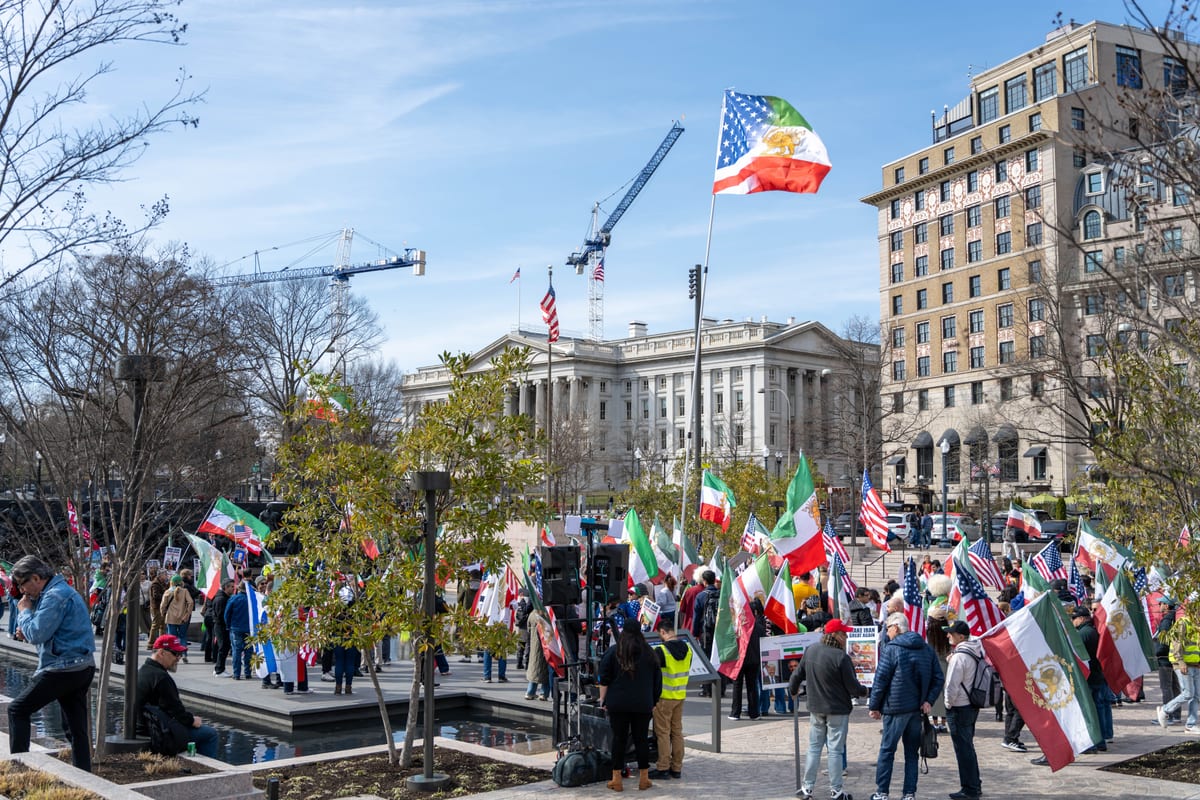
Seventeen American service members are now dead in the US war against Iran, and the president has said almost nothing about what comes next. Videos of B-2 stealth bombers and covert tanker movements circulating in defence circles point toward a major escalation that Washington has not publicly announced, authorised, or explained. The combination of mounting casualties, deliberate presidential silence, and hardware that speaks for itself describes a war being prosecuted through gesture rather than strategy. For anyone watching from New Delhi, where the word "Chabahar" appears in every third sentence at South Block's West Asia desk, that is not reassuring.
The arithmetic of Indian exposure is stark. Iran sits at the junction of two critical Indian interests: crude oil supply and overland connectivity to Central Asia. Roughly 18 of India's 28 oil tanker routes transit through or near the Strait of Hormuz, according to analysts tracking Indian naval logistics. Any naval confrontation in the Persian Gulf—the kind that follows a major B-2 strike on nuclear or military infrastructure—becomes an Indian logistics crisis within days. Every ten-dollar rise in Brent crude adds approximately fifteen billion dollars to India's annual import bill, a figure that lands directly on the Finance Ministry's macro-stability calculations and on the retail price of diesel in every Indian city.
The Port That Washington Carved Out — And May Not Protect
Chabahar is the sharper vulnerability. India signed an eighty-five million dollar deal to develop the Iranian port despite the architecture of US sanctions—a rare carve-out that Washington extended precisely because the corridor serves Afghan reconstruction and Central Asian connectivity goals that Washington nominally shares. That exemption rests on a diplomatic equilibrium between New Delhi and Washington that an open shooting war will strain immediately. If Iranian authorities restrict port access in retaliation for US strikes, or if the broader regional conflagration makes the sea lanes into Chabahar operationally unsafe, the entire connectivity logic that India spent years constructing evaporates.
Harsh V. Pant at the Observer Research Foundation has argued that India must treat Chabahar as a sovereign infrastructure asset rather than a concession inside Washington's sanctions architecture. New Delhi should actively insulate the port from bilateral US-Iran dynamics rather than passively waiting to see whether Washington's war plans leave room for Indian interests. That argument has never been more urgently relevant. The question is whether New Delhi makes that case loudly, through diplomatic channels with Tehran and Washington simultaneously, or continues the quieter posture it has held since the confrontation began.
Post-2019 Insulation Has Limits
Some corners of the Indian foreign-policy establishment treat the current crisis as less dangerous than previous Iran confrontations. India diversified substantially away from Iranian crude after the 2019 sanctions regime tightened—a pivot toward Iraqi, Saudi, and Russian supplies that reduced Tehran's share of the import basket. Happymon Jacob, who studies strategic affairs at JNU and the Council for Strategic and Defense Research, has noted that this diversification gives New Delhi more fiscal headroom than it had during the 2012 sanctions episode. That is true as a baseline condition. But a full regional war changes all calculations, as Jacob himself acknowledges. Supply disruption from a Hormuz closure or Houthi escalation does not care whether India was importing from Iran directly or from an Iraqi terminal that ships through the same chokepoint.
Russia's crude, which has flowed to India through different routing, offers partial insulation—but Russian tanker insurance and payment settlement remain subject to their own Western sanctions complications, meaning that the redundancy is real but not unlimited. The Ministry of Petroleum's contingency planning almost certainly involves accelerating the diversification of loading points and reviewing the strategic petroleum reserve protocol. Whether those preparations are scaled to a scenario of prolonged Hormuz disruption, rather than a brief price spike, is the operative question.
The Diplomatic Geometry India Should Occupy
C. Raja Mohan has argued that India's West Asia policy must become proactive—that New Delhi should leverage its unusual position of maintained working relations with both Washington and Tehran to play a de-escalation role rather than remain a spectator. The structural logic of that argument is compelling. India is not a party to the conflict. It has not endorsed the US military campaign. It maintains functional diplomatic channels with Tehran. It sits inside the I2U2 grouping alongside the United States, Israel, and the UAE, giving it multilateral access to the Gulf states most invested in preventing a full regional conflagration. Saudi Arabia and the UAE are not neutral parties, but they are deeply alarmed by escalation risk, and India's deepening ties with both provide a multilateral platform that is far more credible than any unilateral Indian statement.
A coordinated de-escalation message—one that India advances through the I2U2 format alongside Gulf partners, rather than as a solitary appeal—carries weight that Washington cannot easily dismiss as anti-American positioning. It frames India not as a dissenter from the US alliance network but as a stabilising voice within it, speaking from commercial and strategic interests that are broadly shared across the region. That is a position of strength.
The Silence That Has Costs
India has taken no formal public position on the US-Iran military confrontation. The MEA's default register—dialogue, de-escalation, respect for sovereignty—covers the geometry without occupying it. That reticence is not irrational; India's relationship with Washington is too central to its strategic and economic ambitions to jeopardise with a statement that reads as hostile to American operations. But silence also has costs. It deprives India of the diplomatic capital that comes from being seen as a credible interlocutor. It leaves Chabahar's operational status to be determined by events rather than by Indian diplomatic activity. India's largest strategic infrastructure investment in the region drifts toward irrelevance without New Delhi having made a serious effort to prevent it.
Sushant Singh, writing on Indian naval exposure, has flagged that the Hormuz routing is not peripheral but central to Indian energy logistics. Seventeen dead American soldiers and a president who will not explain his plans suggest that the confrontation is accelerating toward a threshold whose consequences no one in Washington has mapped publicly. India's interest is not in American failure in Iran; India's interest is in an Iran stable enough to export crude, host an Indian-operated port, and sit across the table from Indian diplomats. That interest is specific and large enough to justify a more active Indian posture—one that New Delhi advances from confidence in its own strategic equities rather than from deference to either party in the fight.