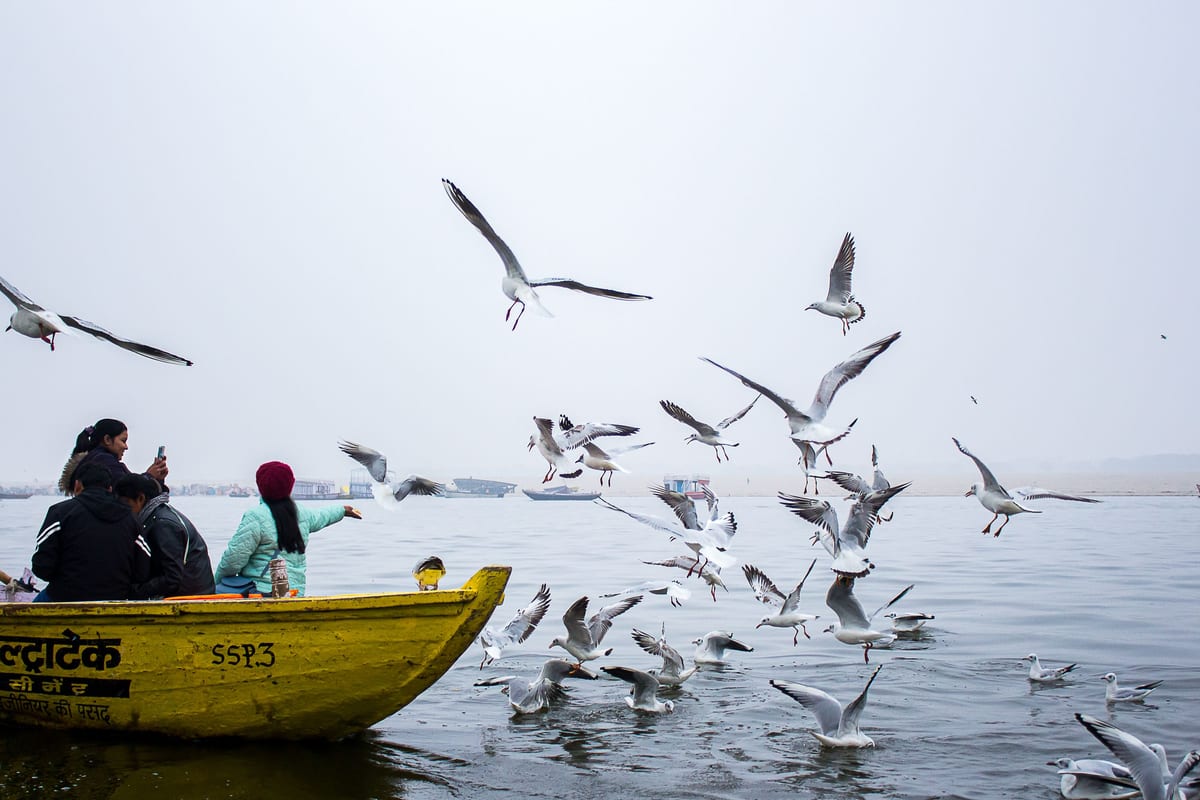
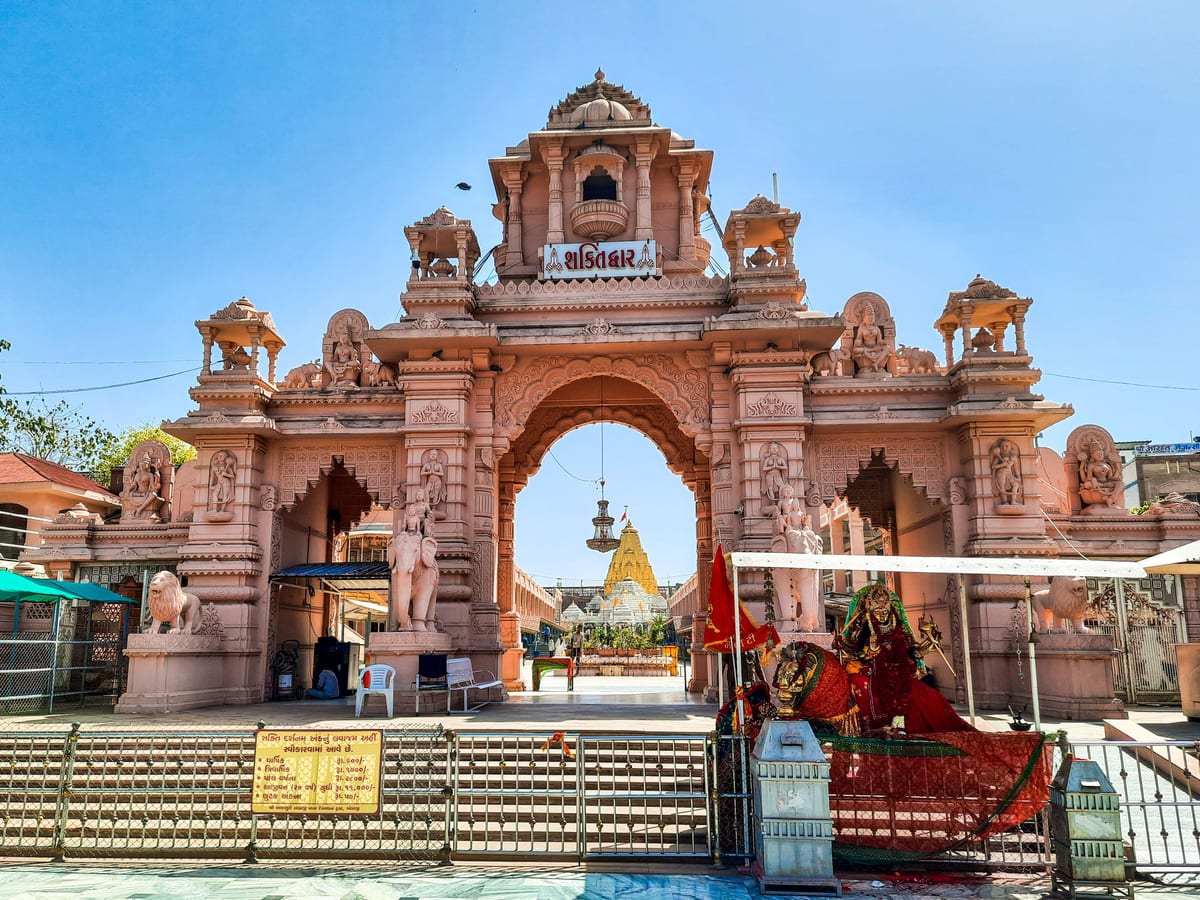
There is a moment, just before the sun clears the horizon over the Arabian Sea, when the spire of Somnath Temple catches the first light and the entire western coast of Gujarat seems to hold its breath. Gulls wheel overhead. Waves strike the ancient stone promenade. And somewhere inside the sanctum, the morning aarti begins, its bells and conch-shells carrying across the water as they have, in one form or another, for more than a thousand years. This is not a museum. This is a civilisation, still breathing.
The Temple at the Edge of the World
Somnath Temple stands on the Prabhas Patra coast in the Gir Somnath district of Gujarat, its feet practically in the sea. It is one of the twelve Jyotirlingas, the sacred abodes of Lord Shiva's luminous form, and tradition holds it to be the first among them. The name Somnath means "Lord of the Moon," referring to the legend in which the Moon god, Soma, cursed and diminished, erected this temple and worshipped Shiva here, eventually recovering his celestial lustre. The site, known in ancient texts as Prabhasa Kshetra, is also believed to be where Lord Krishna concluded his earthly journey, lending it a sanctity that transcends any single devotional lineage.
The temple's location is marked by a remarkable stone pillar on the seawall known as the Baan Stambha, the Arrow Pillar, which carries an inscription stating that between this point and the South Pole, there is no land. Standing there, with the open ocean stretching endlessly south, the sensation is ancient and vertiginous: the feeling of being at an edge of the known world.
Destruction, Memory, and Defiant Reconstruction
To understand Somnath is to understand its wounds, and why they never became permanent. The temple was destroyed and rebuilt multiple times across the centuries, most famously by Mahmud of Ghazni in 1026 CE, an act that reverberates through Indian historical consciousness to this day. Yet what defines Somnath is not the destruction but the reconstruction, again and again, by kings, by communities, by ordinary believers who refused to accept that their sacred geography could be unmade.
The present temple, built in the Chalukya style, was reconstructed after independence through the determined efforts of Sardar Vallabhbhai Patel, who visited the site in 1947 and recognised in its rebuilding a symbolic necessity for the new Indian republic. President Rajendra Prasad consecrated it in 1951. The act of reconstruction was both devotional and political, a statement that independent India would reclaim and tend its civilisational inheritance rather than treat it as rubble to be documented and mourned. Incredible India's official page on Somnath Temple describes the site as one of India's most important pilgrimage destinations, shaped by both its spiritual stature and its turbulent history.
What the Visitor Experiences
Arriving at Somnath, the first impression is of a temple that commands without overwhelming. The Chalukyan shikhara rises with precision and grace, carved in pale limestone that glows amber at sunrise and dusk. The sanctum houses the Jyotirlinga, and the atmosphere inside, especially during aarti, is one of focused, collective devotion rather than spectacle. Pilgrims arrive from every corner of India, many completing vows they made years earlier, some carrying the ashes of loved ones for immersion in the sacred Triveni Sangam nearby, where the Hiran, Kapila, and Saraswati rivers meet the sea.
The temple complex also houses the Somnath Museum, where remnants from earlier structures, carved panels, toranas, fragmentary sculptures, are preserved. These pieces form a kind of geological record of the site's layered past. The evening sound-and-light show narrates the temple's history against the backdrop of the illuminated shrine and the darkening sea, a theatrical but genuinely moving way to absorb the story of this place.
Beyond the Temple: A Region Rich in Pilgrimage and History
The area surrounding Somnath rewards the unhurried traveller. Bhalka Tirth, just a few kilometres away, marks the spot where Lord Krishna is believed to have been struck by an arrow and departed from the mortal world, a site of profound quietude. The Gir National Park, home to the last wild population of Asiatic lions, lies within accessible distance, offering one of India's most dramatic wildlife encounters. The ancient town of Veraval nearby retains the character of a working port with deep maritime history, and the ruins of Prabhas Patan speak to the archaeological richness of this coastal region.
Best Time to Visit and How to Reach
The ideal months to visit Somnath are October through March, when the coastal climate is temperate and the sea winds are pleasant rather than punishing. The months of Shravan (July–August) are considered especially sacred and draw the largest pilgrim gatherings, though the monsoon heat and humidity can be intense. Summer months from April to June bring significant heat and are best avoided for comfortable travel.
Somnath is well connected by road and rail. The nearest railway station is Veraval, approximately five kilometres away, which is linked to major Gujarat cities including Ahmedabad, Rajkot, and Surat. For air travellers, Diu Airport (roughly 90 kilometres away) and Rajkot Airport (approximately 190 kilometres) are the most practical options, with onward travel by road. State transport buses and private taxis connect Somnath to most regional hubs reliably.
Why Somnath Matters
There are destinations in India that impress, and there are destinations that instruct. Somnath does something rarer, it insists. It insists that you reckon with the weight of time, with the cost of belief, with the stubbornness of a civilisation that has learned to rebuild not from habit but from an understanding that some things are worth the effort of perpetual renewal. Whether you arrive as a pilgrim, a heritage traveller, or simply someone who followed a map to the edge of the subcontinent and found a temple standing in the spray, Somnath will not let you leave unchanged. It is the place where India remembers who it is.