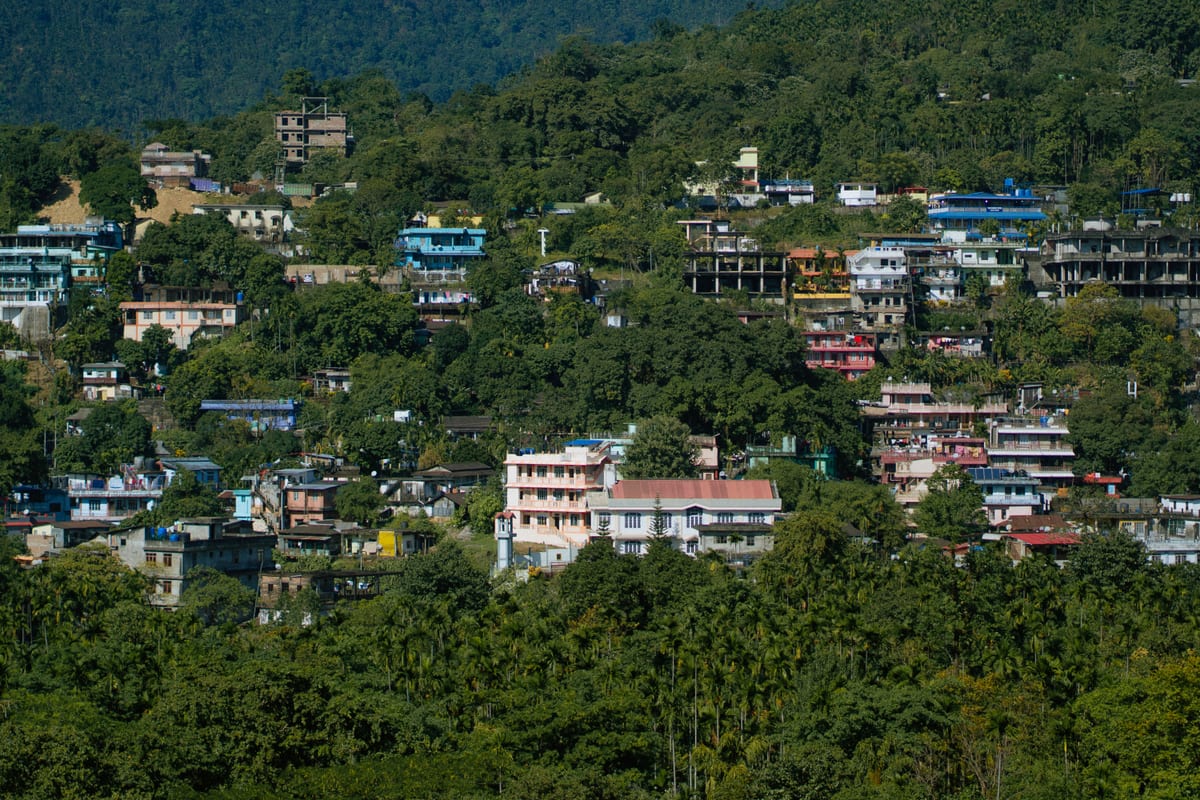
There is a moment, somewhere on the road to Tawang, when the world as you know it simply stops making sense, in the most magnificent way possible. The valley floor has long disappeared beneath you. The clouds are no longer above but level with your eyes. The wind carries something ancient in it, something that has been blowing across these peaks since long before any map was drawn. This is Tawang, the cradle of Tibetan Buddhism in the Indian Himalayas, and it does not ease you in gently. It arrives all at once, total and overwhelming.
The Road That Is Already the Destination
The journey to Tawang from the plains of Assam is a slow, spectacular ascent through dense forest, roaring rivers, and hairpin bends that demand both patience and gratitude. The nearest major airport is Lokpriya Gopinath Bordoloi International Airport in Guwahati, with Tezpur Airport serving as a closer alternative. From Tezpur, the drive into Arunachal Pradesh unfolds through the hills. The nearest railway station is Rangapara, from where road travel into the hills begins.
No traveller should pass through without stopping at Sela Pass, a high-altitude gateway at roughly 4,170 metres above sea level. A frozen lake shimmers beside the road, prayer flags snap in the thin air, and the silence is so complete it feels almost structural. Sela is not a pitstop, it is a threshold. Cross it, and you enter a different India entirely.
The Monastery That Time Chose Not to Abandon
At the heart of Tawang stands the Tawang Monastery, the largest monastery in India and the second largest in the world. Founded in the 17th century, it rises above the town like a citadel of consciousness, a multi-storeyed complex of prayer halls, monks' quarters, libraries, and courtyards alive with the low drone of chanting. Murals line the walls, ornate statues of the Buddha gaze outward with an expression of absolute stillness, and the air inside smells of butter lamps and antiquity.
What makes Tawang Monastery extraordinary in India's heritage story is that it remains in active, uninterrupted use. Monks study here. Rituals are observed. Festivals like Torgya and Losar are celebrated with colour and devotion. India does not only preserve heritage; India lives it. Tawang Monastery is not a ruin being maintained. It is a breathing institution, as alive today as it was three centuries ago. Incredible India's official page on Tawang describes it as a treasure trove of Buddhist art, architecture, and spirituality, words that barely scratch the surface of what it means to stand within its walls.
The Monpa People: Custodians of a Living Culture
No visit to Tawang is complete without an understanding of the Monpa community, the indigenous people whose civilisation has shaped this landscape for generations. The Monpa are not peripheral to Tawang's identity; they are its identity. Their villages, handwoven textiles, thangka paintings, oral traditions, and relationship with the land constitute a cultural ecosystem of extraordinary richness.
Wander into any Monpa village and you are likely to be received with the kind of warmth that no hospitality manual can replicate. Share a meal of traditional Monpa cuisine: hearty, warming, rooted in the ingredients of high altitude. Raise a cup of Ara, the locally brewed rice beer, which tastes of fermentation, friendship, and the particular joy of being somewhere completely unhurried. These are not tourism experiences manufactured for visitors. They are the ordinary rhythms of Monpa life, generously shared.
Into Tawang's Natural Wilderness
Beyond the monastery and the villages, Tawang opens into a wilderness that rewards the adventurous traveller. Trekking routes wind through forests of rhododendron and pine, passing crystal-clear glacial lakes that reflect the sky with mirror-like precision. The Nuranang Waterfall, also called Jang Falls, is among the region's most dramatic natural spectacles, water thundering down from a height of over 100 metres. It is the kind of sight that recalibrates your sense of scale.
Camping by one of Tawang's high-altitude lakes under a sky unpolluted by city light is an experience that belongs on any serious traveller's list. The stars here are not a backdrop, they are a ceiling, close and overwhelming.
When to Go, and How to Prepare
The best time to visit Tawang is between April and October, when the roads are generally accessible and the landscape is at its most alive, wildflowers carpeting the meadows in spring, deep greens saturating the valleys through summer and early autumn. Winter brings heavy snowfall that can close Sela Pass and render the region difficult to reach, though those who manage the journey find a Tawang of extraordinary, silent beauty.
Travellers must obtain an Inner Line Permit (ILP) to enter Arunachal Pradesh, including Tawang, a requirement that applies to all Indian citizens from outside the state, in addition to foreign nationals who require a Protected Area Permit. Plan this well in advance. Acclimatise gradually given the high altitude, dress in warm layers even in summer, and carry basic medicines. The roads, while improving, can be unpredictable in monsoon season.
Why Tawang Belongs in India's Heritage Story
India's civilisational story is often told through the monuments of the plains, the temples of Tamil Nadu, the forts of Rajasthan, the ghats of Varanasi. These are magnificent, and they deserve every word written about them. But Tawang extends that story to the northeastern frontier, to a high Himalayan town where India's borders meet Tibet, where Buddhist monks have chanted the same sutras for four centuries, and where an indigenous people have maintained a culture of extraordinary depth without ever needing the world's validation to do so.
Tawang is not on the edge of India. It is at the centre of what India means, a place where the ancient and the living are not in tension but in conversation, where the landscape itself participates in the spiritual life of its people. To visit Tawang is to understand that India's heritage is not a story that ended. It is a story that is still being told, every morning, when the first prayer bell rings across the mountains and the monks take their seats, and the mist lifts slowly from the valley below.