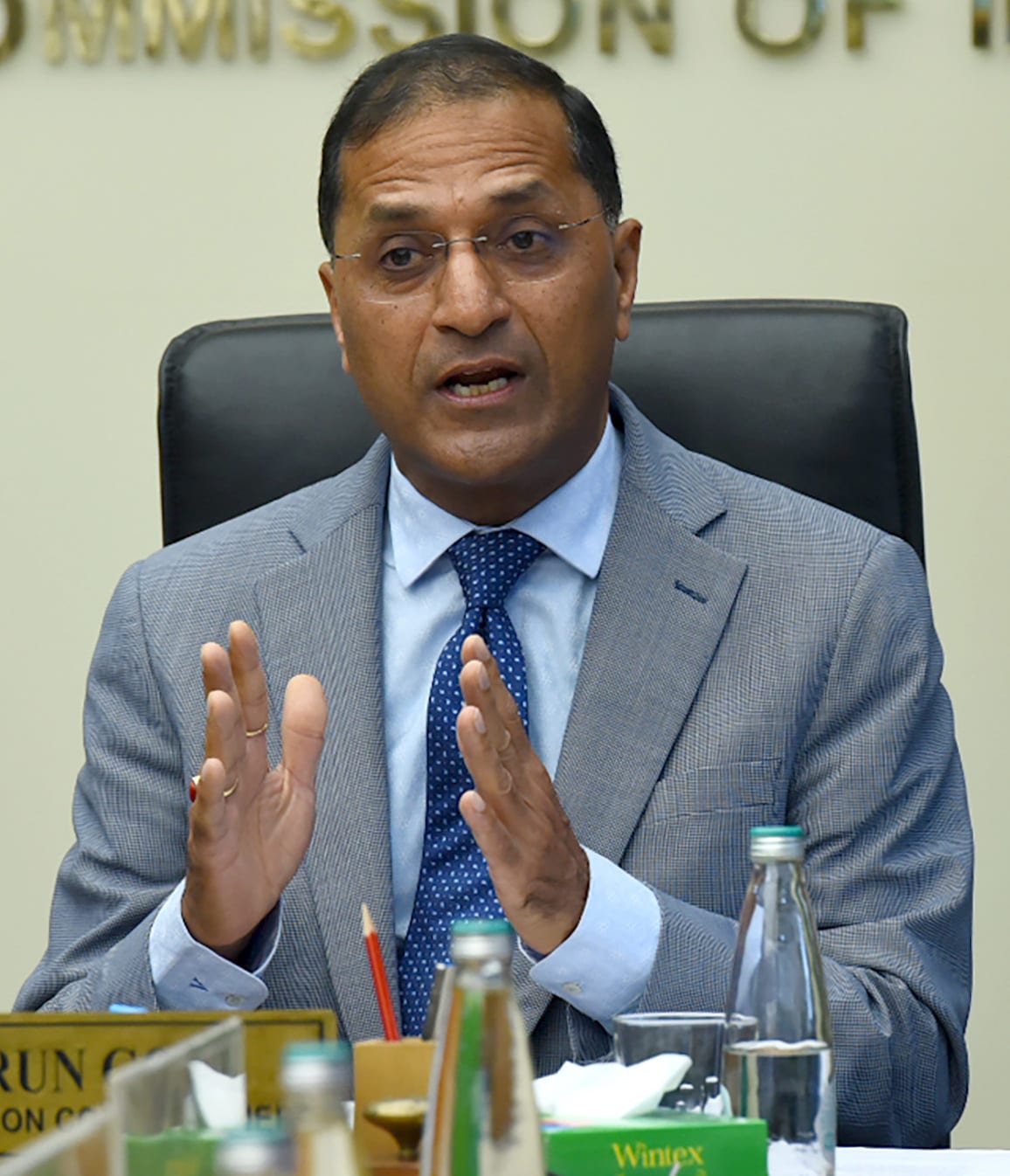
Shashi Tharoor, the Congress MP and former United Nations diplomat, told the Mumbai LitFest on October 24 that India-Pakistan cricket matches are "seen as a country engaging with another," and he linked the running of cricket administration to political influence. NDTV reported that Tharoor said cricket is influencing politics, which is why people with political connections run the sport's administration.
Tharoor has spent decades in diplomacy, literature, and electoral politics. His reading of an India-Pakistan fixture as one country engaging with another is descriptive rather than prescriptive. It describes how the public, the broadcast market, and the two capitals interpret those encounters. The description matters because it treats sport not as an escape from statecraft but as an extension of it.
Cricket's Political Administration
Tharoor's observation that politics now shapes who runs cricket points to a structural feature of Indian sport governance. The Board of Control for Cricket in India sits at the centre of the global game's economy; its broadcast and sponsorship arrangements set the financial terms for much of world cricket. When administrators of that board arrive through political proximity rather than demonstrated competence in sports management, the institution's credibility as a professional body weakens. This is an institutional observation. An autonomous regulator draws legitimacy from transparent selection, performance benchmarks, and the confidence of players, franchises, and fans that decisions follow rules rather than relationships.
Indian state associations have often mirrored party structures. Ticket distribution, venue allocation, and squad selection have at various points borne the imprint of local political influence. The result is rarely a single scandal but a slow erosion of the norm that sports bodies should be governed by the same principles of merit and accountability that citizens expect from other public institutions. Tharoor's framing invites that comparison.
The Bilateral Frame
On India-Pakistan cricket, the official Indian position is consistent: bilateral series cannot resume while cross-border terrorism continues. This has meant no full tours between the two countries for years, even as they meet in International Cricket Council tournaments. Tharoor's phrase, "a country engaging with another," captures the diplomatic meaning of those tournament meetings. Every Indian innings against Pakistan carries a layer of meaning that no fixture with Australia or England does.
An India-Pakistan match in a global tournament commands audiences that dwarf every other sporting event in South Asia; the advertising inventory around it is priced accordingly. Fans treat the match as a proxy for the relationship, and the relationship as something that remains active even when diplomatic channels are narrow. For the Indian state, this creates a tension: how to allow a sporting contest that the public experiences as national assertion while maintaining the security-based refusal of normal bilateral exchange.
The asymmetry of the cricket economy gives India an advantage no other board enjoys: the Indian fan base underwrites the global game's broadcast contracts, and a tournament without Indian participation loses a substantial share of its commercial value. When the BCCI's internal decisions seem shaped by political currents, the credibility of the entire sport's economic model is affected. Other boards watch Indian administrative appointments as markets watch a central bank; the signal travels far beyond the subcontinent.
The bilateral freeze has hardened into a norm that no Indian government, regardless of party, has found reason to alter. That continuity reflects a national consensus that cricket cannot be insulated from the security environment. The Indian state has not banned competition with Pakistan; it has made the conditions of that competition a matter of deliberate choice rather than routine scheduling.
An Institutional Reading
The deeper question Tharoor's remarks raise is whether cricket administration in India can be professionalised without first disentangling it from the networks that currently supply its leadership. Indian democracy has faced this governance challenge in other regulatory domains: electricity, telecommunications, securities markets, and higher education all have histories of political capture followed by efforts at insulation through boards, commissions, and statutory frameworks. The BCCI has not fully travelled that arc. It operates with enormous financial autonomy and limited external oversight, and it has shown only intermittent interest in adopting the transparency norms that now govern comparable institutions in Indian public life.
There is no reason in principle why a cricket board cannot be run by capable administrators who have political histories. The test is whether their decisions can be justified on sporting and commercial grounds rather than on the interests of a party or a faction. Tharoor's comment is best understood as a prompt to apply that test consistently. If the board passes, the institution's credibility strengthens. If it does not, the cost will appear in the accumulating habits of distrust that make every selection, every broadcast deal, and every bilateral decision seem like an exercise of influence.
For Indian readers, the relevance of this story extends beyond cricket. It concerns the quality of the institutions that manage the country's most visible public goods. Cricket is India's most universally consumed cultural product; its governance carries a symbolic weight that goes beyond the boundary rope. A professional, rule-bound cricket board would demonstrate that Indian public institutions can combine commercial success with procedural integrity. A board seen as a political instrument would be a continuous reminder that the institutional promise of Indian democracy remains incomplete.
Tharoor's Mumbai LitFest intervention is not a new policy proposal but a sharper formulation of an old problem: when the boundaries between sport, politics, and diplomacy blur, the burden of proof falls on the institutions that manage all three. The coming ICC tournaments will test whether India can hold its security red lines on bilateral cricket while using those multilateral encounters as genuine confidence-building gestures. The quality of that management will be visible less in diplomatic statements than in the governance of the board that sends the team onto the field.